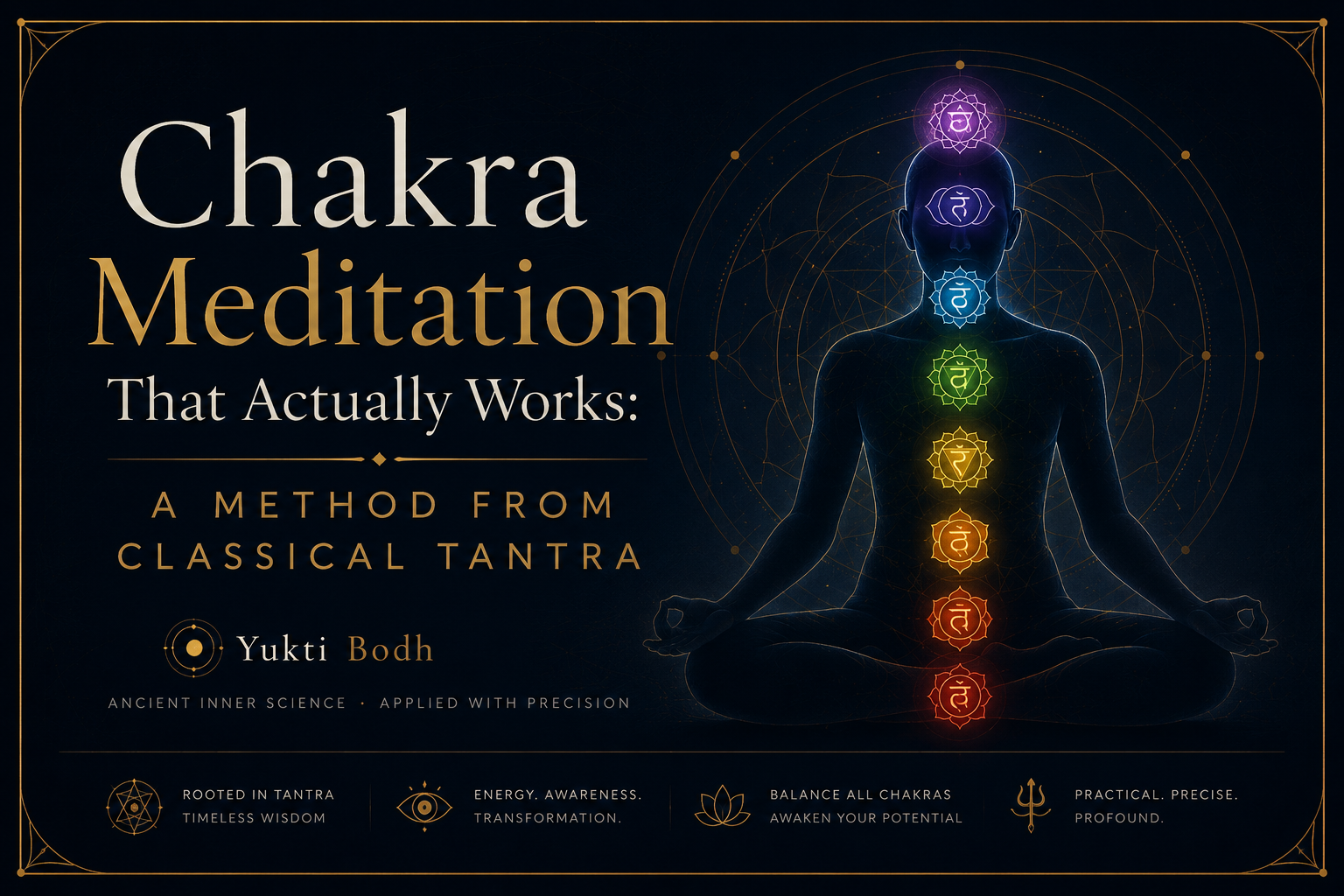
Chakra Meditation That Actually Works: A Method from Classical Tantra
Most chakra meditations available today follow the same structure: lie down, close your eyes, follow a guided voice through each chakra from base to crown, visualise each colour, breathe into each area, perhaps hold an intention for each one. Thirty minutes later, you feel relaxed.
Relaxation is not nothing. But it is not chakra meditation in the classical sense. The classical approach is considerably more demanding, considerably more specific, and produces effects that accumulated guided relaxation does not.
This article describes a functional method derived from classical Tantric practice — accessible to a serious practitioner without years of preparation, but demanding in the quality of attention it requires.
The Foundation: Why Most Chakra Meditation Fails to Penetrate
The reason most chakra meditation produces mild relaxation rather than genuine inner change is not that the practitioner lacks dedication. It is that the Nadi system — the network of channels through which Prana flows — is insufficiently prepared to allow focused attention to penetrate deeply.
Imagine trying to run water through a hose that is partially kinked and clogged. Some water flows, but not freely. The classical approach recognises this reality and addresses it before attempting chakra-specific work.
The prerequisite for effective chakra meditation is a reasonably purified Nadi system. This is achieved through consistent Pranayama practice — not occasional, not once a week, but daily, sustained over weeks and months. Nadi Shodhana (alternate nostril breathing) is the principal Nadi purification technique. Without this foundation, chakra meditation is, at best, a useful relaxation tool. With it, it becomes a precise instrument.
The Classical Structure of Chakra Meditation
The classical Tantric approach to chakra meditation is called Chakra Dharana — one-pointed concentration on a chakra. It is distinct from guided visualisation in one critical way: there is no guidance. The practitioner holds the attention at a single point, without narrative, without movement through a sequence, for a sustained period.
The classical structure is:
Choose one chakra as the object of practice for the session. Practitioners in the classical system typically work with one chakra intensively for a period of weeks, rather than cycling through all seven in a single session.
Establish the physical location precisely. The location is not vague — it is specific: Muladhara at the perineum, Svadhisthana at the base of the genitals, Manipura at the navel, Anahata at the heart in the spine, Vishuddha at the throat, Ajna between the eyebrows.
Engage the three supports of Dharana simultaneously: the Bija mantra of the chosen chakra (mentally repeated), the visual form of the associated Tattva symbol, and awareness of the precise physical location.
Hold this triple focus for the duration of the session without allowing attention to wander to other chakras, to physical sensations elsewhere in the body, or to conceptual content about the chakra.
A Precise Method for Muladhara Dharana
The following is a specific practice for Muladhara, following classical principles:
Preparation: Sit in a stable posture — Siddhasana is the classical recommendation for Muladhara work, as the heel presses directly against the perineum, creating a natural stimulus at the Muladhara location. If Siddhasana is not available, any seated posture with the spine erect is acceptable.
Breath: Begin with twelve rounds of Nadi Shodhana at a comfortable ratio. This is the minimum preparation. Do not proceed to Dharana immediately upon sitting — allow the Pranayama to settle the mental field before shifting attention.
Establish the location: Bring awareness to the perineum — the point between the genitals and the anus. Do not visualise it from above, as a watching position. Bring awareness to it from within — as if consciousness itself has descended to that point and is present there.
Invoke the symbol: Visualise a yellow square at the Muladhara location. The square should be seen as luminous — not flat or conceptual, but genuinely bright. Within the square, visualise the downward-pointing triangle. Do not attempt to add the Linga or the deities at this stage unless you have a very stable concentration — complexity dilutes focus.
Begin Japa: Repeat the Bija mantra Lam mentally, synchronised with the awareness of the yellow square at the perineum. Each repetition of Lam lands at Muladhara. Each repetition is a fresh contact with the location.
Duration: Hold this practice for a minimum of twenty minutes without changing the object. If the attention wanders — to thoughts, to other body sensations, to assessments of how the practice is going — return without self-criticism to the yellow square and the mantra. The return is the practice.
What to Expect: Genuine Signs vs. Fabricated Experience
One of the most important distinctions in classical chakra practice is between genuine signs of progress and experience that the imagination has generated in response to expectation.
When concentration becomes genuinely established at a chakra, the classical texts describe specific spontaneous experiences that arise without being sought: physical sensations of heat, cold, pressure, or vibration at the chakra location; spontaneous changes in breathing — the breath may naturally slow, deepen, or briefly pause; olfactory sensations at Muladhara (the Gandha Tanmatra); visual phenomena at Ajna; auditory phenomena at Vishuddha and Anahata.
The distinguishing feature is that genuine signs are spontaneous and surprising. They arise from the inside out, without being sought. Fabricated experience — produced by expectation or suggestion — tends to feel slightly effortful, slightly performed, slightly unclear.
Do not seek the experiences. Seek the precision of attention. The experiences, if appropriate, will arise on their own.
Working Through All Six Chakras: The Sequential Approach
The classical approach does not recommend cycling through all six chakras in a single session until significant concentration has been developed. The recommended sequence is:
Establish Muladhara Dharana — twenty to thirty minutes daily — until the concentration is steady and the location is consistently accessible. This may take weeks.
Move to Svadhisthana and repeat. Some practitioners spend months at a single chakra before moving upward.
This sequential approach builds the capacity of attention progressively. Each chakra prepares the ground for the next. Attempting to work with Ajna before establishing concentration at the lower chakras is, in the classical framework, comparable to building the upper floors of a structure before the foundation is set.
There is no shame in taking months at a single chakra. The quality of the eventual experience at the higher levels is determined by the depth of the work done below.
The Role of the Meditation Timer in Formal Practice
One practical obstacle in classical Dharana practice is time management. The awareness of how much time remains is itself a distraction — a subtle pulling of attention toward the future. Using a timer resolves this precisely.
Set the timer for the chosen duration before beginning. Do not check the time during practice. When the timer sounds, allow two to three breaths before opening awareness back to the full environment.
The free Meditation Timer on this site is specifically built for this kind of practice: distraction-free, with Tibetan bowl bells at the start and end, with duration options from five to sixty minutes. No accounts, no interface during practice, no interruptions.
Integration: From Formal Practice to Continuous Awareness
The goal of formal Chakra Dharana practice is not to produce pleasant states during sitting. It is to develop a quality of awareness that eventually becomes continuous — a background orientation of attention that persists through daily activity.
When Muladhara has been genuinely accessed in formal practice, there is a natural tendency for awareness to be more grounded in the body — not as a philosophical concept but as a lived reality. When Anahata has been genuinely accessed, there is a natural steadiness of witnessing that does not depend on the quality of circumstances.
This is the practical output of the classical system: not altered states that arise and pass, but a permanently expanded baseline of awareness.
Genuine chakra meditation is demanding in the way that all serious inner work is demanding: it requires sustained, focused, daily effort over a long period. What it offers in return is not relaxation, not pleasant imagery, but genuine structural change in the quality of awareness.
To practise Nadi Shodhana and the other Pranayama techniques that form the essential foundation for Chakra Dharana, use the free Pranayama Guide on this site — with visual breathing animations and classical instruction. For formal sitting practice, the free Meditation Timer provides the distraction-free container the practice requires.
For the complete chakra-by-chakra framework — including the full Dharana instructions, psychological depth, and 42-day practice system — the Chakra Deep-Dive Report is the most thorough resource available on this site.
[Use the Meditation Timer →] to begin your first formal session of Chakra Dharana today.
◎ Try the Tool
Find which chakras are balanced, blocked, or overactive with our free diagnostic.
Open Chakra Diagnostic →