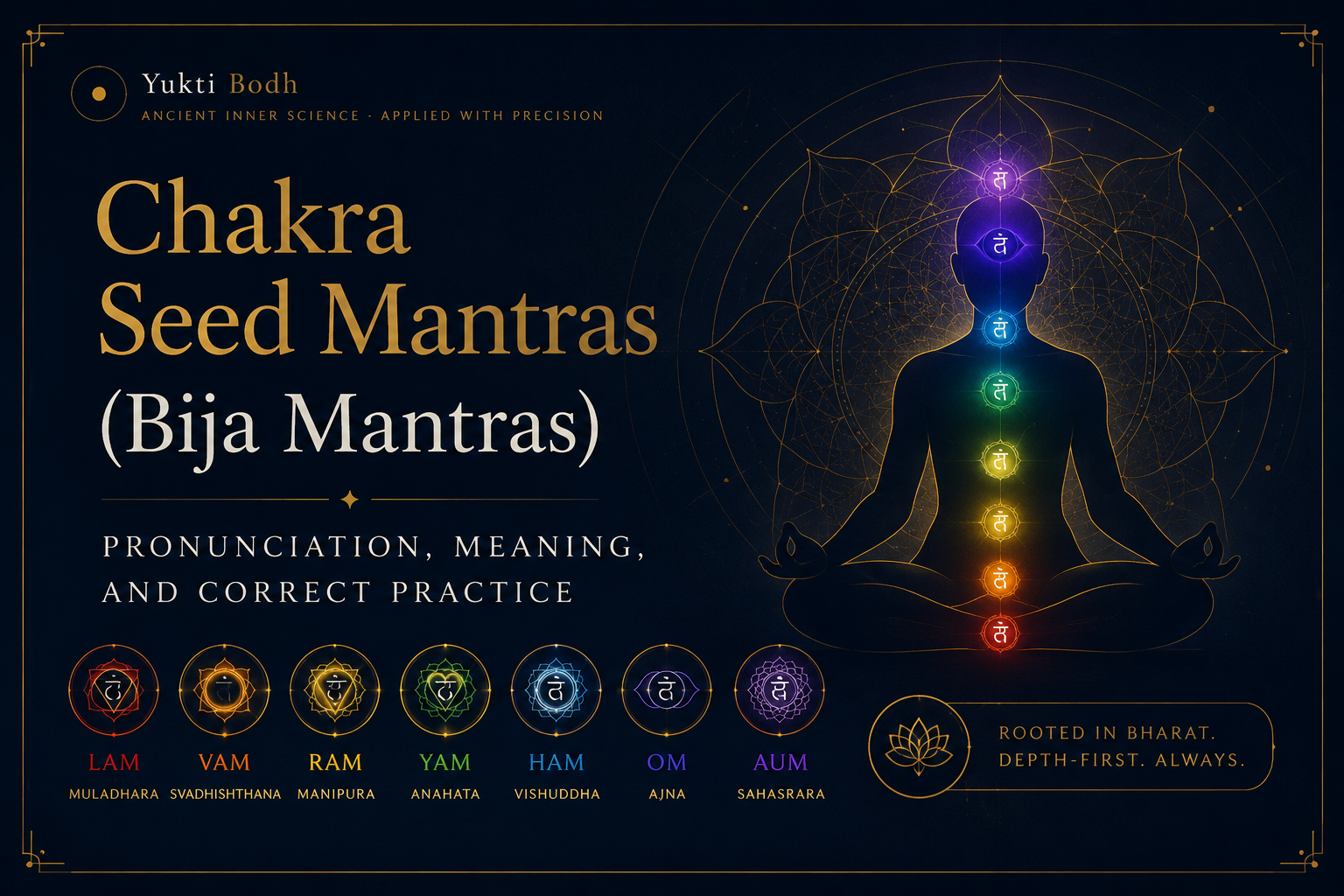
Chakra Seed Mantras (Bija Mantras): Pronunciation, Meaning, and Correct Practice
SEO Meta: The Bija mantras of the seven chakras — Lam, Vam, Ram, Yam, Ham, Om — are precise tools, not affirmations. Here is their correct pronunciation, meaning, and how to practise them.
Slug: /chakra-bija-mantras-pronunciation-practice/
Lam. Vam. Ram. Yam. Ham. Om.
These six syllables — the Bija mantras of the six classical chakras — are among the most precisely specified elements of the chakra system in the original texts. They are not decorative. They are not affirmations. They are functional sonic tools — seed syllables that contain, in condensed form, the vibrational signature of the corresponding Tattva and chakra.
Working with Bija mantras correctly requires understanding what they are, how to pronounce them, and what the practice actually involves. Most introductory material on this subject gets at least one of these wrong.
What a Bija Mantra Is
Bija means seed. A Bija mantra is a single-syllable sound that functions as a concentrated energy packet — containing the essence of a particular principle, deity, or element in sonic form. Unlike longer mantras that carry meaning in the conventional linguistic sense, Bija mantras operate primarily through vibration and resonance rather than conceptual content.
The classical understanding is that the universe arises from primordial sound — Nada Brahman — and that specific patterns of vibration correspond to specific patterns of consciousness and matter. The Bija mantras of the chakras are those specific patterns, identified through millennia of practice and inner listening by practitioners in the Tantric tradition.
This is not a metaphysical claim that requires faith. It is a practical claim that requires testing through sustained practice.
Pronunciation: The Critical Details
The most common error in working with chakra Bija mantras is treating them as English syllables. Sanskrit phonetics are specific, and the vibrational effect of a mantra depends on its correct pronunciation.
Key pronunciation principles for all Bija mantras:
The nasal ending — the M that follows the vowel in each Bija — is not pronounced as a closed M sound. It is pronounced as a nasal resonance that continues after the vowel, often transcribed as NG or a nasalised hum (the Anusvara in Sanskrit). The mantra does not stop at the M; it dissolves into the nasal resonance and then into silence.
The vowel is held as long as comfortable before the nasal ending — typically three to four times the length of the initial consonant.
Each mantra ends in natural silence, which is as much a part of the practice as the sound itself.
The Six Bija Mantras: Individual Detail
Lam (Muladhara): The L is a retroflex lateral — pronounced with the tongue tip curled slightly back against the palate, similar to but not identical to the English L. The A is an open short vowel, as in the English cup. The nasal ending resonates at the base of the skull. This mantra carries the vibrational signature of the Prithvi Tattva — earth — and of the entire Muladhara field.
Vam (Svadhisthana): The V is closer to the English W in some classical pronunciation traditions — softer, labial rather than labiodental. The mantra vibrates in the lower abdomen. It carries the signature of Apas Tattva — water — and the Svadhisthana field.
Ram (Manipura): The R is rolled — a single trill rather than the English approximant R. The mantra generates heat — practitioners often report a warming sensation in the navel region during sustained repetition. It carries the signature of Agni Tattva — fire.
Yam (Anahata): The Y is a soft palatal glide. The mantra vibrates in the chest region. It carries the signature of Vayu Tattva — air. In practice, sustained Yam repetition is often experienced as producing a quality of lightness and expansion at the chest.
Ham (Vishuddha): The H is an aspirated sound from the back of the throat — not the English H exactly, but heavier. The mantra vibrates in the throat and into the back of the skull. It carries the signature of Akasha Tattva — space. The Hamsa — the sacred swan — is encoded in this Bija: Ham and Sa are the two sounds of the inhalation and exhalation in Soham, the natural mantra of the breath.
Om (Ajna): The Ajna Bija is Om — or Aum in its full form. This is the primordial Bija, the source of all Bija mantras. Its correct pronunciation is: A (pronounced as the a in father, arising from the back of the throat), U (pronounced as the u in put, moving forward in the mouth), M (closing at the lips into a resonant hum), followed by Silence — the fourth dimension of Om that corresponds to Turiya, the witness state.
How to Practise Bija Mantra Japa
Japa means repetition — specifically, the sustained mental or vocal repetition of a mantra as a formal practice. Bija mantra Japa for the chakras is practised in three ways in the classical tradition.
Vaikhari Japa — audible repetition — is the entry point for most practitioners. The mantra is spoken aloud, at a comfortable pitch and pace. This form makes the vibration most physically tangible and is the easiest to sustain.
Upamshu Japa — whispered repetition — is subtler. The mantra is formed at the lips and throat without full voicing. This requires more concentration and tends to internalise the vibration.
Manasika Japa — mental repetition — is the most refined form. The mantra arises only in the mind, without any physical movement. This requires significant development of concentration to sustain. When Manasika Japa is established, the distinction between the mantra being repeated and the repetition itself begins to dissolve.
The combination recommended in many texts: begin with Vaikhari, gradually move to Upamshu as concentration develops, and use Manasika Japa in deepening meditation.
Integrating Bija Mantras with Pranayama and Visualisation
The full classical practice combines three elements simultaneously: the Bija mantra (either aloud or mental), visualisation of the Tattva symbol (yellow square for Muladhara, crescent moon for Svadhisthana, and so on), and placement of awareness at the chakra location in the body.
This three-part practice — sound, form, and location — is the basis of the Tattva Shuddhi system and the foundational techniques described in many classical texts. The simultaneous engagement of auditory, visual, and somatic attention creates a quality of concentrated presence that is considerably more effective than any single element alone.
The Pranayama guide on this site provides the breath foundation for this kind of practice. The Pranayama techniques — particularly Nadi Shodhana — purify the Nadi system sufficiently for Bija mantra Japa to penetrate more deeply than it can in an unprepared system.
Common Errors and How to Avoid Them
Several common errors limit the effectiveness of Bija mantra practice:
Treating the mantra as an affirmation — that is, focusing on the meaning or intention while mentally multitasking. Bija mantra practice is a concentration practice. The mantra is the entire object of attention.
Rushing through repetitions to achieve a target count. Quality of attention matters more than quantity of repetition. Twenty repetitions with undivided attention are more effective than two hundred repetitions of distracted sound-production.
Practising without the breath foundation. If the Nadi system is significantly impure — which most practitioners’ systems are at the beginning — Bija mantra Japa has limited penetrating power. Establish a regular Pranayama practice first.
Using romanised transliterations without attending to the actual Sanskrit phonetics described above. Approximate pronunciation is better than none, but moving toward correct pronunciation over time will noticeably deepen the effect.
Bija mantras are among the most accessible entry points into classical chakra practice — requiring no equipment, no specific location, and available in any moment of stillness. Used correctly, they are also among the most powerful.
The free Pranayama Guide on this site provides the breath foundation that makes Bija mantra practice most effective — with visual breathing animations and classical instruction for Nadi Shodhana, Kapalabhati, and other core techniques. For the complete chakra-by-chakra framework including the full mantra, Tattva, and deity correspondences, the Chakra Deep-Dive Report is the most thorough resource available.
[Use the Pranayama Guide →] to build the breath foundation for your mantra practice.
◎ Try the Tool
Find which chakras are balanced, blocked, or overactive with our free diagnostic.
Open Chakra Diagnostic →