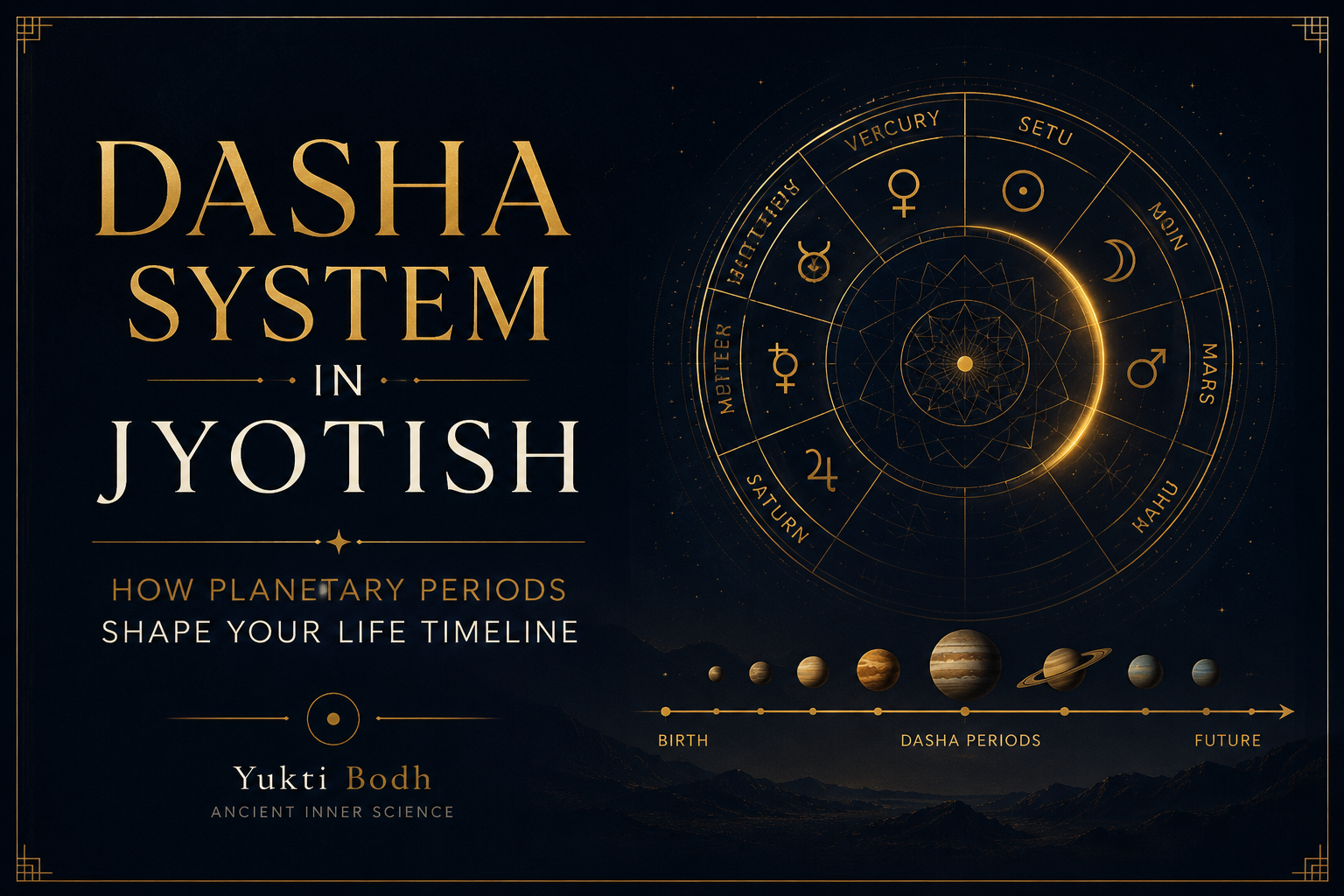
Dasha System in Jyotish: How Planetary Periods Shape Your Life Timeline
If you had to identify the single feature that most distinguishes Jyotish from every other astrological tradition in the world, it would be the Dasha system.
Most astrological traditions use transits — the movement of planets through the sky — as their primary timing tool. Jyotish uses transits too, but it places something considerably more precise at the centre of timing analysis: the Dasha system, a pre-determined sequence of planetary periods that governs successive phases of every human life, calculated from the position of the moon at birth.
The Dasha system transforms the birth chart from a static snapshot into a dynamic timeline — showing not just what themes are present in a life, but when each theme will be most prominent.
The Vimshottari Dasha: The 120-Year Cycle
The most widely used Dasha system is the Vimshottari Dasha — Vimshottari meaning 120 in Sanskrit. It is a 120-year cycle divided among the nine Navagraha in fixed proportions:
Sun: 6 years. Moon: 10 years. Mars: 7 years. Rahu: 18 years. Jupiter: 16 years. Saturn: 19 years. Mercury: 17 years. Ketu: 7 years. Venus: 20 years. Total: 120 years.
The sequence always runs in this fixed order. The starting point — which planet’s period begins at birth — is determined by the moon’s position in its Nakshatra at the exact time of birth.
Each Nakshatra is governed by one of the nine planets. The fraction of the Nakshatra the moon has already traversed at birth determines how much of that planet’s period has already been experienced (notionally, from before birth), and therefore how much remains at the start of life. This is called the balance of Dasha at birth.
For example, if you were born with the moon in Rohini Nakshatra (governed by the Moon), and the moon had traversed exactly half of Rohini, you would begin life with 5 remaining years of Moon Dasha (half of the Moon’s 10-year period).
Mahadasha, Antardasha, Pratyantardasha
The Dasha system operates at multiple levels of refinement simultaneously.
The Mahadasha — major period — is the primary division: the planet whose period is running governs the overall themes and quality of that entire phase of life. Venus Mahadasha, running for twenty years, colours two decades of life with Venusian themes — love, beauty, pleasure, artistic development, material comfort.
Within each Mahadasha, sub-periods of each planet run in sequence — called the Antardasha or Bhukti. The order of the sub-periods follows the same planetary sequence as the Mahadasha, beginning from the planet of the Mahadasha itself. So Venus Mahadasha begins with Venus Antardasha, then Sun Antardasha, then Moon Antardasha, and so on.
Within each Antardasha, further sub-periods — the Pratyantardasha — divide the time into even finer units, each governed by a planet. And within those, the Sookshma Dasha provides sub-sub-period analysis.
In practice, most Jyotishis work primarily with the Mahadasha and Antardasha levels. The combination of the two — the major period and the sub-period — provides the primary timing framework for identifying when specific themes in the birth chart will activate.
Reading the Dasha in the Context of the Chart
The Dasha is not read in isolation. Its meaning entirely depends on how the Dasha planet performs in the specific birth chart.
A Venus Mahadasha will be experienced completely differently by two people with different Lagnas. If Venus is the Lagna lord — for Taurus or Libra Lagna — Venus Mahadasha tends to bring vitality, success, and the fulfillment of desires. If Venus rules difficult houses from the Lagna — the sixth, eighth, or twelfth — Venus Mahadasha may bring challenges in the areas those houses govern.
The house Venus occupies, the sign it is in and whether it is exalted, debilitated, or in its own sign, the planets aspecting it, and the houses it rules — all of these factors determine the quality of the Venus Dasha experience.
This is the essential Jyotish skill: taking a planet’s natural significations, assessing its strength and condition in the specific chart, and predicting the themes of its Dasha period with precision.
Major Life Events and Dasha Timing
One of the most striking demonstrations of the Dasha system’s accuracy is its capacity to pinpoint the timing of major life events.
Marriage tends to occur during the Dasha of planets connected to the seventh house (of marriage) or during Venus periods — or both. Career breakthroughs tend to occur during the Dasha of planets connected to the tenth house or during Jupiter and Sun periods. Spiritual turning points tend to occur during Ketu periods or during the Dashas of planets connected to the ninth house.
The combination of Mahadasha and Antardasha narrows the timing further. If Jupiter Mahadasha is running and Moon Antardasha begins — and the moon rules the seventh house of marriage in the chart — this is a classic window for marriage to occur.
This level of precision — identifying not just that marriage is likely but that it is specifically likely in a particular two-to-three year window — is one of the most distinctive capabilities of the classical Jyotish system.
Sade Sati: Saturn’s Transit and the Dasha
While the Dasha system is the primary timing framework, significant planetary transits — particularly Saturn’s — interact with it in important ways.
The most discussed transit in Jyotish is Sade Sati — the seven-and-a-half year period during which Saturn transits the sign immediately before the natal moon, the sign of the natal moon, and the sign immediately after the natal moon. This is classically described as a period of increased pressure, challenge, effort, and — if navigated consciously — significant maturation and karmic clearing.
The quality of the Sade Sati experience is importantly modified by the Dasha running simultaneously. Sade Sati during a Jupiter Mahadasha is very different from Sade Sati during a Saturn or Rahu Mahadasha. The combination tells a more complete story than either indicator alone.
The Dasha system is the engine of Jyotish timing — the feature that makes it a practical guide to the structure of a life rather than simply a personality map. Understanding which Dasha you are currently running, and what that planet represents in your specific chart, is the most immediately useful application of Jyotish knowledge.
The Vedic Moon and Panchang tool shows today’s Tithi and Nakshatra — the daily foundation of Jyotish timing. For important decisions, the Muhurat Calculator uses the same planetary framework to identify the most auspicious moments for action.
[Use the Muhurat Calculator →] to find the best timing for your important decisions using Jyotish principles.
★ Try the Tool
Generate your free Vedic birth chart — nakshatra, lagna, planetary positions, and more.
Open Vedic Chart Calculator →