How to Read a Vedic Birth Chart: The Basics Explained Without Jargon
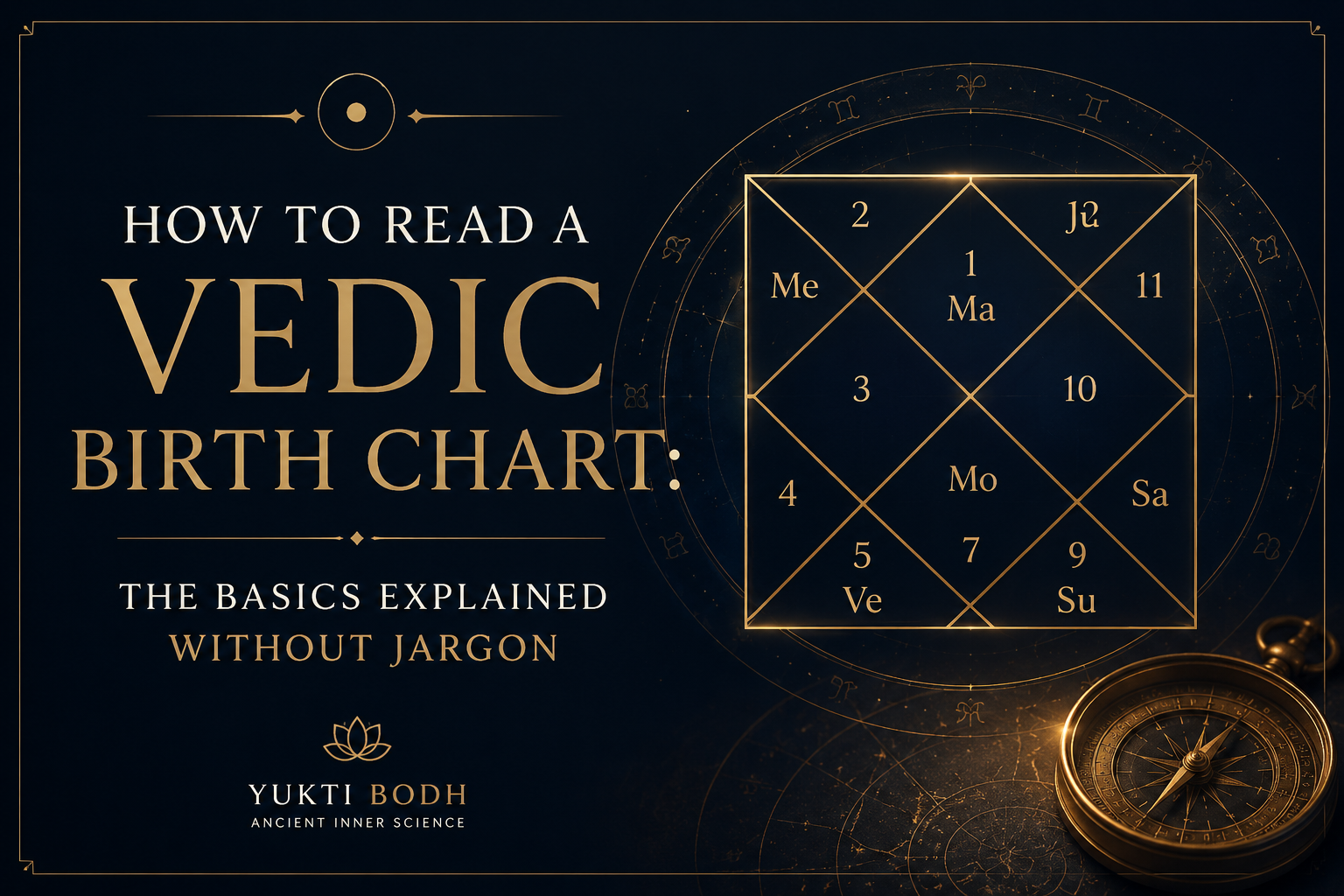
The Jyotish birth chart — the Janma Kundali — looks like a geometric diagram. Depending on the regional tradition, it may be a square divided into boxes (North Indian style), a diamond divided into triangles (South Indian style), or a circular wheel (used internationally alongside software).
The chart contains: twelve houses, nine planets placed in those houses, and a set of relationships between the planets expressed as aspects. Reading a chart is the skill of synthesising all of this information into coherent meaning.
This article explains the basic structure of that process — not to make you a Jyotishi in one article, but to give you a functional orientation that allows you to look at your own chart with genuine understanding.
Step One: Identify the Lagna
Every Jyotish chart begins with the Lagna — the rising sign. In North Indian charts, the Lagna is always in the top-centre box (the first house). In South Indian charts, the Lagna is marked with a diagonal line or the notation Lag. In software charts, the first house is clearly labelled.
The zodiac sign in the Lagna determines the foundational frame of the chart. If your Lagna is Scorpio, the entire chart is read with Scorpio as the first house — meaning Sagittarius is the second house, Capricorn is the third, and so on.
Note the Lagna sign and its ruling planet. This planet — the Lagna lord — is your primary planet, the most significant single planet in your chart. Find it — wherever it is placed — and note its house, sign, and any other planets near it or aspecting it.
Step Two: Note the Planetary Placements
Each of the nine planets is placed somewhere in the twelve houses. Note which planet is in which house. This is the raw material of chart reading.
Some houses will be empty — this is normal. An empty house is not an inactive area of life. The house lord — the planet ruling the sign in that house — carries the energy of that house regardless of whether any planet is physically placed there.
Note which houses are occupied by natural benefics — Jupiter, Venus, unafflicted Moon, Mercury. These houses tend toward positive expression in their domains. Note which houses are occupied by natural malefics — Saturn, Mars, Rahu, Ketu, afflicted Sun. These houses carry greater challenge and intensity, though not necessarily worse outcomes — malefics in the third, sixth, and eleventh (the Upachaya houses) can be excellent for competitive and material success.
Step Three: Assess Planetary Strength
Not all planetary placements are equal. A planet’s strength — its capacity to deliver its significations — depends on several factors.
Sign placement is primary: a planet in its own sign (the sign it rules) or its exaltation sign is strong. A planet in its debilitation sign is weak and struggles to deliver positive results. The debilitations are: Sun in Libra, Moon in Scorpio, Mars in Cancer, Mercury in Pisces, Jupiter in Capricorn, Venus in Virgo, Saturn in Aries.
House placement matters significantly: planets in Kendra houses (1, 4, 7, 10) or Trikona houses (1, 5, 9) are stronger and more effective. Planets in Dusthana houses (6, 8, 12) face greater challenges in delivering clear positive results, though they may have specific strengths in those areas.
Combustion — a planet within a certain degree range of the Sun — weakens that planet, as the sun’s heat overwhelms its expression.
Step Four: Read the House Lord Placements
The most revealing dimension of Jyotish chart reading is the analysis of house lords — where the planet ruling each house is placed in the chart.
The lord of the first house placed in the tenth house indicates a life where the self (first house) finds its primary expression through career and public activity (tenth house). The lord of the fifth house placed in the second house indicates that intelligence, creativity, and children (fifth) are connected to wealth and family of origin (second).
Every house lord tells a story about how that area of life is directed, what it is connected to, and what its primary trajectory is. This analysis — sometimes called Bhavesh (house lord) analysis — can be done for all twelve houses, providing a detailed narrative of the entire chart.
Step Five: Identify the Current Dasha
Once you have a sense of the chart’s structure, the next practical question is: what Dasha period are you currently running? This requires calculating your Dasha balance from your birth Nakshatra and tracking forward to the present date.
The planet whose Mahadasha is running is the lens through which all current experience is filtered. Its condition in your chart — its strength, its house placement, the houses it rules — tells you what themes will be most active in the current period.
If you are in Saturn Mahadasha and Saturn rules your fifth and sixth houses from a Leo Lagna, this is a period that strongly activates themes of children, creativity, service, and health — whatever Saturn’s condition in your chart suggests for these areas.
Reading your own Jyotish chart is a practice — not a one-time analysis but an ongoing conversation between your understanding of the chart and your experience of your life. The chart becomes more useful as your understanding of the planetary principles deepens.
The Vedic Moon and Panchang tool shows today’s Tithi and Nakshatra, allowing you to track the daily planetary quality in relation to your own chart. The Muhurat Calculator applies Jyotish principles to identify the most auspicious timing for any action, event, or decision, using the same framework you are learning to read here.
[Use the Muhurat Calculator →] to apply Jyotish timing to your important decisions today.
★ Try the Tool
Generate your free Vedic birth chart — nakshatra, lagna, planetary positions, and more.
Open Vedic Chart Calculator →