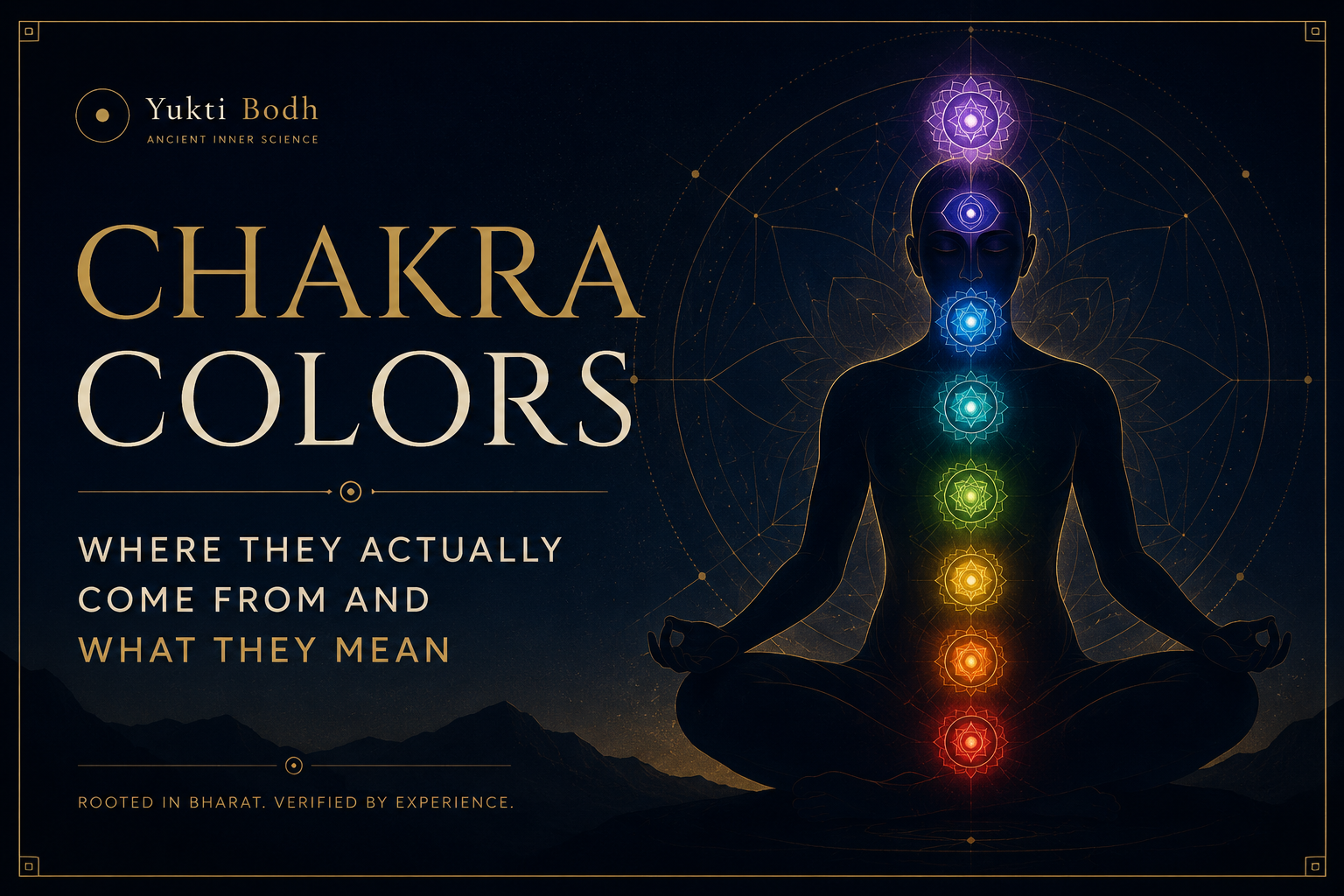
Chakra Colors: Where They Actually Come From and What They Mean
The chakra colour system is one of the most recognised visual frameworks in contemporary wellness culture. Red for root, orange for sacral, yellow for solar plexus, green for heart, blue for throat, indigo for third eye, violet for crown. Clean, graduated, intuitive.
It is also largely a 20th century invention, assembled from a mixture of Theosophical speculation, Western occultism, and selective reading of classical texts. Understanding where the rainbow system actually comes from — and what colours the original texts actually assign — does not diminish the value of colour work in practice. But it does allow you to approach it with appropriate clarity about what you are doing and why.
The Rainbow System: Its Actual Origin
The systematised ROYGBIV chakra colour sequence was not derived from any single classical Sanskrit text. Its most direct source is Charles W. Leadbeater’s 1927 book The Chakras, published by the Theosophical Society. Leadbeater, a prolific Theosophist and claimed clairvoyant, described seeing the chakras as whirling vortices of coloured light during out-of-body observation, and assigned them colours based on what he reported perceiving.
Leadbeater’s sequence was: base — orange-red, sacral — orange-red and rose, solar plexus — green and rose-red, heart — golden yellow, throat — silvery blue, brow — rose and yellow-white, crown — violet. This is not even the modern rainbow sequence — it has already been modified.
The contemporary clean ROYGBIV system emerged through the New Age movement of the 1970s and 1980s, absorbed Leadbeater’s general approach, simplified it further, and aligned it with the visible spectrum for aesthetic coherence. It was designed to be accessible and teachable — and it succeeded at that. But its relationship to classical Tantric texts is tenuous at best.
What Colours the Classical Texts Actually Assign
The Sat-Chakra-Nirupana and related texts do assign colours to the chakras — but they are not a clean rainbow, and they apply to specific elements within each chakra rather than to the chakra as a unified whole.
Muladhara: The lotus petals are described as crimson (some translations say gold or red-gold). The central earth square is yellow. The Svayambhu Linga within is described as shining like a young leaf — greenish, luminous.
Svadhisthana: The petals are vermillion. The central moon crescent is white. The presiding deity Vishnu is described as dark blue — the classic colour of Vishnu.
Manipura: The petals are described as blue-grey or the colour of a rain cloud. The fire triangle at the centre is red. The presiding deity Rudra is white, smeared with grey ash.
Anahata: The petals are described in different translations as blue-black, or in some sources as red-gold. The central hexagram region is smoky or grey. Kakini Shakti is yellow.
Vishuddha: The petals are smoke-coloured or purple. The central circle is white (moon). The elephant at the centre is white. The presiding deity is described as white.
Ajna: The lotus is described as white — luminous and clear. Two petals only.
Sahasrara: White or brilliantly luminous — described as brighter than the full moon.
Notice that the classical colour pattern is not a rainbow. It does not progress cleanly through the spectrum. It assigns multiple colours to each chakra depending on which element of the chakra is being described.
Why Colour in the Classical System is Functional, Not Decorative
In the classical Tantric framework, colour is not used for visual identification or therapeutic association. It is a component of Dharana — concentrated visualisation practice.
When the texts instruct a practitioner to meditate on the yellow square of Prithvi Tattva at Muladhara, the specific colour is part of a precise technique. The Tattvas — the five elements — each have a specific shape, colour, and associated Bija mantra. Visualising the yellow square, invoking the Bija mantra Lam, and holding the attention at the Muladhara region simultaneously is a specific practice for purifying and awakening that element in the subtle body.
The colours are functional precisely because they are specific. Substituting orange for yellow, or green for the smoke-grey of Anahata, changes the technique.
Tattva Colours: The Five Elements and Their Precise Shades
The five Tattva colours — which are the most precisely defined colours in the classical chakra system — are:
Prithvi (earth, Muladhara): Yellow — the colour of ripe grain, of gold, of the sun at midday. Square-shaped.
Apas (water, Svadhisthana): White — the colour of the full moon, of silver, of the conch shell. Crescent-shaped.
Agni (fire, Manipura): Red — the colour of the rising sun, of blood, of cinnabar. Triangle-shaped, pointing downward.
Vayu (air, Anahata): Smoke-grey or blue-grey — the colour of storm cloud, of smoke from incense, of dusk. Hexagonal or star-shaped.
Akasha (space, Vishuddha): Black or transparent — the colour of deep space, of the sky at midnight. Circular.
These five colours, shapes, and their associated Bija mantras form the foundation of Tattva Dharana practice — one of the most precise and powerful concentration techniques in the classical repertoire.
Using Colour in Practice: A Calibrated Approach
Given this history, how should colour be used in chakra practice?
If you are working with the classical Tattva Dharana system, use the precise classical colours for each element. They are functional, not aesthetic.
If you are working with a modernised colour system — green for heart, blue for throat — recognise what you are doing: working with a colour psychology framework that has some resonance with the chakra system but is not derived from classical texts. This can still be useful, particularly for visualisation work that operates at the level of imagination and suggestion. But do not mistake it for classical practice.
The most honest and effective approach is to understand both systems and apply each on its own terms. The classical Tattva colours for precise Dharana work. The broader colour associations — including modern ones — as supportive frameworks for the imagination, held lightly.
Understanding where your practices actually come from is not academic pedantry. It allows you to practise with appropriate precision — knowing which elements of the system are classical and which are modern reconstructions, and making conscious choices about how to work with each.
For the complete classical framework of all seven chakras — including the precise descriptions from the original texts — the Real Chakra System guide is available as a free download, no signup required. For the deepest available exploration of each chakra individually, the Chakra Deep-Dive Report covers all seven in full psychological and somatic depth.
Check and diagnose your chakra in tools section.
◎ Try the Tool
Find which chakras are balanced, blocked, or overactive with our free diagnostic.
Open Chakra Diagnostic →