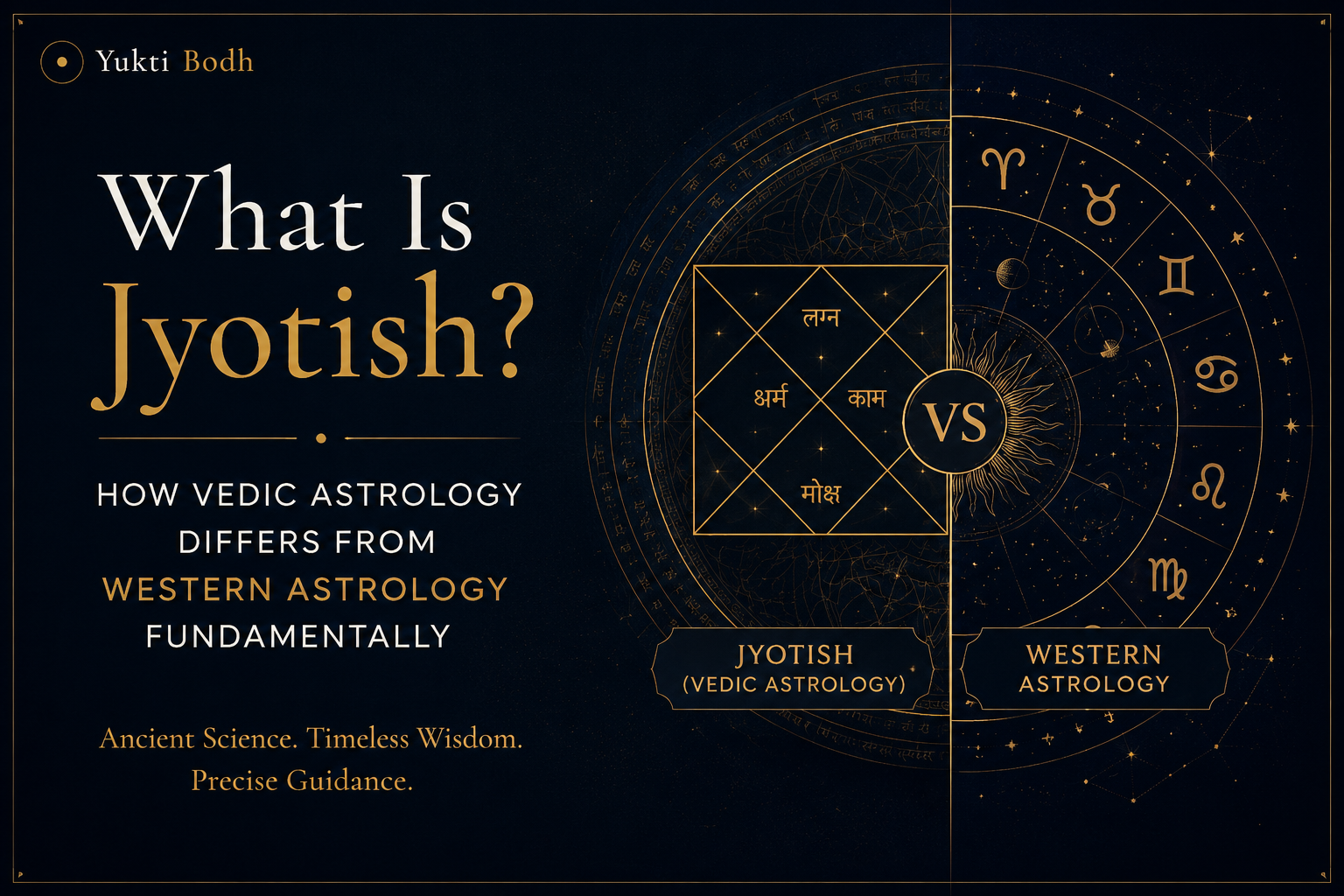
What Is Jyotish: How Vedic Astrology Differs from Western Astrology Fundamentally
Most people encounter Jyotish through a comparison: Western astrology versus Vedic astrology. Sun sign versus moon sign. Tropical zodiac versus sidereal zodiac. The comparison is useful as a starting point but it obscures something more fundamental — Jyotish and Western astrology are not two versions of the same system. They are built on different philosophical foundations, use different mathematical frameworks, and serve different purposes.
Understanding what Jyotish actually is — not as a curiosity or an alternative to Western astrology, but on its own terms — is the starting point for working with it seriously.
The Meaning of the Word
Jyotish comes from the Sanskrit Jyoti — light — and the suffix Isha — lord or master. Jyotish is the science of light, or more precisely, the science of the luminaries — the sun, the moon, and the planets — and their relationship to human experience.
In classical Indian tradition, Jyotish is one of the six Vedangas — the limbs of the Veda — considered auxiliary sciences necessary for the correct interpretation and application of Vedic knowledge. Its classical name is Jyotisha Shastra — the teaching of the luminaries. It is also called Hora Shastra — the science of time — reflecting its fundamental orientation: not toward the positions of planets as symbols, but toward time itself as a structured, meaningful field.
The Vedanga Jyotisha, one of the earliest texts in the tradition, opens with a statement that locates the purpose of the science precisely: Jyotish exists to determine the correct timing for Vedic ritual. This utilitarian origin is important. Jyotish began as a science of auspicious timing — of understanding the quality of moments — and expanded from there into a comprehensive system for understanding life.
The Mathematical Foundation: Sidereal vs. Tropical Zodiac
The most commonly cited difference between Jyotish and Western astrology is the zodiac system used. Western astrology uses the tropical zodiac, anchored to the seasons — the spring equinox defines zero degrees Aries regardless of where the stars are in the sky. Jyotish uses the sidereal zodiac, anchored to the actual positions of the fixed stars.
Due to a phenomenon called the precession of the equinoxes — the slow wobble of the earth’s axis over a cycle of approximately 25,800 years — the spring equinox point shifts backward through the fixed stars at a rate of approximately 50 arc seconds per year. Over the two millennia since Western astrology was systematised, this has produced a gap of approximately 23 to 24 degrees between the tropical and sidereal zodiacs.
The practical result: if you are a Gemini sun in Western astrology, you are almost certainly a Taurus sun in Jyotish. If you are an Aries rising in Western astrology, you are likely a Pisces rising in Jyotish.
This is not a minor adjustment. It is a fundamentally different calculation of where the planets are, based on a fundamentally different understanding of what the zodiac is and what it is anchored to.
The amount by which the sidereal zodiac lags behind the tropical zodiac at any given time is called the Ayanamsha. Different schools within Jyotish use slightly different Ayanamsha values — the Lahiri Ayanamsha being the most widely used in India, with the Krishnamurti and Raman Ayanamshas also in significant use.
The Philosophical Foundation: Karma and Time
The deeper difference between Jyotish and Western astrology is not mathematical. It is philosophical.
Western astrology, particularly in its contemporary psychological form, treats the birth chart as a map of personality — a description of who you are, your tendencies, your strengths and challenges. It is primarily a language for self-understanding, often used in a therapeutic context.
Jyotish, rooted in the Vedic philosophical framework of karma and dharma, treats the birth chart as a map of time — specifically, of the karmic conditions that the individual consciousness has brought into this life and the timing through which those conditions will express themselves.
The Jyotish chart is not a personality profile. It is a temporal map — showing which periods of life will be governed by which planetary principles, what themes will arise when, and what the overall trajectory of the life is in terms of the individual’s karmic inheritance.
This does not mean Jyotish is fatalistic. The classical texts distinguish between Dridha karma — fixed karma that will express itself regardless of action — and Adridha karma — malleable karma that can be modified through right understanding and right action. The purpose of Jyotish is not to predict a fixed future but to understand the karmic conditions operating in time so that intelligent choices can be made.
The Nine Planets: Navagraha
Jyotish works with nine planetary bodies, called the Navagraha — the nine seizers or holders. These are: Surya (Sun), Chandra (Moon), Mangala (Mars), Budha (Mercury), Guru (Jupiter), Shukra (Venus), Shani (Saturn), Rahu (North Lunar Node), and Ketu (South Lunar Node).
Uranus, Neptune, and Pluto — the outer planets discovered after the telescope — are not used in classical Jyotish. This is not because Vedic astrologers were unaware of distant objects, but because the classical system was built on the observable sky — the planets visible to the naked eye — and on a philosophical framework in which the Navagraha represent complete archetypal principles.
Rahu and Ketu — the lunar nodes — deserve special mention. They are mathematical points rather than physical bodies: the points where the moon’s orbit crosses the ecliptic. In Jyotish they are treated as fully significant planets, associated with karma, obsession, and the axes of fate and liberation.
The Twelve Houses: Bhavas
Jyotish uses twelve houses, called Bhavas, to organise the areas of life the chart addresses. The house system begins with the Lagna — the rising sign, the degree of the zodiac ascending on the eastern horizon at the moment of birth — as the first house.
Unlike most Western house systems, classical Jyotish uses the whole sign house system as its primary framework: the entire sign containing the Lagna becomes the first house, the next sign becomes the second house, and so on. Each house governs specific domains of life with high precision.
The Lagna — the ascendant — is considered the most important single factor in the chart in Jyotish. It represents the body, the self, the overall vitality of the life, and the overall direction of consciousness in this incarnation. This is the foundational difference from Western solar astrology, which centres the sun sign. In Jyotish, the sun sign is one factor among many — the Lagna is the anchor of the entire chart.
The Dasha System: Time Lords
Perhaps the most distinctive and powerful feature of Jyotish — with no equivalent in Western astrology — is the Dasha system: a sequential set of planetary periods that govern successive phases of life.
The most widely used system is the Vimshottari Dasha — a 120-year cycle divided among the nine planets in fixed proportions. The starting point of the cycle is determined by the moon’s position in its Nakshatra at birth.
Each planet governs a major period — the Mahadasha — ranging from six years (Sun) to twenty years (Venus). Within each Mahadasha, sub-periods (Antardashas) of each planet run in sequence. Within each Antardasha, smaller sub-periods (Pratyantardashas) further refine the timing.
The practical power of this system is considerable: a competent Jyotishi can identify which planets govern any period of a person’s life, assess their strength and quality in the birth chart, and thereby understand what themes will dominate that period. Birth, major life events, career changes, health challenges, relationship developments — in classical Jyotish, these are not random. They are expressions of the Dasha system unfolding through the karmic map of the birth chart.
Jyotish and Muhurat: The Practical Application
One of the most immediately practical applications of Jyotish is Muhurat — the selection of auspicious timing for important actions and events. Marriage, business launch, travel, entering a new home, beginning a new practice — Jyotish provides precise tools for identifying the most supportive moments for each.
This application of Jyotish is deeply embedded in Indian culture and remains in active daily use. The Muhurat Calculator on this site applies the core principles of the Vedic Panchang — the five elements of Vedic time — to identify auspicious and inauspicious moments for major life events, with the full reasoning made transparent.
The Panchang itself — Tithi, Vara, Nakshatra, Yoga, Karana — is the foundational output of Jyotish mathematics applied to daily time. Understanding the Panchang is understanding Jyotish at its most practical and immediate level.
Jyotish is a complete system — one that has been refined over thousands of years and that rewards serious study with a quality of insight into time, karma, and the structure of life that is not available elsewhere.
To use the practical tools derived from Jyotish — finding auspicious timing for major life events, understanding the Nakshatra and Tithi governing today — the Muhurat Calculator and the Vedic Moon and Panchang tool are available on this site, free to use at any time, no signup required.
[Use the Muhurat Calculator →] to apply Jyotish timing principles to your own life decisions.
★ Try the Tool
Generate your free Vedic birth chart — nakshatra, lagna, planetary positions, and more.
Open Vedic Chart Calculator →