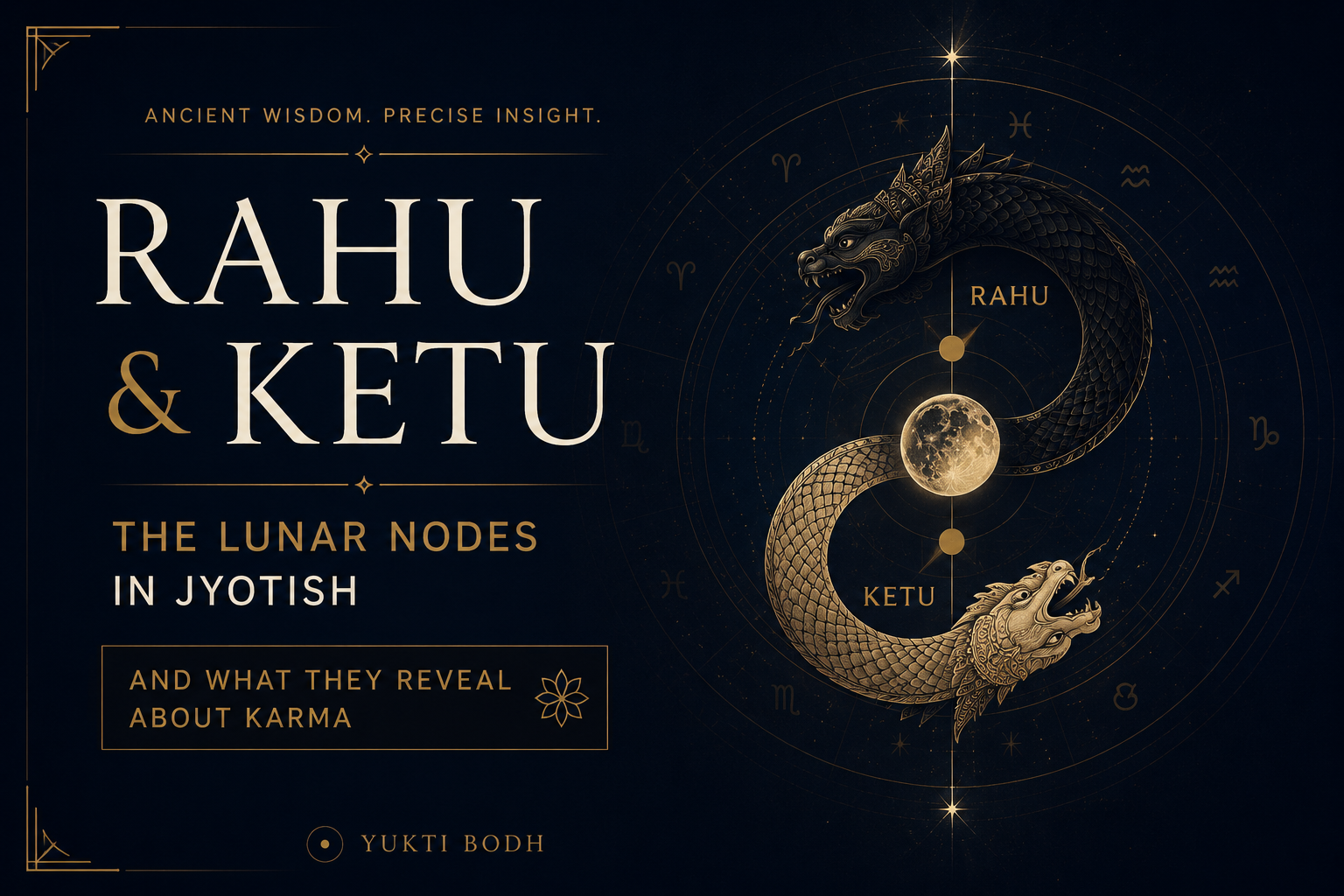
Rahu and Ketu: The Lunar Nodes in Jyotish and What They Reveal About Karma
Of all the planets in the Jyotish system, none are more misunderstood or more significant than Rahu and Ketu. They are not physical bodies. They are mathematical points — the north and south nodes of the moon, the two points where the moon’s orbit intersects the ecliptic (the apparent path of the sun). Yet the classical texts treat them as fully significant planets, give them entire Dasha periods (18 years for Rahu, 7 years for Ketu), and identify them as the primary indicators of karma — the karmic axis of the individual life.
Understanding Rahu and Ketu is understanding the direction of your life’s most fundamental momentum.
What Rahu and Ketu Actually Are
The moon’s orbit is tilted approximately five degrees relative to the ecliptic. The two points where the moon’s orbit crosses the ecliptic are the nodes. The ascending node — where the moon crosses from south to north of the ecliptic — is Rahu. The descending node — where it crosses from north to south — is Ketu. They are always exactly opposite each other in the zodiac.
In Vedic myth, Rahu and Ketu arise from the story of the churning of the primordial ocean: a demon called Svarbhanu disguises himself as a god and drinks the nectar of immortality. The sun and moon identify him and inform Vishnu, who cuts him in two with the Sudarshana Chakra. The head — Rahu — and the tail — Ketu — become immortal and are placed in the sky as shadow planets, ever chasing the sun and moon. The solar and lunar eclipses, in this cosmology, are Rahu and Ketu periodically swallowing the luminaries in revenge.
This myth encodes something precise: Rahu and Ketu are about eclipse — about what is obscured, what is hidden, what operates from shadow.
Rahu: The North Node — Obsession and Future Karma
Rahu represents the karmic direction of this life — what the soul has come to experience, achieve, and integrate in the current incarnation. Its house and sign placement describe the area of life where there is insatiable hunger, strong desire, and the pull toward unfamiliar territory.
Rahu’s qualities: amplification and intensification — whatever Rahu touches, it magnifies; obsessive desire and the inability to feel satisfied; the foreign, the unconventional, the taboo; illusion and deception — both being deceived and the capacity to deceive; worldly ambition and material success, particularly in the areas its house governs; and material intelligence — the capacity to succeed in the outer world through strategy and adaptation.
Rahu is associated with the serpent’s head — all appetite, no digestion. It consumes endlessly and is never satisfied. This is both its driving force and its limitation.
The house where Rahu is placed is where this hunger and drive are focused. Rahu in the second house obsessively accumulates wealth and speech. Rahu in the seventh house is intensely focused on relationship and partnership. Rahu in the tenth house drives relentlessly toward public success and recognition.
Ketu: The South Node — Past Mastery and Liberation
Ketu represents what has been mastered and accumulated in past lives — the areas of natural intuitive competence that come without effort in this life, and therefore tend to be taken for granted or released rather than developed further.
Ketu’s qualities: spiritual intelligence and detachment; the capacity to withdraw and renounce; sharp, penetrating insight that bypasses ordinary logical processes; dissolution and loss — Ketu erodes whatever it touches, undermining material structures and worldly ambitions; moksha and liberation — Ketu is the primary Moksha Karaka, the planet most associated with spiritual liberation; and the occult, the hidden, and the depth of investigation.
Ketu is associated with the serpent’s tail — no head, no mouth, no ability to consume. It digests experience without being driven by desire. In areas where Ketu is placed, there is often a quality of effortless competence alongside a lack of motivation to develop that area further — because the soul already knows it.
The house where Ketu is placed is where things tend to dissolve, withdraw, or become spiritualised rather than materialised.
The Rahu-Ketu Axis: Reading the Karmic Direction
Since Rahu and Ketu always occupy opposite houses, they form an axis — a polarity that describes the fundamental tension in a life’s karma.
The classic example: Rahu in the first house, Ketu in the seventh. The soul is being pulled toward self-development, individual identity, and personal authority (Rahu in the first). The past mastery is in partnership, merging, and relationship (Ketu in the seventh). The life’s tension is between the pull toward self-definition and the deep familiarity — even comfort — in losing the self in relationship. The karmic growth is in building a genuine individual self; the karmic danger is excessive attachment to partnership as a means of escaping that work.
Reading the Rahu-Ketu axis in this way — understanding the directionality, the tension, and the specific domains involved — is one of the most revealing dimensions of Jyotish chart interpretation.
Rahu and Ketu Mahadasha: 18 and 7 Years
In the Vimshottari Dasha system, Rahu governs an 18-year Mahadasha and Ketu a 7-year Mahadasha — together accounting for 25 years of the 120-year cycle.
Rahu Mahadasha is classically described as a period of intense worldly engagement — ambition, material pursuit, foreign influences, and the breaking of conventional boundaries. It can bring extraordinary success in worldly terms, particularly in fields where Rahu excels: technology, mass communication, unconventional fields, foreign countries. It can also bring confusion, obsession, and the experience of maya — the seductive illusion of the material world.
Ketu Mahadasha is almost the opposite in quality: a withdrawal from the world, a deepening of inner life, a dissolution of structures that had been built. It is often spiritually productive but materially challenging. What had been built during Rahu periods may come apart during Ketu periods, making way for a different kind of depth and understanding.
Rahu and Ketu are the planets of destiny — not in a fatalistic sense, but in the sense that they describe the fundamental momentum of the soul’s journey across time. Understanding their placement in your chart is understanding the deepest directional thrust of your current life.
The Vedic Moon and Panchang tool shows today’s Nakshatra — which is directly connected to the Rahu and Ketu cycle through the nodes’ positions in the sky. For timing important decisions in alignment with auspicious Nakshatras and away from Rahu-Ketu influence when it is inauspicious, the Muhurat Calculator applies these principles practically.
[Use the Panchang tool →] to understand today’s planetary quality in the Vedic framework.
★ Try the Tool
Generate your free Vedic birth chart — nakshatra, lagna, planetary positions, and more.
Open Vedic Chart Calculator →