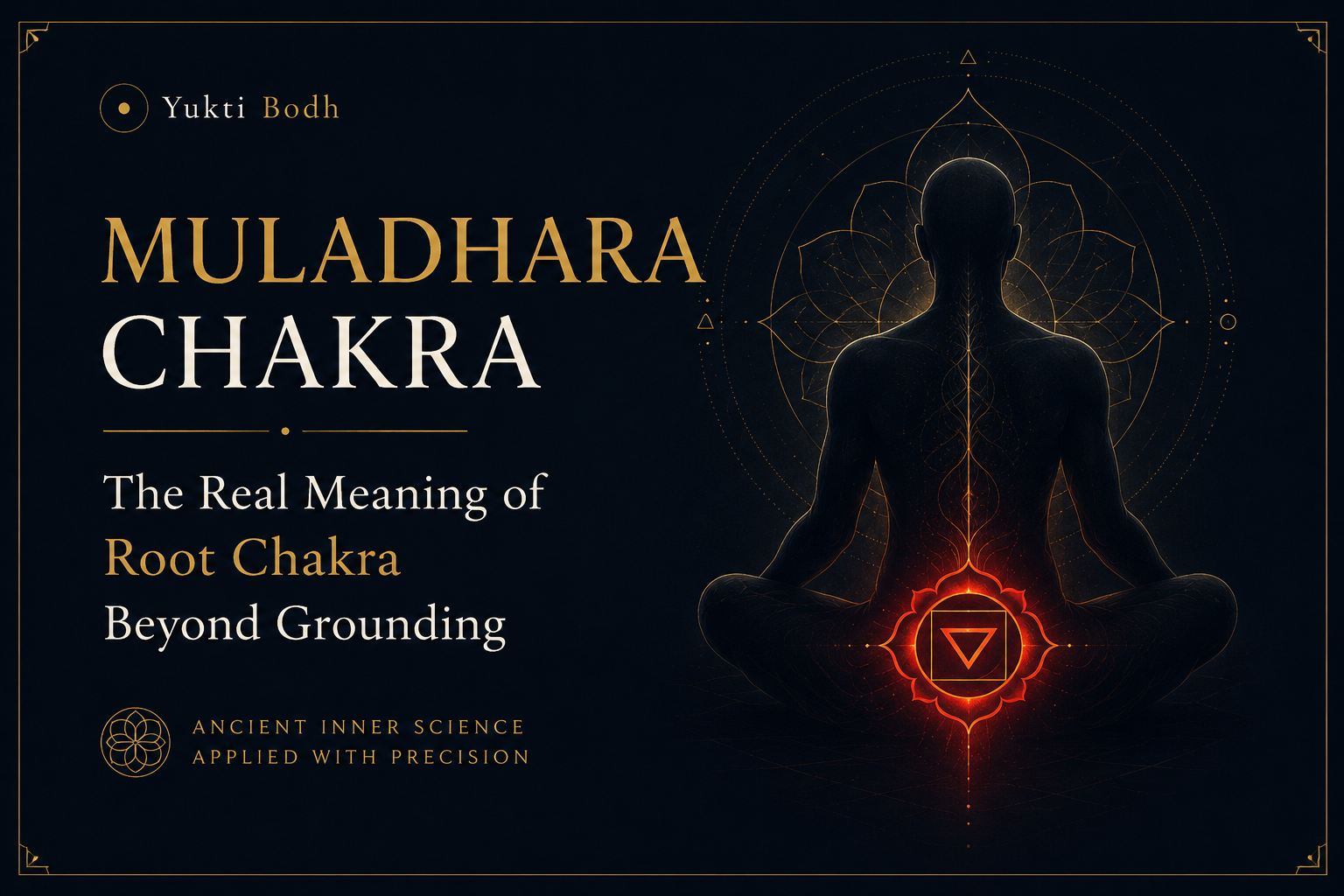
Muladhara Chakra: The Real Meaning of Root Chakra Beyond Grounding
Every introduction to chakras starts with Muladhara. It is described as the root, the foundation, the chakra of stability and grounding. You are told it governs your sense of safety, your connection to the earth, your ability to feel secure in the world.
This is not wrong. But it is radically incomplete. And what is missing is precisely what makes Muladhara the most significant of the six classical chakras — not because of what it does for your nervous system, but because of what it contains.
The Name and Its Meaning
Muladhara comes from two Sanskrit roots: Mula, meaning root or foundation, and Adhara, meaning support or base. The name describes its position — at the base of the spine, at the perineum — but it also describes its function in the classical system: it is the root support of the entire subtle body structure.
The Sat-Chakra-Nirupana locates Muladhara at the meeting point of the Kanda — the bulbous root from which all 72,000 Nadis are said to arise — and the base of the Sushumna Nadi, the central channel. Everything above depends on what is established here.
What the Texts Actually Describe
The classical description of Muladhara is specific and layered. The Sat-Chakra-Nirupana describes a lotus of four petals, deep crimson in colour, with the Sanskrit syllables Va, Sha, Sha, and Sa inscribed on its petals — the four Vrittis or modifications of consciousness associated with this level: greatest joy, natural pleasure, delight in controlling passions, and blissfulness in concentration.
At the centre of the lotus is a yellow square — the Prithvi Tattva, the earth element. Within the square is a downward-pointing triangle — the Traipura, associated with creation — and within the triangle is the Svayambhu Linga, a naturally formed Shiva Linga, described as shining like a young leaf, smooth and lustrous.
Coiled around this Linga, three and a half times, is Kundalini Shakti — described as a sleeping serpent, luminous as lightning, her mouth closing the entrance of the Brahma Nadi, the innermost channel of Sushumna.
This is what Muladhara actually contains. Not merely a grounding centre. The entire creative potential of consciousness, in its dormant form.
Kundalini at Muladhara: The Significance
The presence of Kundalini Shakti coiled at Muladhara is the central fact of this chakra — and the central fact of the entire classical chakra system.
In Tantric cosmology, Shakti is the dynamic power of consciousness. Shiva — pure awareness — is present at the Sahasrara, the crown. Shakti — the power that creates, sustains, and dissolves — has descended into matter and sleeps at the base of the spine in every human being. The entire project of Tantric practice, as the texts describe it, is to awaken Shakti, reunite her with Shiva through the sequential awakening of each chakra, and realise the non-separation of the two.
Muladhara is the starting point of this journey. Not because it is the lowest or least refined level, but because it is where the journey actually begins — where the sleeping potential lies.
This reframes what it means to work with Muladhara. Grounding exercises and feelings of stability are peripheral. The actual work is about making contact with the sleeping Shakti — through pranayama, through specific meditative techniques, through Moola Bandha (the root lock), and through sustained attention.
The Presiding Deity: Brahma and Dakini
Each chakra in the classical system has presiding deities — both a masculine and a feminine principle. At Muladhara, the presiding deity is Brahma — the creator — in his form as a four-faced, red-complexioned figure seated on a swan (Hamsa). His presence here reflects the creative principle at its most fundamental: not yet differentiated into the world of forms, but containing all potential.
The Shakti of Muladhara is Dakini — described as lustrous and four-armed, carrying a spear, a staff, a sword, and a skull cup. In Tantric iconography, Dakini is the threshold guardian — fierce, demanding, and the gatekeeper to the inner dimensions of the subtle body. Her presence at Muladhara indicates that access to what lies within this chakra is not casual. It requires preparation.
The Tattva: Earth, Smell, and the Capacity for Stability
Muladhara is associated with the Prithvi Tattva — the earth element — and with the Tanmatra of smell (Gandha). The corresponding faculty is Payu — the organ of excretion.
This correspondence is precise rather than symbolic. In the classical understanding, the earth element is the densest of the five Tattvas — it contains and integrates all the qualities of the elements above it. Stability, coherence, the capacity to hold form — these are functions of Prithvi.
The association with smell is similarly specific. Smell is the sense most directly connected to memory, to instinct, to the body’s deep orientation in space. In meditation on Muladhara, practitioners sometimes report spontaneous olfactory sensations — fragrances arising without external source. This is described in the texts as a sign of progress in concentration at this level.
The Three Granthis and Brahma Granthi
The classical texts describe three Granthis — psychic knots — that obstruct the upward movement of Kundalini through the Sushumna. The first of these, Brahma Granthi, is located at Muladhara.
Brahma Granthi represents the binding force of the physical world — attachment to bodily existence, sensory experience, and the pleasure of material things. It is the knot of inertia, of Tamas — the quality of heaviness and unconsciousness.
Releasing Brahma Granthi is not a metaphor for becoming non-attached in a philosophical sense. In the context of practice, it refers to a specific threshold in the quality of concentration and energy that must be reached before Kundalini can begin her upward movement. This is why the early stages of serious practice often focus heavily on purification — physical, energetic, and mental — before any chakra work in a precise sense begins.
What Muladhara Work Actually Involves
In practice terms, working with Muladhara involves several approaches from the classical framework:
Moola Bandha — the root lock — involves the contraction of the perineal muscles in a specific way that directs Apana Vayu (the downward-flowing Prana) upward, toward the Sushumna. This is considered a direct technique for awakening Muladhara.
Ashwini Mudra — rhythmic contraction and release of the anal sphincter — is preparatory to Moola Bandha and is used to purify and enliven the Muladhara region.
Trataka and Dharana — concentrated gazing and one-pointed attention — on a specific symbol or on the Muladhara region itself in meditation, develop the quality of awareness necessary to make contact with what the texts describe as present at this level.
Pranayama — particularly practices that work with Apana Vayu and build internal heat (Tapas) — form the essential foundation. Without a reasonably purified Nadi system, specific chakra work has limited effect.
Muladhara is the beginning, but not in the sense of being elementary. It is the beginning in the sense of being the ground — the place where what is most fundamental is located, sleeping, waiting for the right conditions to awaken.
For a complete map of all seven chakras with their classical descriptions, somatic signatures, and 42-day practice system, the Chakra Deep-Dive Report goes into the full depth this subject requires. If you are working with the subtle body more broadly — understanding Koshas, Nadis, and how the complete framework fits together — the Subtle Body Complete Guide is the natural companion.
[Download the free Real Chakra System guide →] to start with the foundational framework.
◎ Try the Tool
Find which chakras are balanced, blocked, or overactive with our free diagnostic.
Open Chakra Diagnostic →