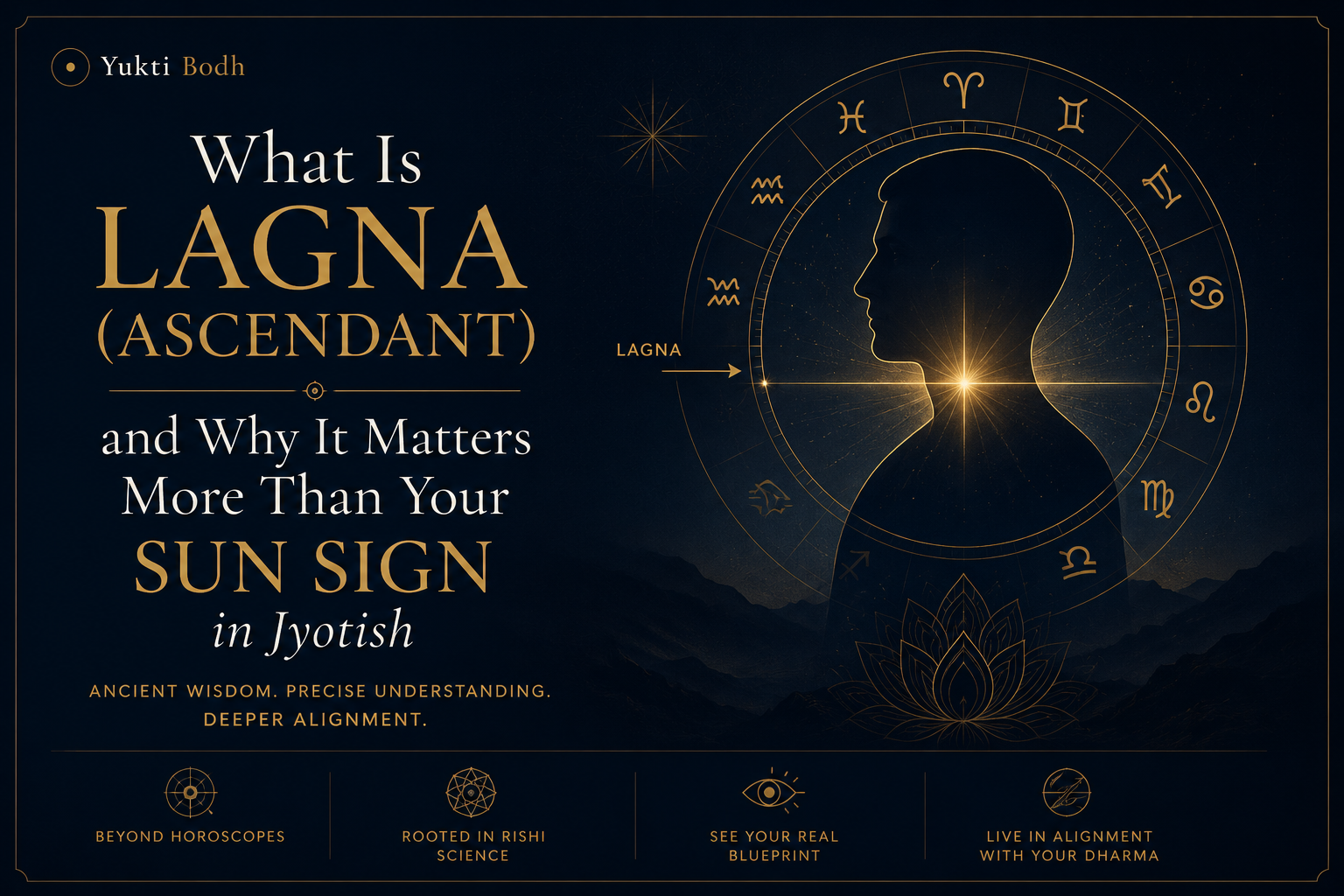
What Is Lagna (Ascendant) and Why It Matters More Than Your Sun Sign in Jyotish
In Western astrology, when someone asks what sign you are, they mean your sun sign — the zodiac sign the sun occupied at your birth. This is how most people in the modern world understand astrology: as a twelve-fold personality typology based on solar position.
In Jyotish, this question has almost no importance on its own. The first and most fundamental question is: what is your Lagna? And the Lagna — the ascendant, the rising sign — is not a personality type. It is the pivot of the entire chart.
What the Lagna Is
The Lagna is the degree of the zodiac that was rising on the eastern horizon at the exact moment of your birth, at your precise location on earth. Because the earth rotates at approximately one degree every four minutes, the Lagna changes signs roughly every two hours. This is why birth time accuracy is critical in Jyotish in a way that it is not in sun-sign astrology — the sun sign is the same for everyone born within a 30-day period. The Lagna is specific to a two-hour window.
The Sanskrit word Lagna means contact or that which is joined — specifically, the point at which the ecliptic (the apparent path of the sun) meets the horizon. It is the interface between the individual and the cosmos — the point of arrival of consciousness into a specific body, time, and place.
Why the Lagna Governs More Than the Sun Sign
The Lagna functions as the first house of the chart — and in Jyotish, the first house is the most powerful of the twelve. Its significance extends across multiple dimensions simultaneously.
The Lagna represents the physical body — its constitution, vitality, and overall health trajectory. The Lagna lord — the planet ruling the Lagna sign — is considered the most significant planet in the entire chart, governing both the body and the overall direction of the life.
The Lagna represents the self as subject — the I that experiences the chart, rather than any one facet of the personality. Where the sun sign describes the soul’s orientation, the Lagna describes the vehicle through which that soul is operating in this specific life.
The Lagna determines the house rulerships of every planet in the chart. The same planet can be a great benefic in one chart and a challenging influence in another, depending entirely on what houses it rules from the Lagna.
Every other house in the chart is counted from the Lagna. The fourth house of home is the fourth sign from the Lagna. The seventh house of marriage is the seventh sign from the Lagna. Change the Lagna and you change the meaning of every planetary placement in the chart.
The Lagna Lord: The Most Important Planet
The planet that rules the sign of the Lagna is called the Lagna lord or Ascendant lord. Its placement by sign, house, and the planets aspecting it tells the primary story of the life.
If the Lagna is Aries, the Lagna lord is Mars. If Mars is placed in the tenth house in Capricorn — its sign of exaltation — the chart belongs to someone whose life force is directed powerfully toward career, public recognition, and achievement in the world, with considerable success likely in Mars-related fields.
If the same Aries Lagna has Mars placed in the eighth house in Scorpio — a challenging placement — the life force is directed toward hidden things, research, transformation, and potentially crisis. The career may be in healing, research, or crisis management. The life has depth but is not straightforward.
The Lagna lord’s placement in a benefic or malefic house, its relationship with other planets, its strength in its sign — these factors together paint the primary narrative of the individual life.
The Chandra Lagna: The Second Ascendant
In Jyotish, the sign occupied by the moon functions as a second ascendant — called the Chandra Lagna. Many experienced Jyotishis read the chart simultaneously from the Lagna and the Chandra Lagna, and also from the Surya Lagna (the sun’s sign as ascendant).
The Chandra Lagna is particularly important for understanding the emotional and psychological patterns of the individual — how the mind experiences life, the relationship with the mother, and the quality of the inner life. Some classical traditions consider the Chandra Lagna even more important than the Lagna for understanding the person’s inner reality.
How to Find Your Lagna
The Lagna requires three inputs: date, time, and place of birth. Given these three factors, the Lagna can be calculated precisely. Online Jyotish calculators and chart-drawing software can produce a full chart within seconds.
The most important thing: your birth time must be accurate. A one-hour error in birth time can shift the Lagna by an entire sign — completely changing the chart’s structure. If you do not know your birth time, there are Jyotish techniques for birth time rectification, but these require the assistance of a skilled practitioner.
Once you have your Lagna, the next step is understanding the qualities of that Lagna sign, the natural significations of the Lagna lord, and where the Lagna lord is placed in your specific chart.
The Lagna in Muhurat: Why Rising Signs Matter for Timing
The concept of the Lagna extends beyond the birth chart into Muhurat — auspicious timing. When selecting a Muhurat for an important event, the Lagna of the Muhurat moment — the rising sign at the time the event begins — is one of the most critical factors assessed.
A Muhurat with a powerful, unafflicted Lagna — and a benefic in the Lagna — gives the event the strongest possible beginning. The Muhurat Lagna functions exactly as a birth Lagna does for the event itself: it describes the fundamental nature of what is being launched.
This is why starting an important venture at an astrologically selected moment — using the Muhurat Calculator’s framework — is not superstition. It is the application of the same logic that makes birth charts meaningful, applied to the moment of an event’s birth.
[Use the Muhurat Calculator →] to select a Lagna-optimised auspicious time for your important decisions and events.
★ Try the Tool
Generate your free Vedic birth chart — nakshatra, lagna, planetary positions, and more.
Open Vedic Chart Calculator →