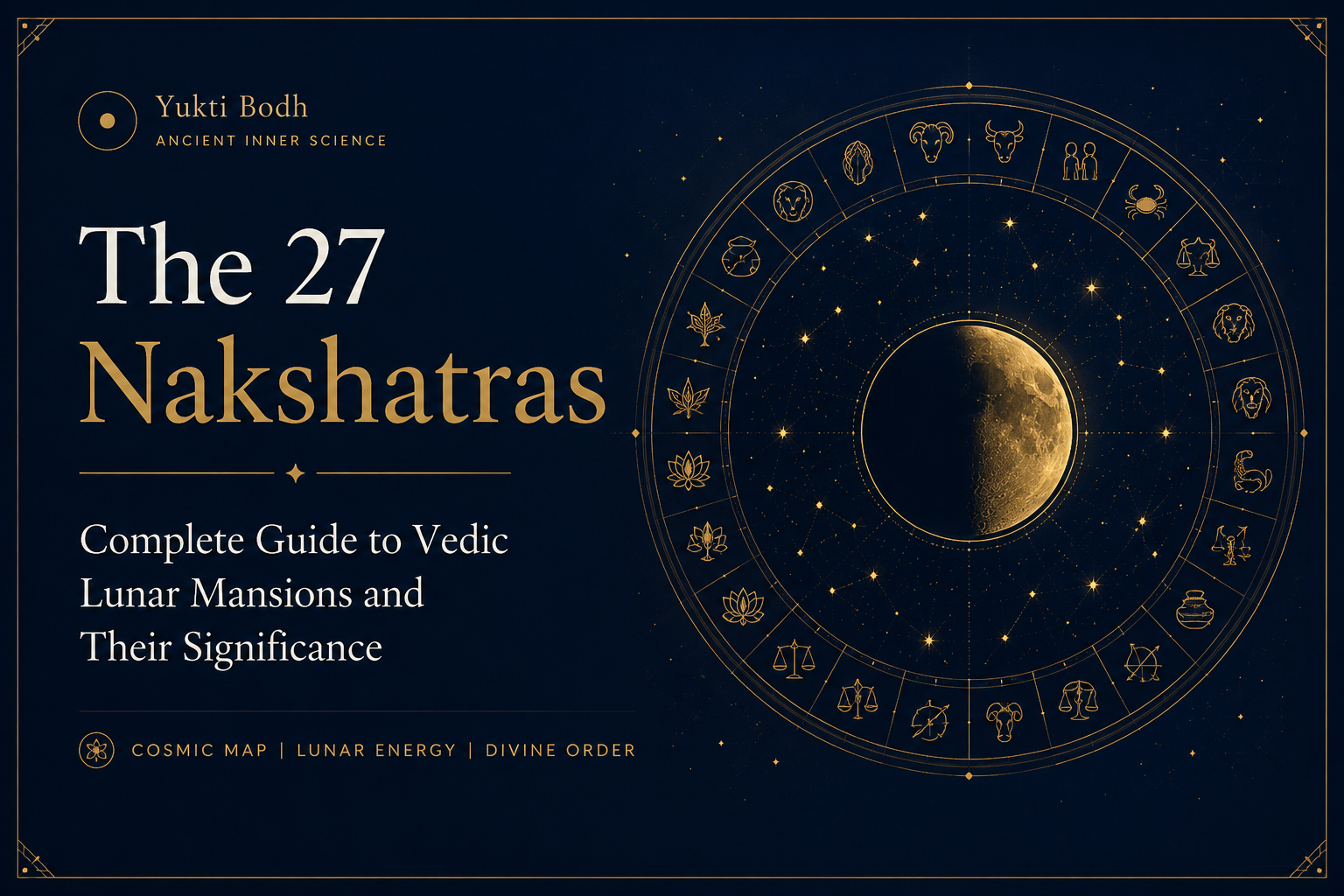
The 27 Nakshatras: Complete Guide to Vedic Lunar Mansions and Their Significance
The Nakshatras are one of the oldest and most distinctively Indian elements of the Jyotish system. Predating the use of the twelve-sign zodiac, the Nakshatra system divides the sky into 27 equal segments of approximately 13 degrees 20 minutes each — the approximate daily motion of the moon through the fixed stars.
The moon completes one full orbit of the earth in approximately 27.3 days — one day per Nakshatra. The 27 Nakshatras are literally the moon’s 27 daily dwelling places as it moves through the sky. They are called lunar mansions for this reason.
Understanding the Nakshatras is essential for working seriously with Jyotish and with the daily Panchang — they are the primary factor used in the Dasha system, in Muhurat selection, and in assessing the quality of any given day.
The Structure of the Nakshatra System
Each Nakshatra spans exactly 13 degrees and 20 minutes of the 360-degree zodiac. The 27 Nakshatras together span 360 degrees — one complete circuit of the sky.
Each Nakshatra is divided into four Padas (feet or quarters) of 3 degrees 20 minutes each, producing 108 Padas total. 108 is a sacred number in the Indian tradition — the 108 Padas of the Nakshatra system, the 108 Upanishads, the 108 beads of a Japa mala — all arise from the same mathematical structure.
Each Nakshatra has a ruling planet — one of the nine Navagraha — which governs the period when that Nakshatra is prominent in a given time window or when the moon passes through it. This planetary rulership is the basis of the Vimshottari Dasha system.
The 27 Nakshatras: An Overview
The 27 Nakshatras in order, with their ruling planets and primary qualities:
Ashwini (0° to 13°20′ Aries) — Ketu. The healing twins, swift and pioneering. New beginnings, medicine, speed.
Bharani (13°20′ to 26°40′ Aries) — Venus. The bearer. Cycles of birth and death, transformation, sensory intensity.
Krittika (26°40′ Aries to 10° Taurus) — Sun. The fire star. Purification, sharp discrimination, cutting away the inessential.
Rohini (10° to 23°20′ Taurus) — Moon. The red star, the moon’s favourite dwelling. Fertility, beauty, abundance, creativity. The moon is exalted in Rohini.
Mrigashira (23°20′ Taurus to 6°40′ Gemini) — Mars. The deer’s head. Searching, gentle sensitivity, restless seeking.
Ardra (6°40′ to 20° Gemini) — Rahu. The moist star, the teardrop. Storms, dissolution, the destructive power that precedes renewal.
Punarvasu (20° Gemini to 3°20′ Cancer) — Jupiter. The return of light. Renewal, restoration, the home found after wandering.
Pushya (3°20′ to 16°40′ Cancer) — Saturn. The most auspicious of Nakshatras for most activities. Nourishment, support, the flower that opens fully.
Ashlesha (16°40′ to 30° Cancer) — Mercury. The clinging star. Serpent wisdom, penetrating insight, the power of the subconscious.
Magha (0° to 13°20′ Leo) — Ketu. The throne. Ancestry, royalty, the power of lineage and past lives.
Purva Phalguni (13°20′ to 26°40′ Leo) — Venus. The first of the fig tree. Pleasure, creativity, rest and enjoyment.
Uttara Phalguni (26°40′ Leo to 10° Virgo) — Sun. The second of the fig tree. Partnership, social contracts, the grace of being supported.
Hasta (10° to 23°20′ Virgo) — Moon. The hand. Skill, craftsmanship, the work of the hands, healing.
Chitra (23°20′ Virgo to 6°40′ Libra) — Mars. The bright jewel. Beauty, creative intelligence, the art of making.
Swati (6°40′ to 20° Libra) — Rahu. The sword. Independence, the breath of wind, the capacity to stand alone.
Vishakha (20° Libra to 3°20′ Scorpio) — Jupiter. The forked branch. Goal-orientation, the tension between two directions, eventual triumph.
Anuradha (3°20′ to 16°40′ Scorpio) — Saturn. Devotion, friendship, the organisation of effort toward a distant goal.
Jyeshtha (16°40′ to 30° Scorpio) — Mercury. The eldest, the chief. Seniority, the weight of responsibility, protective power.
Mula (0° to 13°20′ Sagittarius) — Ketu. The root. The capacity to uproot, to go to the foundation, to destroy what is false.
Purva Ashadha (13°20′ to 26°40′ Sagittarius) — Venus. The early victory. Invincibility, the strength that comes from truth.
Uttara Ashadha (26°40′ Sagittarius to 10° Capricorn) — Sun. The later victory. The final and lasting victory that endures.
Shravana (10° to 23°20′ Capricorn) — Moon. The ear. Listening, learning, the capacity to receive knowledge across distances.
Dhanishtha (23°20′ Capricorn to 6°40′ Aquarius) — Mars. The most famous. Wealth, music, abundance, the power of rhythm.
Shatabhisha (6°40′ to 20° Aquarius) — Rahu. The hundred physicians. Healing, the power of the mysterious, scientific inquiry.
Purva Bhadrapada (20° Aquarius to 3°20′ Pisces) — Jupiter. The first of the auspicious feet. Intensity, depth, the burning away of impurity.
Uttara Bhadrapada (3°20′ to 16°40′ Pisces) — Saturn. The second of the auspicious feet. Wisdom, depth, the capacity to endure.
Revati (16°40′ to 30° Pisces) — Mercury. The wealthy star. Completion, nourishment, the safe crossing to the other shore.
The Nakshatra in Daily Practice: The Panchang
The Nakshatra of the day — specifically, the Nakshatra the moon occupies — is one of the five elements of the daily Panchang, alongside the Tithi (lunar day), Vara (day of the week), Yoga (a combined sun-moon calculation), and Karana (half-tithi).
The Nakshatra changes approximately once per day. Certain Nakshatras are considered auspicious for specific activities — Rohini, Pushya, Hasta, and Uttara Phalguni and Uttara Ashadha are among the most broadly auspicious. Ardra, Ashlesha, Jyeshtha, and Mula are considered inauspicious for beginnings in most Muhurat frameworks.
The Vedic Moon and Panchang tool on this site shows the Nakshatra for today automatically, along with the Tithi, Yoga, and the full classical significance of each.
The Nakshatras are one of the richest and most nuanced elements of the Vedic astronomical tradition — each one a complete universe of meaning, accumulated through centuries of precise observation and inner inquiry.
To see today’s Nakshatra and full Panchang — and understand what it means for the quality of the day — the Vedic Moon and Panchang tool is free to use at any time. For selecting the most auspicious Nakshatra for an important event, the Muhurat Calculator incorporates Nakshatra quality as a primary factor in its assessment.
[Use the Vedic Moon and Panchang tool →] to see today’s Nakshatra and its significance.
★ Try the Tool
Generate your free Vedic birth chart — nakshatra, lagna, planetary positions, and more.
Open Vedic Chart Calculator →