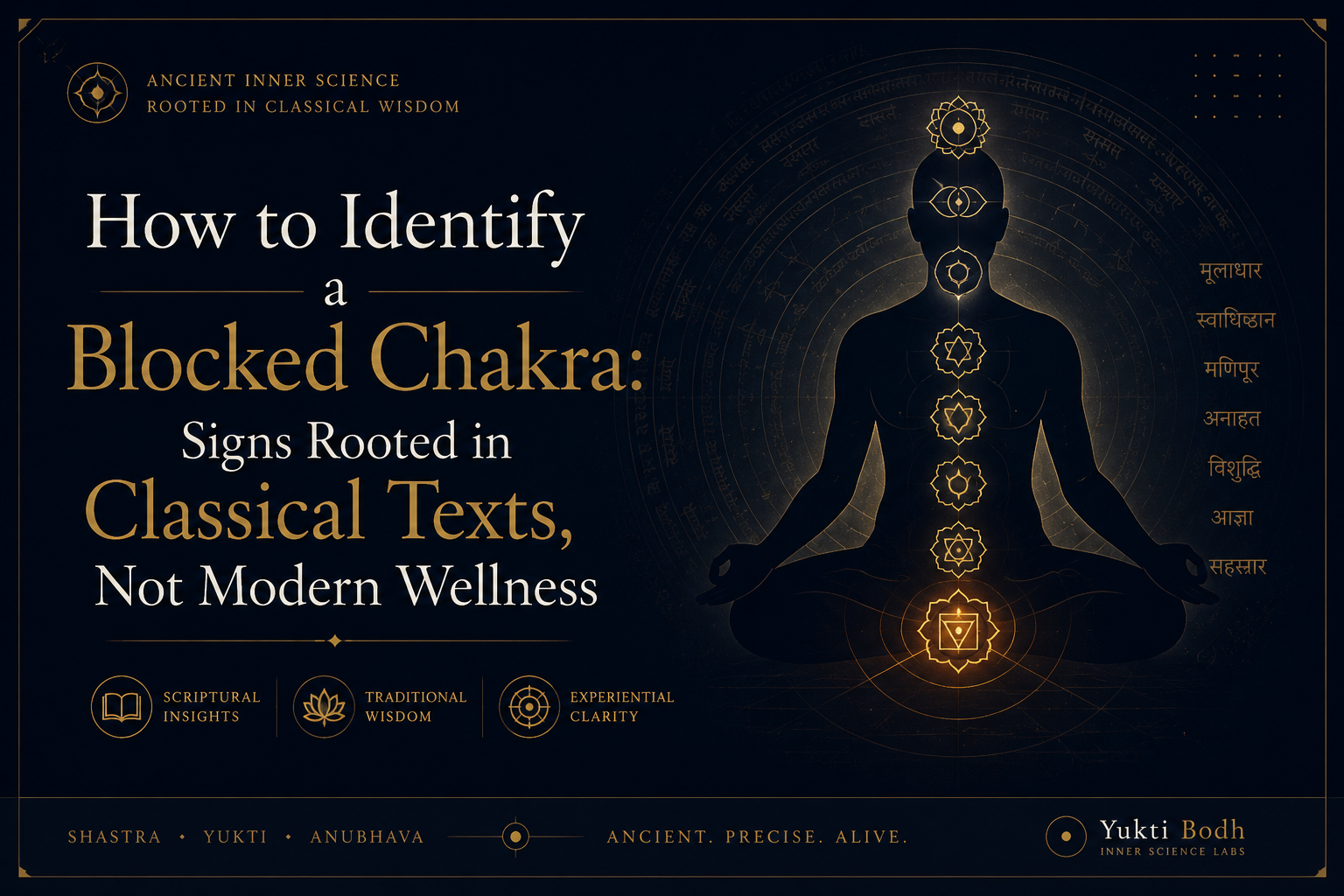
How to Identify a Blocked Chakra: Signs Rooted in Classical Texts, Not Modern Wellness
The modern approach to identifying blocked chakras typically involves a questionnaire: Do you feel unsafe? Muladhara is blocked. Do you struggle with intimacy? Svadhisthana is blocked. Do you lack confidence? Manipura is blocked.
This framework is not useless. Pattern recognition at a gross level is better than no pattern recognition. But the classical texts offer something considerably more precise — and they locate the signs of obstruction not in feelings and self-perceptions, but in the specific quality of consciousness, the dominant Vrittis (mental modifications), and the somatic manifestations that arise at each level.
Identifying a blocked chakra in the classical sense is not about checking symptoms against a list. It is about recognising the dominant texture of your experience and understanding which chakra level is governing it.
What a Blocked Chakra Actually Means
In the classical framework, a blocked chakra does not mean a chakra that has stopped working. Prana flows through all the chakras in all living beings — it cannot not flow. What varies is the quality and direction of that flow.
A chakra is functionally obstructed when: the Nadi system at that level is impure or contracted, which restricts the flow and quality of Prana; the consciousness is identified with the Vrittis of that level and cannot move above them; or there is accumulated Samskaric material (latent impressions) that keeps the awareness anchored there.
The result is not a chakra that is shut down. It is a chakra through which energy moves in distorted or restricted ways — producing characteristic patterns in both experience and behaviour.
Signs of Obstruction at Muladhara
The Vrittis of Muladhara are: greatest joy (of the physical-instinctual kind), natural pleasure, delight in controlling passions, and blissfulness in concentration. When Muladhara is obstructed, these Vrittis appear in their shadow forms.
Classical and classical-derived signs include: chronic physical contraction at the perineum and base of the spine; an experience of fundamental unsafety that is not responsive to changing circumstances; inability to be present in the body — the sense of being somehow above or disconnected from physical existence; obsessive attachment to physical security — money, shelter, food — without ever reaching a sense of sufficiency; bowel and elimination difficulties (the associated organ is the faculty of excretion); and the inability to sit in stillness without significant agitation.
The common thread: the ground of physical existence feels unreliable, so the awareness cannot rest there, and the body’s most basic organisational intelligence — the sleeping Shakti — is not accessible to conscious direction.
Signs of Obstruction at Svadhisthana
The Vrittis of Svadhisthana include affection in its possessive form, pitilessness, delusion, disdain, and suspicion. Obstruction here manifests as:
Compulsive sensory seeking — food, sexuality, sensation — as a means of managing an underlying sense of emptiness; emotional volatility that seems sourceless — arising and passing with a kind of tidal rhythm; a sense of being powerfully shaped by the emotional states of others, with difficulty maintaining a stable internal reference point; the presence of chronic guilt or shame that is not clearly connected to specific events; and patterns that repeat despite conscious intention to break them — this is the Samskaric material of the Svadhisthana storehouse expressing itself.
Physiologically: creative blocks are often correlated with Svadhisthana obstruction, as are reproductive system difficulties and lower back pain at the sacral level.
Signs of Obstruction at Manipura
Manipura Vrittis in their shadow form include: jealousy, shame, fear, disgust, delusion, and the hunger for recognition without the capacity to earn it.
Obstruction at Manipura manifests as: weak or irregular digestion and metabolism (Jatharagni is weak); chronic fatigue that is more energetic than physical — the inability to sustain directed effort; either the collapse of will — passivity, procrastination, the inability to act from personal authority — or its inflation into controlling and dominating behaviour; acute sensitivity to disrespect or being overlooked; and the inability to complete things, because the fire that drives transformation through a process is insufficient.
Anger is a Manipura faculty — its refined form is the discriminative capacity to cut through confusion. Obstructed Manipura produces either the suppression of anger into passivity or its uncontrolled eruption.
Signs of Obstruction at Anahata
The Vrittis of Anahata in their shadow form include: fraudulence, indecision, repentance, hope and anxiety as a coupled pair, longing, and arrogance. These are not random — they are the specific textures of a consciousness that has become aware of itself but is not yet stable in that awareness.
Obstruction at Anahata manifests as: the deep intuition of something more than personal existence, paired with the inability to access it — spiritual longing that does not resolve; the experience of love as painful — because it brings hope and the fear of loss in equal measure; chronic grief or a background sense of incompleteness; and the quality of self-betrayal — knowing what is true for you and choosing otherwise, repeatedly.
Physiologically: cardiac and respiratory difficulties are classically correlated with Anahata obstruction, as are conditions of the hands and immune function (Anahata governs the thymus gland in some classical-derivative frameworks).
Signs of Obstruction at Vishuddha
Obstruction at Vishuddha manifests in the sphere of expression and reception. The specific signs include: the inability to express what is genuinely known — a felt sense that truth cannot be communicated; conversely, compulsive speech as a means of managing internal tension; difficulty hearing — not physical deafness, but the inability to listen without immediately filtering through personal reaction; chronic throat conditions, tension in the neck and jaw; and the collapse of discrimination between what should be spoken and what should not — the inability to hold appropriate silence.
In practice terms, Vishuddha obstruction often manifests in practitioners as a kind of spiritual bypassing — using philosophical language and elevated concepts to avoid the direct encounter with lower-chakra material that has not yet been processed.
Signs of Obstruction at Ajna
Obstruction at Ajna manifests as: the inability to access inner guidance — a felt sense of being cut off from one’s own knowing; headaches and tension in the frontal brain region; the collapse of discriminative wisdom into either rigid rationalism or undiscriminating intuition; the inability to concentrate beyond a certain threshold despite sustained effort; and in advanced practitioners, the attachment to inner experiences — visions, sounds, lights — that is the signature of Rudra Granthi.
What to Do With This Information
Identifying which chakra level is dominant in your experience is not a diagnosis that requires treatment. It is information that makes practice more intelligent.
The appropriate response to recognising Muladhara obstruction is not crystal placement on the base of the spine. It is consistent Pranayama, Moola Bandha, physical grounding through the body, and the reduction of the excessive mental activity that prevents awareness from descending into the body.
The appropriate response to recognising Svadhisthana obstruction is increasing the quality of awareness brought to sensory experience — not suppression, but the capacity to observe the pull of sensation without being completely captured by it.
At each level, the practice is not corrective in the sense of fixing something broken. It is educational — developing the qualities of awareness that allow consciousness to move more freely through the level in question.
Understanding which chakra is most active in your experience is the beginning of genuinely personalised inner work. The Chakra Assessment Report provides exactly this: a specific, direct reading of your individual chakra patterns, delivered as a 15-page personalised PDF within 48 hours. This is not a generic profile — it is specific to you.
For a complete framework of all chakras with their signs, psychology, and 42-day practice system, the Chakra Deep-Dive Report is the most thorough resource available on this site.
Download the free Real Chakra System guide in Products section to ground yourself in the classical framework before going deeper.
◎ Try the Tool
Find which chakras are balanced, blocked, or overactive with our free diagnostic.
Open Chakra Diagnostic →