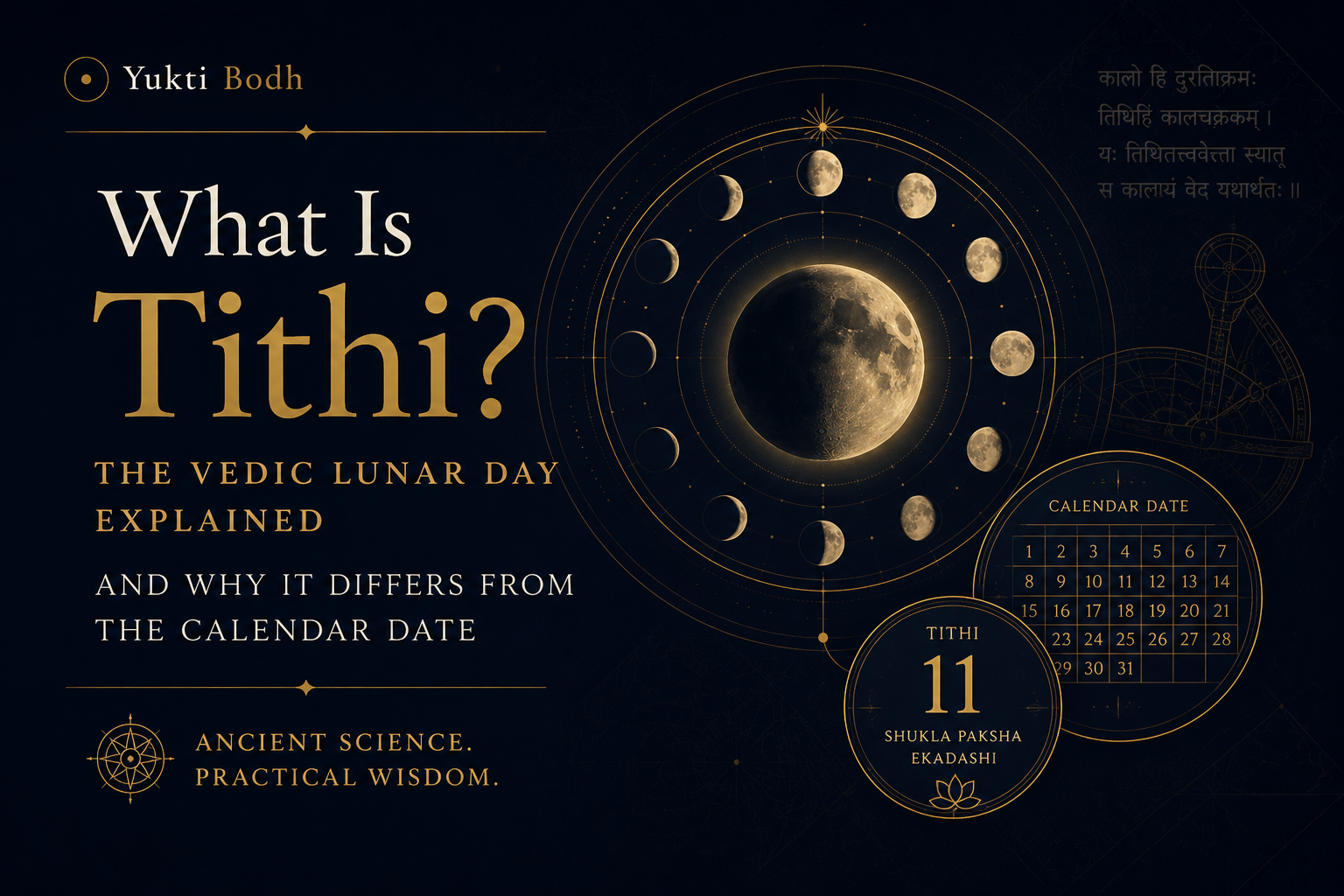
What Is Tithi: The Vedic Lunar Day Explained and Why It Differs from the Calendar Date
Most people who encounter the word Tithi for the first time assume it means the same as a calendar date — just the Indian version. It does not. A Tithi is something fundamentally different from a solar calendar day, calculated by a different method, carrying a completely different quality of meaning.
Understanding what a Tithi actually is changes how you think about time — not as a neutral container in which events happen, but as a structured field with specific qualities that influence the nature and outcome of actions performed within it.
What a Tithi Is
A Tithi is a lunar day — specifically, the time required for the moon to gain exactly 12 degrees on the sun. Since the moon moves faster than the sun through the zodiac, it gains 12 degrees on the sun approximately once per day. The lunar month contains 30 Tithis — 30 intervals of 12 degrees each — covering the full 360 degrees of the moon’s cycle from new moon back to new moon.
This is the critical difference from a solar calendar day: a solar day is defined by the earth’s rotation — exactly 24 hours. A Tithi is defined by the angular relationship between the sun and the moon — which takes a variable amount of time, ranging from approximately 19 to 26 hours depending on the speed of the moon and sun at any given moment.
The practical consequence: a Tithi does not align with a calendar date. A Tithi may begin at 2 AM on Tuesday and end at 11 PM on Tuesday. Or it may begin at 6 PM on Wednesday and end at 4 PM on Thursday, spanning across midnight. A given calendar date may contain parts of two different Tithis, or — rarely, when a Tithi is very short — an entire Tithi may occur within a single calendar date without touching the one before or after it.
The Calculation of Tithi
The calculation is precise. At new moon (Amavasya), the sun and moon are at the same degree — zero degrees of separation. The moon then moves ahead. When the moon is 12 degrees ahead of the sun, the first Tithi (Pratipada) of the waxing fortnight begins. At 24 degrees, the second Tithi (Dwitiya) begins. At 36 degrees, the third (Tritiya). This continues until the moon is 180 degrees ahead of the sun — which is the full moon (Purnima) — and then the waning cycle begins, with the moon continuing to gain on the sun through the next 15 Tithis back to Amavasya.
This 12-degree interval is why there are 30 Tithis: 360 degrees divided by 12 equals 30.
The Tithi governing any given moment is the Tithi that is current at sunrise — the sunrise Tithi is considered the Tithi of that day in the Panchang tradition, though the exact Tithi at any specific hour can be different.
The 30 Tithis and Their Classification
The 30 Tithis are divided between the two fortnights — the Shukla Paksha (waxing, bright fortnight) and Krishna Paksha (waning, dark fortnight) — with 15 Tithis in each.
The 15 Tithis of each fortnight are: Pratipada (1st), Dwitiya (2nd), Tritiya (3rd), Chaturthi (4th), Panchami (5th), Shashthi (6th), Saptami (7th), Ashtami (8th), Navami (9th), Dashami (10th), Ekadashi (11th), Dwadashi (12th), Trayodashi (13th), Chaturdashi (14th), and Purnima or Amavasya (15th — full moon in Shukla, new moon in Krishna).
The Tithis are further classified by quality: Nanda Tithis (1st, 6th, 11th) — joy and celebration; Bhadra Tithis (2nd, 7th, 12th) — auspicious for fixed activities; Jaya Tithis (3rd, 8th, 13th) — victory and conflict; Rikta Tithis (4th, 9th, 14th) — considered inauspicious for beginnings; and Purna Tithis (5th, 10th, 15th) — completeness and full expression.
This classification is directly used in Muhurat selection — certain Tithis are considered auspicious for beginnings, others for specific categories of action, and others are generally avoided for important ventures.
Specific Tithis and Their Significance
Certain Tithis carry special significance in the classical tradition:
Ekadashi (11th Tithi, both Shukla and Krishna) is one of the most sacred Tithis in the Vaishnava tradition — observed as a day of fasting and prayer dedicated to Vishnu. Classical texts recommend avoiding meat, grain, and certain foods on Ekadashi.
Purnima (full moon, 15th Shukla Tithi) is considered broadly auspicious and is the time of maximum lunar energy in the month — the Tithi of highest emotional and mental intensity, used for important rituals and celebrations.
Amavasya (new moon, 15th Krishna Tithi) is the darkest Tithi — considered inauspicious for most activities and auspicious for ancestral worship (Pitru Tarpan), as the veil between the living and the ancestors is considered thinnest at this time.
Chaturdashi (14th Tithi, both fortnights) carries the energy of Shiva in the Krishna Paksha — the night before new moon is Shiva Ratri — and the energy of Kali and Durga in certain ceremonial contexts.
Why Tithi Matters for Daily Life and Muhurat
The Tithi is one of the five elements of the Panchang — Tithi, Vara (day of the week), Nakshatra (lunar mansion), Yoga (sun-moon angular combination), and Karana (half-Tithi). In Muhurat selection, the Tithi is among the most important factors.
Different Tithis are considered appropriate for different categories of action. For marriage, Tithis 2, 3, 5, 7, 10, 11, 13, and the full moon are generally preferred in most regional traditions. For business launches, Tithis 1, 2, 3, 5, 7, 10, 11, and 13 in the Shukla Paksha are typically favoured. Rikta Tithis (4, 9, 14) are generally avoided for new beginnings.
Beyond Muhurat, the Tithi informs the quality of any given day. A practitioner aware of the Tithi can align their activities — beginning things, completing things, resting, worshipping — with the natural quality of the lunar cycle rather than imposing activity against it.
The Tithi restores a dimension of time that the solar calendar has completely removed: the dimension of lunar quality. Time is not neutral. The moon’s relationship to the sun creates a structured field of qualities that changes every day — and the Tithi is the primary map of that field.
The Vedic Moon and Panchang tool on this site shows today’s Tithi automatically, along with its classical significance and the full Panchang. The Muhurat Calculator uses the Tithi as one of its primary inputs when identifying the most auspicious timing for important events and decisions.
[Use the Vedic Moon and Panchang tool →] to see today’s Tithi and understand the quality of the present moment.
★ Try the Tool
Generate your free Vedic birth chart — nakshatra, lagna, planetary positions, and more.
Open Vedic Chart Calculator →