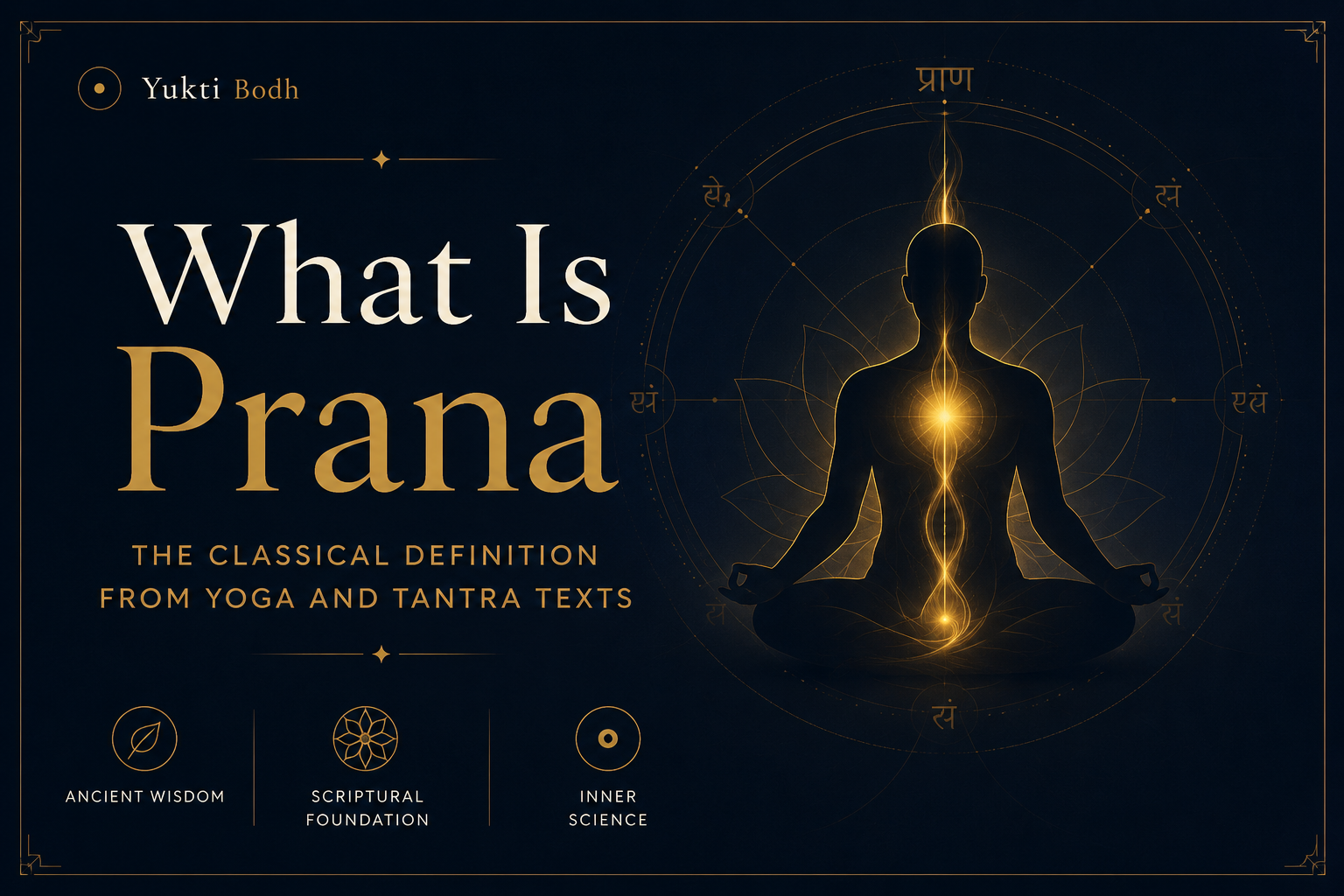
What Is Prana: The Classical Definition from Yoga and Tantra Texts
Prana is one of the most used and most misunderstood words in contemporary wellness culture. It appears on supplement bottles, in yoga class descriptions, in breathwork marketing, and in general conversation as a synonym for life force energy — a vague vitality that can be increased through the right practices and depleted by the wrong ones.
This is not entirely wrong. But it is radically imprecise. The classical Yoga and Tantra texts define Prana with a specificity that transforms the entire understanding of what it is, how it functions, and what practices actually affect it — and how.
The Classical Definition
In the Yoga and Tantric framework, Prana is not a single substance or a general life force. It is the fundamental principle of movement in the universe — the force that animates all activity in both matter and consciousness. The word itself comes from the Sanskrit prefix Pra (before, primary) and the root An (to breathe, to move) — Prana is the primary breath, the first movement, the animating impulse prior to all specific manifestations.
The Hatha Yoga Pradipika defines Prana as that which sustains the life of all living beings: Prana is the life of all living beings; Prana is the life of the mind. This definition is precise in both its scope and its direction — Prana governs not just biological life but the life of the mind, which places it at the intersection of the physical and the psychological.
In Tantric cosmology, Prana is one of the primary manifestations of Shakti — the dynamic, creative power of consciousness. Where Shiva is pure awareness — still, unchanging — Shakti is Prana in its most fundamental form: the movement within consciousness that produces the world. Every vibration, every movement, every change in the cosmos is an expression of Prana-Shakti.
Prana and the Breath: A Critical Distinction
The most common confusion about Prana is its equation with the breath. The breath — Shvasa — is the vehicle of Prana, not Prana itself. The distinction matters enormously for practice.
The classical texts are explicit: Pranayama is not breath control. It is Prana control, for which the breath is the most accessible means. By regulating the breath — its rhythm, duration, direction, and retention — the practitioner indirectly regulates Prana. But Prana is more fundamental than breath. It persists in the subtle body after the physical breath ceases, as in advanced states of meditation and in samadhi. It is present in the food we eat, in water, in sunlight, in the quality of the environment — all of these are sources of Prana, not just the air we breathe.
This distinction explains why the classical Pranayama texts always situate breath practice within a broader framework of living: diet, sleep, the quality of relationships, the environment, moral conduct — all of these affect the Pranic body, not just the breath practices themselves.
The Nadi System: How Prana Moves
Prana does not move randomly through the body. It moves through specific channels called Nadis — tubular pathways in the subtle body through which Prana flows. The classical texts describe 72,000 Nadis, of which three are primary: Ida (left channel, lunar, cooling), Pingala (right channel, solar, heating), and Sushumna (central channel, the path of awakening).
The health of the Nadi system determines the quality of Pranic flow throughout the subtle body. Impure or blocked Nadis restrict Pranic movement, creating the energetic conditions that the classical texts associate with disease, mental agitation, and spiritual stagnation. The primary purpose of Pranayama in the classical framework is Nadi Shuddhi — the purification and clearing of the Nadi system — which is the prerequisite for all higher practice.
The Five Vayus: The Five Forms of Prana
Within the human subtle body, Prana manifests in five primary functional forms called the Pancha Vayus — the five winds or vital airs. Each governs a specific domain of bodily and mental function.
Prana Vayu: Located primarily in the chest and head. Governs inhalation, the intake of experience, the upward and inward movement of energy. Responsible for the reception of food, breath, and sensory experience. When Prana Vayu is strong and clear, there is vitality, receptivity, and clarity of mind.
Apana Vayu: Located in the lower abdomen and pelvis. Governs exhalation, elimination, and the downward and outward movement of energy. Responsible for the elimination of waste — physical, energetic, and experiential. When Apana Vayu is strong, elimination is efficient and the body is clear of accumulation.
Samana Vayu: Located in the navel region. Governs digestion and assimilation — the processing of food, experience, and all forms of input into usable form. Samana balances Prana and Apana, digesting what Prana takes in and preparing what Apana eliminates. Strong Samana means strong digestion at every level.
Udana Vayu: Located in the throat. Governs the upward movement of energy, speech, the expression of consciousness outward, and — at the subtle level — the separation of consciousness from the body at death. Udana is responsible for the quality of speech and for the capacity to ascend in states of meditation.
Vyana Vayu: Pervades the entire body. Governs circulation, distribution, and the integration of all the other Vayus. It is the connective Prana — ensuring that what is received (Prana), processed (Samana), and expressed (Udana) is distributed throughout the system, and that elimination (Apana) occurs properly everywhere.
These five are not theoretical categories. Each has specific practices associated with it, specific signs of imbalance, and specific relationships to diseases and mental states in classical Ayurveda and Yoga.
Five Upa-Pranas: The Secondary Forms
Beyond the five primary Vayus, the classical texts describe five secondary or subsidiary Pranas — the Upa-Pranas. These govern more specific bodily functions: Naga (belching, hiccup), Kurma (blinking and the protection of the eyes), Krikara (sneezing and the protection of the respiratory tract), Devadatta (yawning), and Dhananjaya (governing the heart valves and remaining in the body after death).
These secondary Pranas are less frequently addressed in practice contexts but appear in the classical texts to complete the map of Pranic governance of the body’s functions.
How Prana Is Affected: What the Texts Actually Say
The classical texts are specific about what increases and what depletes Prana — and the list extends well beyond breathing exercises.
Prana is increased by: correct breathing, particularly slow deep diaphragmatic breathing and formal Pranayama; sattvic food (fresh, light, nourishing, prepared with care); adequate, regular sleep; contact with nature, particularly moving water, open sky, and living plants; mantra — sound vibration that resonates with Pranic patterns; and sustained ethical living — the texts consistently note that dishonesty, cruelty, and excessive sensory indulgence deplete Prana regardless of how many breathing exercises are performed.
Prana is depleted by: excessive or irregular breathing; overeating or eating heavy, processed, or stale food; sleep deprivation or excessive sleep; excessive talking, particularly gossip and conflict; overexertion; excessive sexual activity without regulation; and prolonged states of fear, anger, or grief.
This comprehensive picture — Prana as something affected by the totality of how one lives — explains why the classical texts always situate Pranayama within a broader system of practice and ethical living (the Yamas and Niyamas of Patanjali’s Yoga Sutras, the Shatkarmas of the Hatha Yoga tradition) rather than as a standalone technique.
Prana is not a vague energy concept. It is the most fundamental organising principle of the subtle body — the force through which consciousness acts in matter, and through which matter becomes available to consciousness. Understanding it correctly transforms Pranayama from a breathing technique into a complete science of subtle physiology.
The free Pranayama Guide on this site offers six major Pranayama practices with visual breathing animations and classical instruction — each one a direct tool for working with the specific Vayus and Nadi pathways described in this article. The Subtle Body Complete Guide provides the full traditional map of Koshas, Nadis, and the Pranic system in one comprehensive resource.
[Use the Pranayama Guide →] to begin working with Prana directly through the classical breath practices.
◎ Try the Tool
Find which chakras are balanced, blocked, or overactive with our free diagnostic.
Open Chakra Diagnostic →