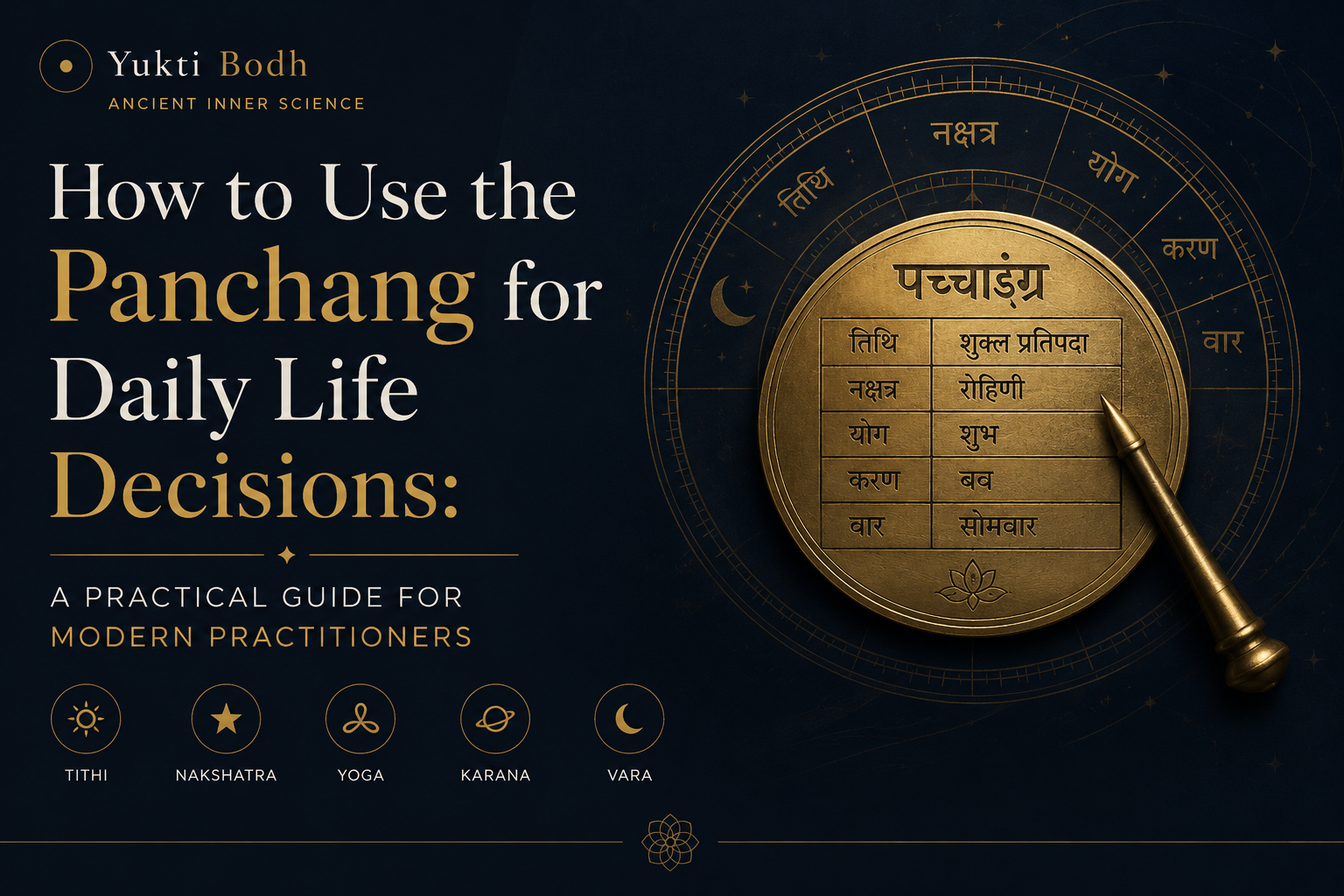
How to Use the Panchang for Daily Life Decisions: A Practical Guide for Modern Practitioners
The Panchang is one of the most underused practical tools available to anyone living within or interested in the Vedic tradition. Most people know the Panchang exists — it is consulted for weddings, for new home entries, for business launches. But in the classical tradition, the Panchang was a daily tool — a map of the quality of every day, used to make intelligent choices about when to act, when to wait, and when to practise.
You do not need to be a Jyotishi to use the Panchang meaningfully. You need to understand its five elements, know the basic guidelines for each, and develop the habit of checking it as you would check the weather. This article is that practical guide.
The Daily Check: What to Look At First
Begin with three things each morning:
The Tithi — which lunar day is it? Is it in the Shukla Paksha (waxing) or Krishna Paksha (waning)? Is it a Rikta Tithi (4th, 9th, or 14th) — if so, avoid beginning important new activities today. Is it a broadly auspicious Tithi — Panchami, Saptami, Dashami, Ekadashi in the Shukla Paksha — if so, the day is naturally supportive of important beginnings.
The Nakshatra — which lunar mansion is the moon in today? Is it a Deva Gana Nakshatra (broadly harmonious) or a Rakshasa Gana Nakshatra (intense, competitive)? Is it Pushya — if so, the day is among the most auspicious of the month. Is it Mula, Ardra, or Ashlesha — if so, approach the day with more care.
The Vara — what day of the week is it? Monday and Thursday are broadly auspicious. Tuesday and Saturday carry the energies of Mars and Saturn respectively and require more care for delicate new beginnings.
These three checks take sixty seconds and immediately orient the quality of the day. The Vedic Moon and Panchang tool on this site provides all three at a glance, updated automatically each day.
Inauspicious Periods: Rahu Kala, Yamaganda, and Gulika
Within each day, there are specific periods considered inauspicious for beginning important activities — regardless of the overall Panchang quality. These are Rahu Kala, Yamaganda Kala, and Gulika Kala.
Rahu Kala is an approximately 90-minute period each day governed by Rahu — the shadow planet of obscuration and instability. It falls at different times each day of the week. For Sunday: the 8th period (approximately 4:30-6:00 PM). For Monday: the 2nd period (approximately 7:30-9:00 AM). For Tuesday: the 7th period (approximately 3:00-4:30 PM). For Wednesday: the 5th period (approximately 12:00-1:30 PM). For Thursday: the 6th period (approximately 1:30-3:00 PM). For Friday: the 4th period (approximately 10:30 AM-12:00 PM). For Saturday: the 3rd period (approximately 9:00-10:30 AM). The exact times vary with sunrise in your location.
Classical advice: do not begin important new activities during Rahu Kala. This includes signing contracts, beginning journeys, launching businesses, or making major decisions. Completing ongoing tasks, routine work, and personal practice during Rahu Kala is generally unaffected.
Yamaganda and Gulika Kala are similar inauspicious daily periods governed by Saturn’s influence — their avoidance is particularly important in South Indian Muhurat traditions.
Using the Panchang for Major Decisions
For significant life decisions — marriage timing, business launch, home entry, travel for important purposes — the Panchang provides the framework, but the full Muhurat calculation goes beyond the daily check.
A proper Muhurat assesses: the Tithi (is it auspicious for this category of event?), the Nakshatra (does it support the type of activity?), the Vara (is the weekday appropriate?), the Yoga (is the Panchangic Yoga auspicious?), the Karana (is Bhadra/Vishti Karana absent from the chosen time window?), and the Lagna of the moment (is the rising sign at the chosen time auspicious for the event?).
The Muhurat Calculator on this site handles this full calculation for the most common categories of important life events — Griha Pravesh, Vivah (marriage), Vyapar Aarambh (business launch), Vaahan Puja (vehicle worship), Yatra (auspicious travel) — providing the reasoning behind each recommendation.
For events where no pre-built Muhurat category applies, the daily Panchang check remains the most accessible practical tool: choose a day with auspicious Tithi and Nakshatra, in Shukla Paksha if possible, and time the specific action outside Rahu Kala.
The Panchang and Spiritual Practice
Beyond timing external decisions, the Panchang is a guide for aligning inner practice with the natural energetic cycle.
Ekadashi — the 11th Tithi of both fortnights — is the classical fasting and prayer day in the Vaishnava tradition. Observing even a partial fast on Ekadashi and dedicating the day to Japa, meditation, or study is one of the most accessible and deeply rooted Panchang practices available.
Pradosha — the twilight of the 13th Tithi (Trayodashi), both Shukla and Krishna — is dedicated to Shiva and Parvati. Shiva puja during the Pradosha period (approximately 90 minutes after sunset on these days) is considered highly auspicious in the Shaivite tradition.
Purnima and Amavasya (the 15th Tithis of each fortnight) call for heightened practice — extended meditation, Japa, ancestral offerings at Amavasya, full moon sitting at Purnima.
The Nakshatra of each day suggests the quality of practice most supported: Pushya days for devotional practice, Hasta days for detailed skill-based work, Rohini days for creative and beauty-related practice, Shravana days for study and listening.
Simply aligning these monthly and daily rhythms — choosing when to fast, when to intensify practice, when to rest — with the Panchang creates a noticeably different quality of inner life over time. The practice feels supported rather than arbitrary.
A Simple Weekly Panchang Practice
For the practitioner who wants to begin using the Panchang without overwhelming complexity, here is a simple weekly structure:
Each morning: Check the Tithi, Nakshatra, and Vara. Note whether the day is broadly auspicious or requires care.
For important activities: Check the Rahu Kala for the day and schedule important actions outside that window.
On Ekadashi: Fast partially or fully. Increase Japa or meditation. Avoid beginning new ventures.
On Purnima: Sit in meditation at moonrise if possible. Fast during the day or eat lightly. Engage in extended Japa.
On Amavasya: Perform Pitru Tarpan if this is part of your practice. Fast. Use the day for completion and inner reflection rather than new beginnings.
This minimal structure — five or six points of Panchang alignment per month — produces a noticeable difference in the quality of practice and the sense of being in rhythm with natural time rather than moving against it.
The Panchang is not a superstition. It is a sophisticated mapping of time — the product of millennia of careful observation of the relationship between celestial cycles and human experience. Using it practically does not require becoming a scholar. It requires only the habit of daily awareness and the willingness to work with the quality of time rather than against it.
The Vedic Moon and Panchang tool on this site provides the full Panchang every day — Tithi, Nakshatra, Paksha, Yoga, and practice guidance — automatically updated and free to use at any time. The Muhurat Calculator applies the full five-limb assessment to important life decisions.
[Use the Vedic Moon and Panchang tool →] and [Use the Muhurat Calculator →] to begin working with the Panchang practically today.
★ Try the Tool
Generate your free Vedic birth chart — nakshatra, lagna, planetary positions, and more.
Open Vedic Chart Calculator →