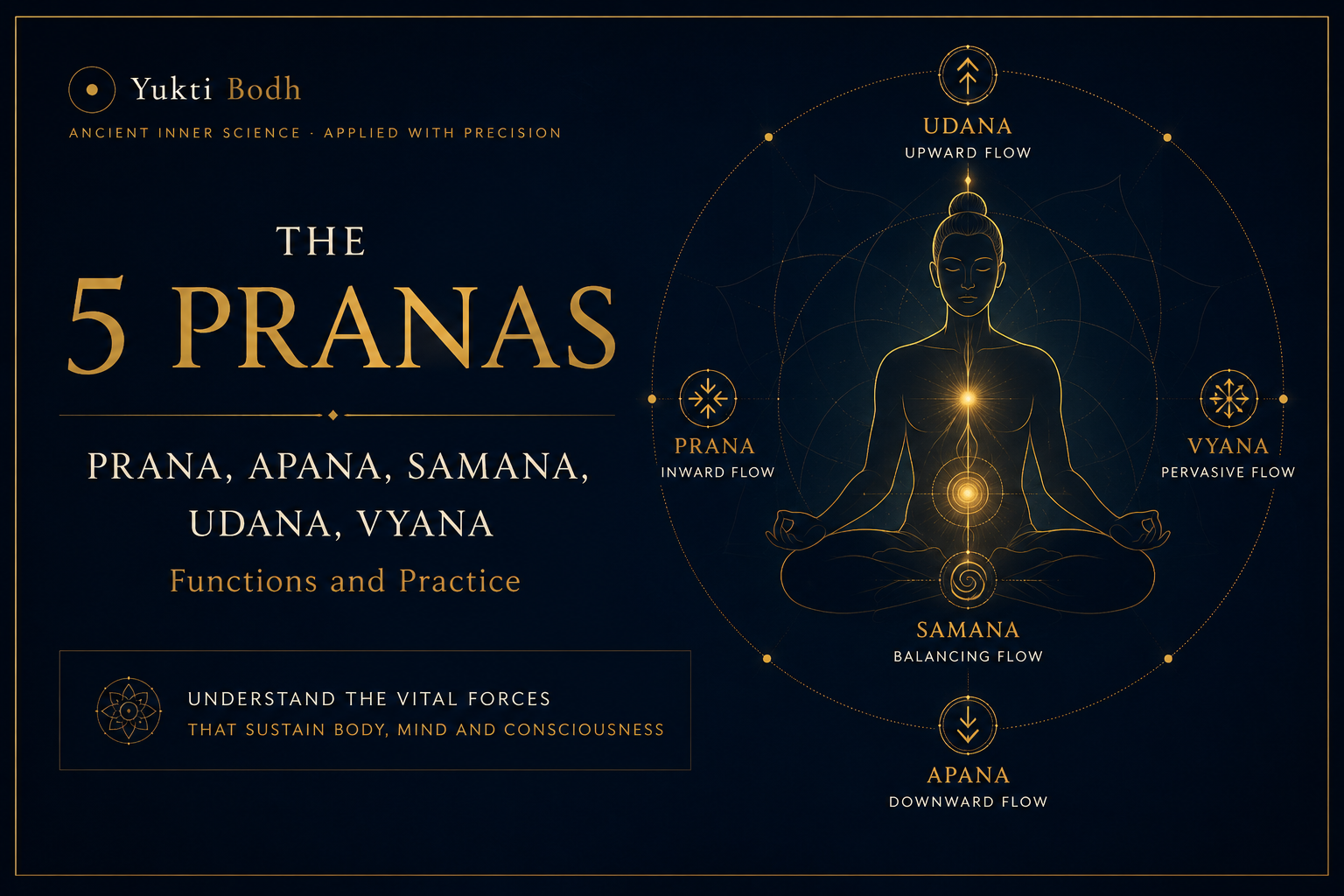
The 5 Pranas: Prana, Apana, Samana, Udana, Vyana — Functions and Practice
The five Vayus — the five winds or vital airs — are one of the most practically useful frameworks in the entire classical Yoga system. They are not abstract philosophical categories. They are functional descriptions of the five primary directions and patterns through which Prana organises itself in the human subtle body.
Understanding the five Vayus changes the relationship to every physical sensation, every health condition, and every breathwork practice — because each of these is an expression of one or more of the five fundamental Pranic patterns. When you understand which Vayu governs which function, you can work precisely: identifying which Pranic pattern is disturbed and applying the appropriate practice to restore it.
Prana Vayu: The Inward-Moving Force
Location: chest, heart, lungs, head. Direction: inward and upward — specifically, the movement from the periphery toward the centre, from the outside to the inside.
Function: Prana Vayu governs all forms of reception and intake. Inhalation — the intake of breath — is its most obvious expression. But its governing function extends to all forms of reception: the intake of food (from the mouth to the stomach), the intake of sensory experience through all the senses, the reception of mental impressions, and the capacity to receive and absorb knowledge.
At the gross physical level, Prana Vayu governs the respiratory and cardiac systems. Weak Prana Vayu manifests as shortness of breath, poor cardiovascular circulation, difficulty concentrating, and a reduced capacity to absorb nourishment from food and experience.
Practice for Prana Vayu: deep diaphragmatic inhalation; chest-opening postures; Nadi Shodhana with emphasis on the quality of the inhalation; being in natural environments — open air, near moving water — where Pranic quality is highest. Mantra Japa, which opens the practitioner to receive the mantra’s vibration, is also a Prana Vayu practice.
Apana Vayu: The Downward-Moving Force
Location: lower abdomen, pelvis, base of the spine. Direction: downward and outward — the movement from the centre to the periphery, from inside to outside, from above to below.
Function: Apana Vayu governs all forms of elimination and release. The elimination of waste from the colon, the excretion of urine, the downward movement of menstruation, the expulsion of the foetus at birth, and the exhalation of breath — these are all expressions of Apana Vayu.
At the psychological level, Apana Vayu governs the capacity to release: to let go of experiences, emotions, memories, and attachments that have been processed and no longer serve. When Apana Vayu is weak, there is accumulation — of physical waste, of unprocessed emotion, of old patterns that cannot be released.
In the classical Tantric framework, Apana Vayu is also associated with the downward flow of Prana that keeps Kundalini Shakti dormant at Muladhara. The practices of Moola Bandha (root lock) and Ashwini Mudra (anal contractions) reverse Apana’s downward flow, directing it upward to meet the inward-moving Prana Vayu at Manipura — creating the conditions for the awakening of Kundalini.
Practice for Apana Vayu: Moola Bandha; Ashwini Mudra; squatting postures that engage the pelvic floor; Kapalabhati (the forced exhalation is an Apana Vayu practice at the respiratory level); dietary practices that support elimination — adequate water, fibre, and movement.
Samana Vayu: The Equalising Force
Location: navel region, small intestine. Direction: outward from the centre in all directions simultaneously — the centrifugal distribution of what has been received and processed.
Function: Samana Vayu governs digestion and assimilation. It is the fire of processing — receiving what Prana Vayu has brought in, breaking it down, assimilating what is useful, and preparing the residue for elimination by Apana Vayu. At the gross level, it governs the digestive fire (Jatharagni) and the assimilation of nutrients. At the subtle level, it governs the assimilation of experience — the processing of sensory, emotional, and intellectual material into integrated understanding.
Samana Vayu is located at Manipura — the solar plexus chakra. Its association with fire, with the capacity to transform, and with personal power reflects this shared location. A strong Samana means strong digestion at every level of experience.
Practice for Samana Vayu: Agni Sara (abdominal pumping); Nauli (abdominal rotation); Uddiyana Bandha (upward abdominal lock); Kapalabhati (which stimulates Samana through abdominal compression); regular meal timing (eating at consistent times trains Samana to produce Agni reliably); avoiding food combining errors that confuse the digestive system.
Udana Vayu: The Upward-Moving Force
Location: throat, head, upper extremities. Direction: upward — the movement from below to above, from the physical to the subtle, from the individual to the universal.
Function: Udana Vayu governs upward expression and ascent. Speech — the expression of consciousness from within outward and upward — is its most immediate manifestation. The quality of speech, the capacity for sustained clear expression, and the health of the throat and vocal apparatus are all governed by Udana.
At the subtle level, Udana Vayu governs the ascent of consciousness in meditation — the movement of awareness from the lower chakras upward toward Ajna and Sahasrara. It also governs the process of death — the classical texts describe Udana as the Vayu responsible for separating the subtle body from the physical body at death and directing it upward.
Jalandhara Bandha — the throat lock — directly regulates Udana Vayu. By contracting the throat and chin toward the sternum, Jalandhara arrests the upward movement of Prana and directs it through the Sushumna rather than allowing it to escape through the upper openings.
Practice for Udana Vayu: Jalandhara Bandha; Ujjayi Pranayama (the victorious breath, which creates an audible sound in the throat through slight glottal constriction); singing and sustained toning; postures that open the throat and neck; Vishuddha chakra meditation.
Vyana Vayu: The Pervasive Force
Location: entire body — Vyana pervades every cell, every tissue, every space in the body simultaneously. Direction: outward in all directions from every point — the centrifugal force of distribution and integration.
Function: Vyana Vayu governs circulation, distribution, and coordination. It is the connective Prana — ensuring that the Prana received by Prana Vayu, processed by Samana Vayu, expressed by Udana Vayu, and released by Apana Vayu is distributed throughout the system appropriately. The circulatory system — heart and blood vessels — is the gross physical expression of Vyana. The nervous system’s coordinating function is Vyana at the neurological level.
When Vyana Vayu is strong, there is systemic integration — the body functions as a coherent whole, all its systems communicating effectively. When Vyana is weak, there is fragmentation: poor circulation, lack of coordination, the sense of being disconnected from different parts of the body or different aspects of experience.
Practice for Vyana Vayu: vigorous physical movement that increases circulation; full-body yogic postures (particularly standing and balancing postures that require the whole body to coordinate); Shavasana (complete relaxation that allows Vyana to redistribute evenly after practice); whole-body massage; being in nature where Pranic distribution is most harmonious.
Working with the Five Vayus in Practice
The most practical application of the five Vayu framework is in identifying which Pranic pattern is disturbed in any given condition and applying the appropriate corrective practice.
Feeling scattered, unable to concentrate, difficulty receiving input or nourishment: Prana Vayu is weak. Increase deep inhalation practices, be in natural environments, reduce sensory overload.
Feeling accumulated — physically constipated, emotionally stuck, unable to release the past: Apana Vayu is weak. Increase Moola Bandha practice, Kapalabhati, and physical practices that engage the lower body and pelvic floor.
Poor digestion, inability to process experience, feeling overwhelmed by accumulated input: Samana Vayu is disturbed. Increase abdominal practices, regulate mealtimes, practise Agni Sara.
Difficulty with speech and expression, throat conditions, feeling unable to ascend in meditation: Udana Vayu is disturbed. Increase Jalandhara Bandha, Ujjayi, and singing or toning practices.
Poor circulation, lack of body-mind coordination, feeling fragmented: Vyana Vayu is disturbed. Increase physical movement, full-body yoga, and ensure sufficient rest for redistribution.
The five Vayus are the most immediately practical framework the classical tradition offers for understanding the relationship between specific physical, psychological, and energetic conditions — and the practices most directly suited to addressing each.
The Subtle Body Complete Guide on this site covers the five Vayus in their full context alongside the Koshas, Nadis, chakras, and the complete traditional subtle body map. The Pranayama Guide provides the breath practices that directly work with each Vayu — Kapalabhati for Apana and Samana, Nadi Shodhana for Prana, Ujjayi for Udana, and the full retention practices for Vyana integration.
[Get the Subtle Body Complete Guide →] for the full classical map of the Pranic body and the practices that work with each dimension.
◎ Try the Tool
Find which chakras are balanced, blocked, or overactive with our free diagnostic.
Open Chakra Diagnostic →