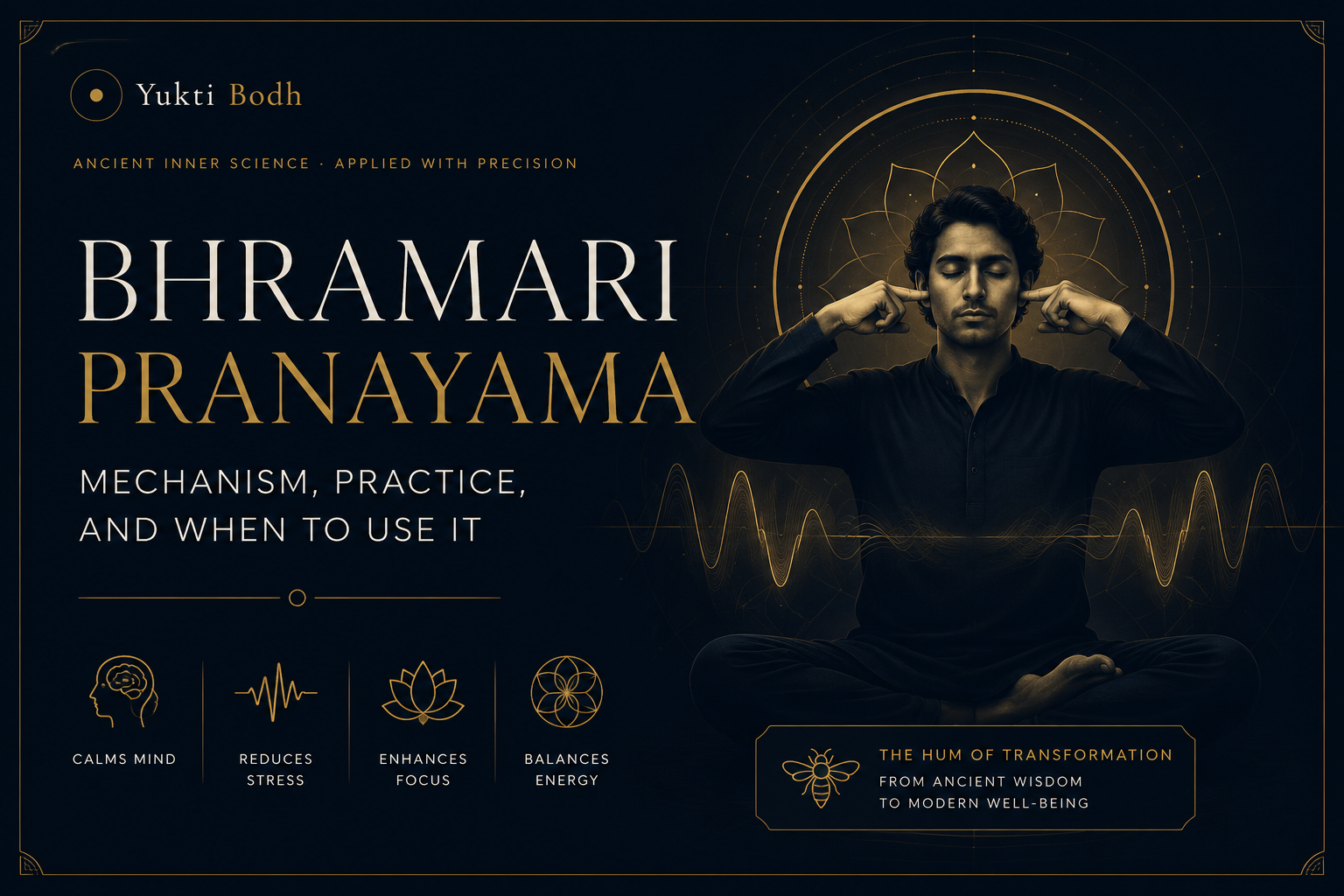
Bhramari Pranayama: Mechanism, Practice, and When to Use It
Of all the Pranayamas described in the classical texts, Bhramari is perhaps the most immediately and consistently effective for calming the mind. Its effects are rapid, gentle, and not dependent on the level of practice development — a first-time practitioner sitting with Bhramari for five minutes often experiences a quality of stillness that would otherwise require considerably more sophisticated practice.
Understanding why it works — not just that it works — allows you to use it with greater precision and to integrate it intelligently into a broader practice framework.
The Name and Classical Description
Bhramari takes its name from the black Indian bee — Bhramara in Sanskrit. The humming sound produced during the exhalation resembles the sound of a bee’s drone. The Hatha Yoga Pradipika describes the practice in a single verse: inhaling speedily, making a sound like a male bee (Bhringi), and exhaling slowly, making a sound like a female bee (Bhramari). The Gheranda Samhita is slightly more detailed, adding the instruction to press the ears closed with the thumbs and to concentrate on the inner sound.
The Shanmukhi Mudra — the six-gate gesture — is often used with Bhramari: the thumbs close the ear canals, the index fingers rest gently on the closed eyelids, the middle fingers touch the sides of the nose without closing it, and the ring and little fingers rest above and below the lips. This gesture closes the six sensory openings of the head (two ears, two eyes, two nostrils partly) and directs awareness entirely inward.
The Mechanism: Why Bhramari Works
Bhramari works through several simultaneous mechanisms, each reinforcing the others.
The humming vibration directly stimulates the vagus nerve — the primary parasympathetic nerve of the body — through the vibration it produces in the pharynx, larynx, and surrounding tissues. The vagus nerve is the primary pathway for parasympathetic activation, and its stimulation produces the characteristic calming effect of Bhramari: reduced heart rate, lowered blood pressure, decreased cortisol, and a shift from sympathetic (fight-flight) to parasympathetic (rest-digest) nervous system dominance.
The extended exhalation inherent in Bhramari — the humming is sustained on a long, slow exhale — activates the respiratory vagal reflexes that signal safety to the nervous system. Whenever exhalation is longer than inhalation, the parasympathetic system is preferentially activated. Bhramari’s naturally prolonged exhale makes this activation particularly pronounced.
The humming vibration creates a specific resonance in the sinuses and nasal passages that stimulates the production of nitric oxide — a molecule with vasodilatory, antimicrobial, and neurological functions. Research has shown that humming increases nasal nitric oxide production by approximately fifteen-fold compared to normal breathing. This is part of the physiological basis for Bhramari’s classically described effects on the sinuses and respiratory system.
The inner sound produced — particularly with Shanmukhi Mudra — becomes an object of concentrated awareness. The Nada (inner sound) produced by Bhramari bridges the gap between external sound practice (mantra) and the inner sound meditation of classical Nada Yoga. Concentrating on the Bhramari sound draws the mind inward and provides a natural object for Dharana — the beginning of formal meditation.
The Correct Practice
Sit in a comfortable, erect posture. Apply Shanmukhi Mudra if using it, or simply close the eyes and allow the hands to rest in the lap.
Take a natural inhalation through both nostrils — neither forced nor particularly deep. As you exhale, produce a steady, smooth humming sound from the throat. The hum should be continuous throughout the entire exhalation, neither too loud nor too soft. The sound resonates in the face, skull, and chest. Feel the vibration rather than listening to it from the outside.
At the end of the exhalation, release Shanmukhi Mudra if using it, and take the next natural inhalation. Reapply the Mudra as you begin the next exhalation hum.
Begin with seven rounds. Progress to eleven, then twenty-one over weeks. Some practitioners do Bhramari for extended periods — the Gheranda Samhita describes extended Bhramari practice as one of the approaches to Samadhi.
Nada Yoga and Bhramari: The Inner Sound Connection
Classical Nada Yoga — the yoga of sound — teaches that there is a progression of inner sounds that a practitioner can access as the subtle body purifies and the mind becomes more concentrated. These sounds — described in the Hatha Yoga Pradipika as ranging from chirping and tinkling to the sound of a flute, a vina, drums, bells, and ultimately the sound of the ocean and thunder — are called the Anahata Nada, the unstruck sound.
Bhramari is described in some texts as a direct bridge to Nada Yoga practice. The outer hum of Bhramari trains the practitioner to listen inward — to follow the sound as it moves from external to internal. After extended Bhramari practice in a sitting, some practitioners find that when the humming stops and the mouth is closed, a subtle inner resonance continues — the Nada beginning to be perceptible.
This is not imagination. It is the beginning of the inner sound experience that the classical texts describe as one of the markers of significant Nadi purification.
When to Use Bhramari: Specific Applications
Bhramari is one of the most versatile Pranayamas for specific situational application.
Before meditation: Bhramari rapidly stills the mind and withdraws the senses (Pratyahara) — making it an ideal bridge practice between the activities of daily life and formal sitting meditation. Seven to eleven rounds before meditation consistently deepens the subsequent sitting.
For anxiety and acute stress: the rapid vagal activation of Bhramari makes it one of the most effective emergency calming tools available. Even three to five rounds of Bhramari in the midst of anxiety produces a measurable shift in physiological arousal.
For insomnia: practised lying down in the dark, Bhramari with extended exhalation is one of the most effective natural sleep-induction techniques. The parasympathetic activation and sensory withdrawal combine to create the physiological conditions for sleep onset.
For headaches: the vibration and the stimulation of nasal nitric oxide production often relieve tension headaches. The classical texts specifically recommend Bhramari for conditions of the head and sinuses.
For singers and speakers: the regular practice of Bhramari strengthens and clarifies the voice, improves breath control for sustained speech, and reduces the effects of vocal fatigue.
Bhramari is a gift from the classical tradition — one of the few practices that is simultaneously highly effective, immediately accessible, and suitable for virtually every practitioner regardless of level or physical condition.
The free Pranayama Guide on this site includes Bhramari with visual breathing animation and classical instruction. The free Meditation Timer provides the structured silent sitting that Bhramari practice prepares the mind for.
[Use the Pranayama Guide →] to practise Bhramari with visual guidance and begin building the inner sound foundation.
◎ Try the Tool
Find which chakras are balanced, blocked, or overactive with our free diagnostic.
Open Chakra Diagnostic →