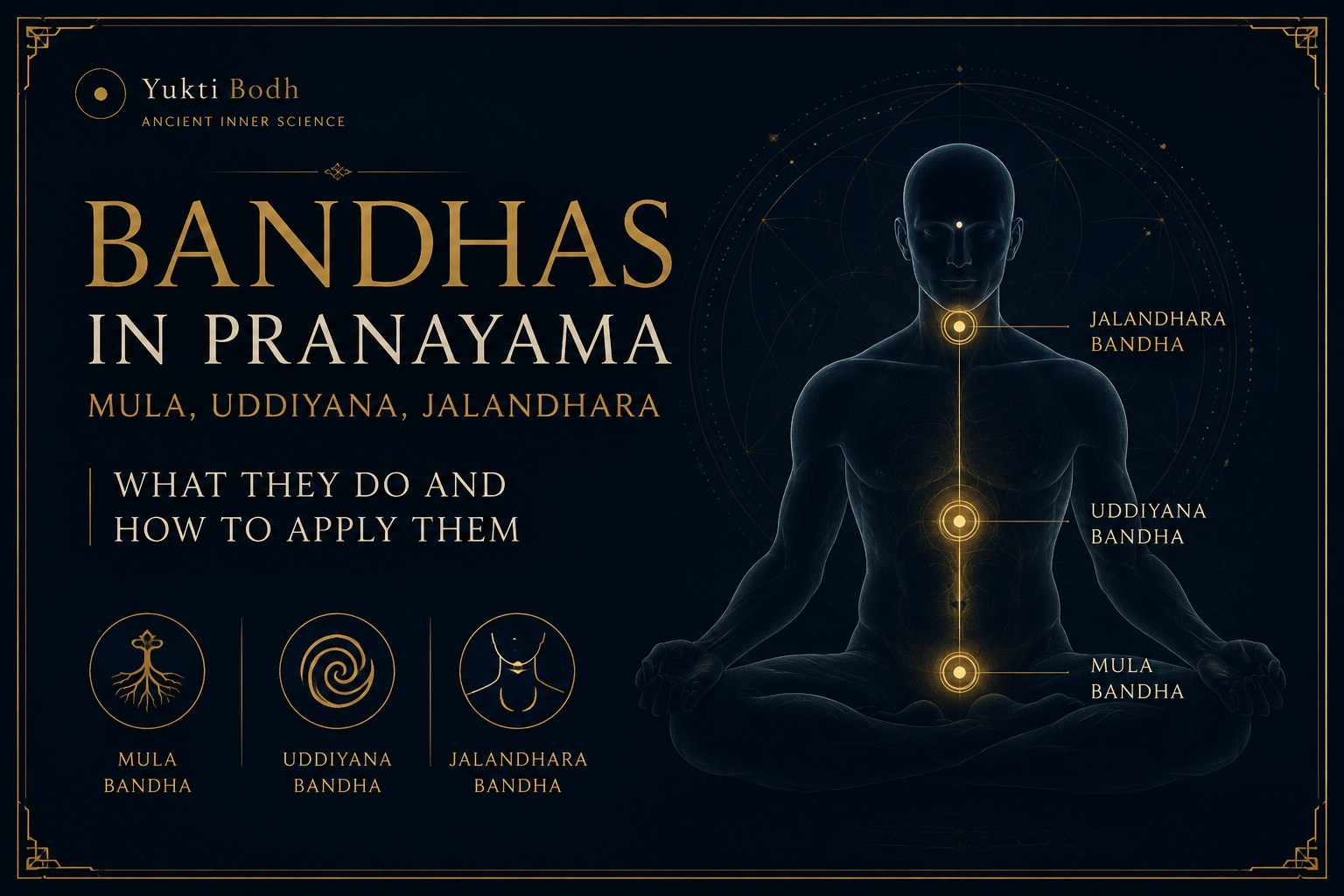
Bandhas in Pranayama: Mula, Uddiyana, Jalandhara — What They Do and How to Apply Them
Bandha means lock or bond in Sanskrit. In the context of Pranayama, the three primary Bandhas — Mula Bandha, Uddiyana Bandha, and Jalandhara Bandha — are specific muscular contractions that seal and redirect the flow of Prana within the subtle body, preventing its escape through the lower, upper, and lateral openings and directing it into the Sushumna Nadi.
The Bandhas are not optional additions to an advanced practice. In the classical framework, they are the mechanism by which Pranayama moves from respiratory exercise to genuine Pranic direction. Without the Bandhas, Kumbhaka (breath retention) is a physiological event — the breath is held. With the Bandhas applied correctly during Kumbhaka, it becomes a Pranic event — the energy is held, contained, and directed.
The Function of the Three Bandhas
The classical texts describe the three Bandhas as sealing three specific openings through which Prana escapes: Mula Bandha seals the lower opening — the base of the spine and perineum, the gateway through which Apana Vayu naturally flows downward and outward. Jalandhara Bandha seals the upper opening — the throat, through which Prana and Udana Vayu escape upward. Uddiyana Bandha seals the middle — drawing the abdominal region upward and inward, containing Samana Vayu and preventing the dissipation of the central Pranic fire.
When all three Bandhas are applied simultaneously — called Maha Bandha or the great lock — the Prana is completely sealed within the subtle body. The pressure created by this sealing, combined with the concentrated awareness of the practitioner, is the classical mechanism for driving Prana into the Sushumna and initiating the conditions for Kundalini awakening.
Mula Bandha: The Root Lock
Mula means root. Mula Bandha is the contraction of the muscles of the pelvic floor — specifically, the perineal body (the central tendon of the perineum) and the muscles of the pubococcygeal region.
The classical instruction is precise: the contraction is not of the anal sphincter (which is Ashwini Mudra, a preparatory practice) but of the perineum itself — the muscular point between the genitals and the anus. The contraction is firm but not forced — a lifting and drawing inward at the base of the pelvis.
In Hatha Yoga, Mula Bandha is applied during Kumbhaka (breath retention) after inhalation. It prevents Apana Vayu from continuing its natural downward flow and redirects it upward through the central channel. This reversal of Apana — its meeting with Prana Vayu in the navel region — is described as the ignition of the inner fire that is the energetic precondition for Kundalini movement.
At the physiological level, Mula Bandha engages the deep pelvic floor muscles, which support the pelvic organs and maintain healthy pressure relationships within the abdominal cavity. Regular Mula Bandha practice strengthens the pelvic floor, improves continence, and supports the health of the reproductive and eliminatory systems.
Uddiyana Bandha: The Upward Lock
Uddiyana means flying upward. Uddiyana Bandha is the forceful retraction of the abdominal wall upward and inward, creating a deep concavity in the abdomen as the diaphragm rises.
Uddiyana Bandha is practised on external Kumbhaka — after a complete exhalation, with the breath out. The exhalation empties the lungs, and the subsequent upward retraction of the abdomen creates a strongly negative pressure in the thoracic cavity, drawing the diaphragm up into the chest cavity and the abdominal organs upward.
The effect on the abdominal organs is vigorous: the liver, stomach, and intestines are compressed and massaged. The mesenteric blood is expressed, and fresh blood enters when the Bandha is released. This churning action is considered one of the most powerful techniques for strengthening the digestive fire and removing abdominal accumulation.
At the Pranic level, Uddiyana draws Apana Vayu and Samana Vayu upward — toward the heart and head — reinforcing the upward movement of Prana that the Bandha system is designed to create. The upward suction of Uddiyana is described as one of the most direct techniques for aging reversal and the preservation of vitality in the classical texts.
Caution: Uddiyana Bandha should not be practised during pregnancy, during menstruation, by those with hernia, or by those with uncontrolled high blood pressure.
Jalandhara Bandha: The Throat Lock
Jalandhara comes from Jala (net or web) and Dhara (stream or flow). The throat lock — produced by bringing the chin toward the sternum while the sternum rises toward the chin — creates the compression of the throat region that seals the upper opening through which Prana and Udana Vayu escape.
Jalandhara is applied during internal Kumbhaka — after inhalation. With the breath retained and Mula Bandha applied at the base, Jalandhara closes the top of the system. The Prana, contained between the two Bandhas, is held within the trunk of the body and directed into the Sushumna.
Physiologically, Jalandhara compresses the carotid sinuses in the neck — the baroreceptors that regulate blood pressure and heart rate. This compression produces a reflex slowing of the heart and a reduction in blood pressure, which is the physiological basis for the calming effect that Kumbhaka with Jalandhara produces.
The classical texts also describe Jalandhara as preventing the Amrita — the nectar produced by the soma centre above the palate — from dripping downward into the fire of Manipura, where it would be consumed. By catching the Amrita at the throat, Jalandhara is associated with the classical practice of extending life and preserving vitality.
Maha Bandha: All Three Together
Maha Bandha — the great lock — is the application of all three Bandhas simultaneously, typically during internal Kumbhaka after inhalation. Mula Bandha seals the base. Jalandhara seals the top. Uddiyana (in its gentler form during internal Kumbhaka, rather than the external Kumbhaka version) draws the centre inward.
The experience of Maha Bandha with developed concentration is described in the classical texts as one of the most direct methods for directing Prana into the Sushumna — producing the distinctive internal pressure, heat, and upward movement of energy that is the energetic precursor to the experiences described in the context of Kundalini awakening.
Maha Bandha should be approached gradually — establishing each individual Bandha separately in practice before combining them. The combination requires a degree of breath control and body awareness that develops only through consistent prior practice.
The Bandhas transform Pranayama from a respiratory practice into a genuine Pranic direction system. They are the mechanism through which the classical system creates the internal conditions for the higher stages of practice — and they are among the most powerful tools available for physical health, mental clarity, and energetic development.
The free Pranayama Guide on this site covers the breath practices with which the Bandhas are most commonly combined — Nadi Shodhana, Kapalabhati, and Ujjayi. The Subtle Body Complete Guide provides the full map of the Pranic body within which the Bandha system operates.
[Use the Pranayama Guide →] to develop the breath foundation for Bandha practice.
◎ Try the Tool
Find which chakras are balanced, blocked, or overactive with our free diagnostic.
Open Chakra Diagnostic →