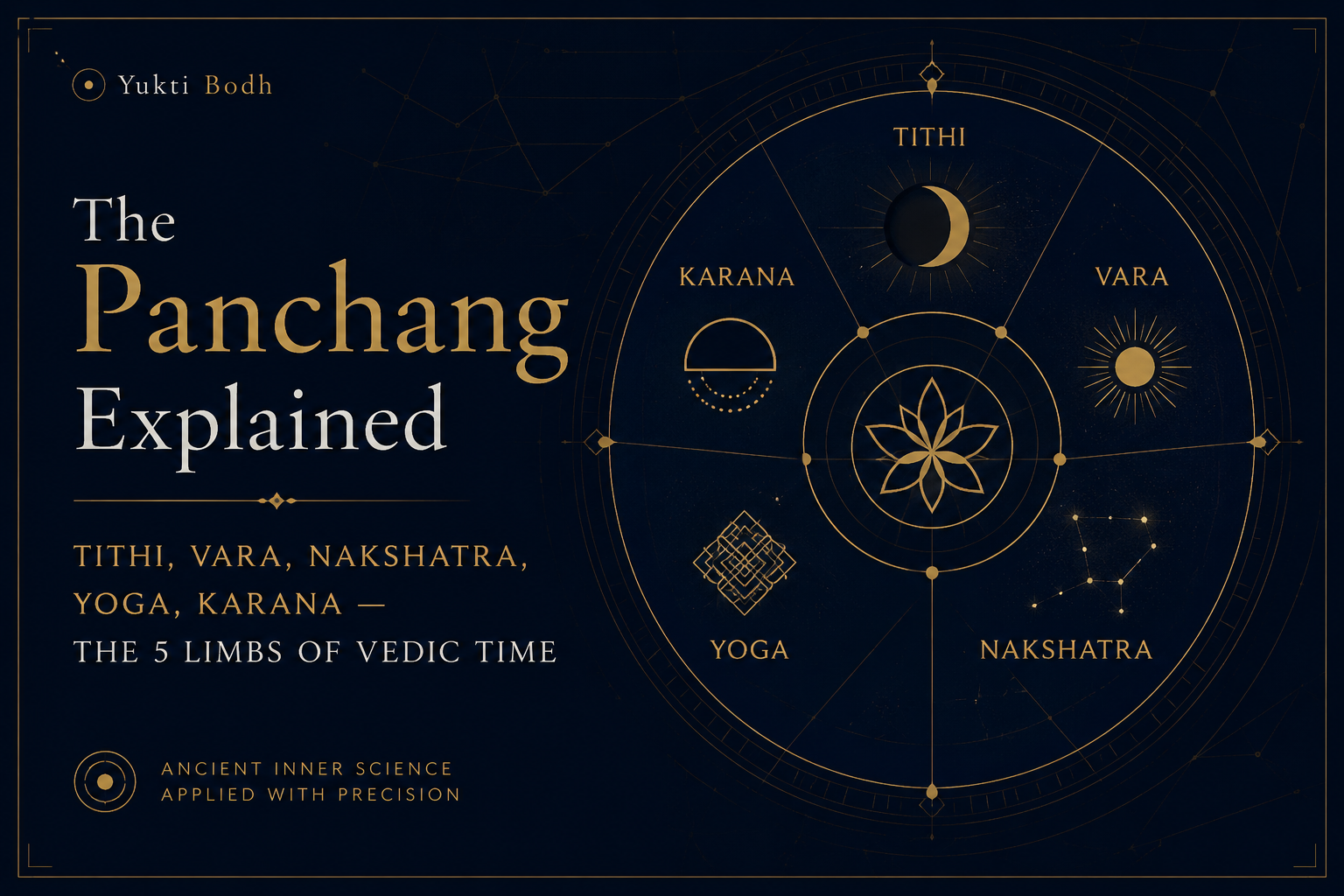
The Panchang Explained: Tithi, Vara, Nakshatra, Yoga, Karana — The 5 Limbs of Vedic Time
The word Panchang comes from the Sanskrit Pancha (five) and Anga (limb). The Panchang is literally the five-limbed body of time — the five elements that together constitute a complete description of the quality of any given moment in the Vedic framework.
The Panchang is not a calendar. A calendar tells you where you are in linear time — what day, month, and year. The Panchang tells you the quality of the moment — the specific configuration of lunar, solar, and planetary energies that govern that day, that hour, and that decision.
Every Muhurat calculation, every auspicious timing selection, every daily practice alignment in the Vedic tradition begins with the Panchang. Understanding the five elements is understanding the language of Vedic time.
The First Limb: Tithi — The Lunar Day
Tithi is the lunar day — the time required for the moon to gain 12 degrees on the sun. As detailed in a previous article on this site, there are 30 Tithis in a lunar month, 15 in each of the two fortnights.
The Tithi is the foundation of the Panchang — it is why the Vedic calendar is a lunisolar system, tracking the sun and moon simultaneously rather than fixing time only to the solar cycle. The Tithi changes approximately every 19 to 26 hours, and its current state at sunrise is considered the Tithi governing that solar day.
Tithi governs the overall lunar quality of the day — whether the day is in the building phase or the contracting phase, which Vritti category it belongs to (Nanda, Bhadra, Jaya, Rikta, or Purna), and whether it is generally auspicious for initiating activity or better suited for completion and internal work.
The Second Limb: Vara — The Day of the Week
Vara is the weekday — the day of the week, each governed by one of the classical seven planets. This is the most familiar element of the Panchang, because the Western calendar also preserves the seven-day week with its planetary associations, though the names have been modified.
The seven Varas and their governing planets:
Ravivara (Sunday) — Surya (Sun). Auspicious for matters related to authority, government, health, and solar practices. Generally favourable for most activities. Dedicated to Surya worship.
Somavara (Monday) — Chandra (Moon). The most auspicious Vara in most Muhurat frameworks. Dedicated to Shiva in the devotional tradition. Favourable for travel, new beginnings, and activities connected to the public and the feminine.
Mangalavara (Tuesday) — Mangala (Mars). Associated with energy, courage, and conflict. Favourable for competitive activities, surgery, real estate, and matters requiring decisive action. Generally avoided for marriage Muhurat in most traditions.
Budhavara (Wednesday) — Budha (Mercury). Favourable for education, commerce, writing, communication, and intellectual activity. One of the better weekdays for most auspicious activities.
Guruvara (Thursday) — Guru (Jupiter). Considered the most auspicious Vara for religious and spiritual activities, education, and matters governed by Jupiter. Dedicated to the Guru. Excellent for marriage in many traditions.
Shukravara (Friday) — Shukra (Venus). Favourable for arts, beauty, romance, luxury goods, and activities connected to pleasure and creativity. Also good for business in Venus-related fields.
Shanivara (Saturday) — Shani (Saturn). Generally considered inauspicious for new beginnings in most Muhurat frameworks, because Saturn’s contracting, disciplining energy works against the expansive energy needed for successful new ventures. Dedicated to Saturn and considered important for Shani Puja and propitiation practices.
The Third Limb: Nakshatra — The Lunar Mansion
Nakshatra is the lunar mansion — the 27 divisions of the zodiac, each of approximately 13 degrees 20 minutes, through which the moon passes over the course of one lunar month.
The Nakshatra of the day — the Nakshatra the moon is transiting at sunrise — is one of the most important elements in Muhurat selection. Different Nakshatras are classified as broadly auspicious, neutral, or inauspicious for different categories of activity.
The Nakshatra also determines the starting point of the Vimshottari Dasha system — making the birth Nakshatra (called Janma Nakshatra or Chandra Nakshatra) one of the most significant factors in the entire Jyotish chart.
In daily Panchang reading, the Nakshatra tells you which of the 27 archetypal lunar energies is most active in the current moment, and which activities that energy most supports.
The Fourth Limb: Yoga — The Sun-Moon Combination
The Yoga of the Panchang — not to be confused with the physical or philosophical practice of Yoga — is a calculation that combines the longitudes of the sun and the moon.
There are 27 Panchangic Yogas, each spanning 13 degrees 20 minutes of the combined sun-moon longitude. The 27 Yogas range from the highly auspicious (Siddha, Shiva, Amrita, Dhruva) to the highly inauspicious (Vishkumbha, Atiganda, Shula, Ganda, Vyaghata, Vajra), with most falling somewhere in between.
The Yoga is assessed alongside the Tithi and Nakshatra in Muhurat selection, with inauspicious Yogas such as Vishkumbha and Vajra generally avoided for important beginnings. Siddha Yoga and Amrita Yoga are considered among the most auspicious and can compensate for weaker Tithi or Nakshatra conditions.
The Fifth Limb: Karana — The Half-Tithi
The Karana is the fifth and finest division of Panchang time — a half-Tithi, lasting approximately 6 hours. Each Tithi contains two Karanas.
There are 11 Karanas in total: 4 fixed (Shakuni, Chatushpada, Naga, Kimstughna) and 7 repeating (Bava, Balava, Kaulava, Taitila, Garija, Vanija, Vishti/Bhadra). The 7 repeating Karanas cycle through the 30 Tithis of the month in a specific pattern.
The most significant Karana in daily practice is Vishti, also called Bhadra — a Karana considered highly inauspicious for important new activities. Bhadra is one of the first things checked in Muhurat selection: if the Bhadra Karana is operating at the intended time for a wedding, business launch, or other important beginning, the time is adjusted until Bhadra has passed.
The Karana adds the finest layer of time quality to the Panchang — allowing timing to be refined down to a roughly 6-hour window rather than a full day.
Reading the Five Together: How Muhurat Is Selected
A Muhurat is not selected by checking each Panchang element individually and then checking each off a list. The five elements interact — a strong Tithi and Nakshatra combination can compensate for a weaker Yoga. A powerful benefic transit can elevate an otherwise ordinary Panchang combination. The Lagna of the moment — the rising sign at the exact time chosen — is also assessed and may be the deciding factor when multiple Panchang conditions are otherwise equally balanced.
The classical Muhurat selection process weighs all five Panchang elements simultaneously and also assesses the position of the moon, the influence of any inauspicious periods (Rahu Kala, Yamaganda, Gulika), and the specific requirements of the event being timed.
This is why the Muhurat Calculator on this site provides not just a timing recommendation but the full Panchang reasoning behind it — allowing you to understand not just when to act but why that moment is auspicious.
The Panchang is one of the most sophisticated systems for understanding the quality of time ever developed. Its five elements — Tithi, Vara, Nakshatra, Yoga, Karana — together create a complete map of the lunar-solar-planetary field governing any given moment.
The Vedic Moon and Panchang tool on this site provides the full Panchang daily — all five elements, updated automatically, with the classical meaning and practice guidance for each. The Muhurat Calculator applies all five elements in its auspicious timing recommendations.
[Use the Vedic Moon and Panchang tool →] to see all five Panchang elements for today and understand what kind of day it is.
★ Try the Tool
Generate your free Vedic birth chart — nakshatra, lagna, planetary positions, and more.
Open Vedic Chart Calculator →