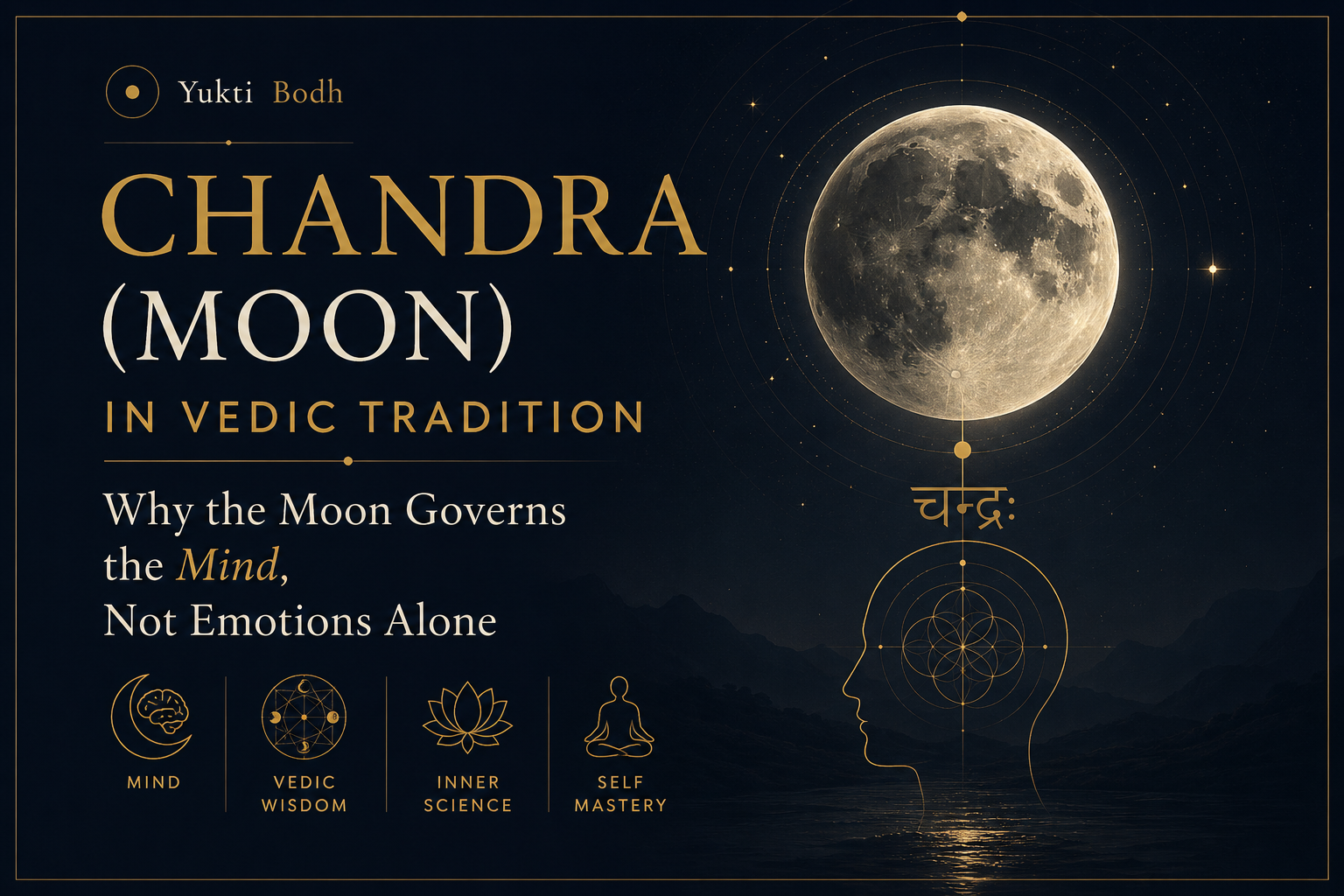
Chandra (Moon) in Vedic Tradition: Why the Moon Governs the Mind, Not Emotions Alone
SEO Meta: In Vedic tradition, the moon (Chandra) governs the mind — not just emotions. Here is the classical understanding of Chandra: its cosmology, its role in Jyotish, and its daily significance.
Slug: /chandra-moon-vedic-tradition-governs-mind/
In contemporary astrology, the moon is the planet of emotions — feelings, moods, intuition, the inner child. This is not wrong, but it is a reduction. In the Vedic tradition, Chandra governs something considerably more fundamental: the mind itself — Manas — the entire faculty of inner experience, of which emotion is only one expression.
Understanding what Chandra actually governs in the classical framework transforms how you relate to the moon’s cycle, to Jyotish, and to your own inner life.
Chandra in Vedic Cosmology
In Vedic cosmology, Chandra Deva is a Graha — a seizer — who governs the domain of the mind with the same totality that Surya (the Sun) governs the domain of the soul. The Rig Veda describes the moon as the vessel of Soma — the nectar of immortality, the fluid of consciousness — and as the nourisher of all plant life and, through plants, of all life.
The moon’s association with water — tides, the fluid systems of the body, plants, the cycles of fertility — is not merely symbolic. The gravitational pull of the moon on the earth’s water systems is measurable. The classical tradition observed these connections millennia before modern science quantified them and drew a coherent map of the moon’s governing function.
Chandra is described in the Puranas as riding a chariot drawn by ten white horses, made of antimony (Vimala — pure), wearing white garments, holding a mace and a lotus, and possessing the quality of coolness, gentleness, and nourishment. The moon is the soma vessel — the cup in which the nectar of consciousness is carried.
Manas: What the Mind Actually Is
The Sanskrit term Manas is sometimes translated as mind, sometimes as emotion, sometimes as heart-mind. It is actually more specific than any of these translations suggests.
In the Samkhya-Yoga philosophical framework, the Antahkarana — the inner instrument — consists of four functions: Manas (the receiving, processing mind), Buddhi (the discriminating intellect), Ahamkara (the ego-identity), and Chitta (the deep memory and storehouse of impressions). Of these four, Chandra governs Manas — the first and most immediate layer of the inner instrument.
Manas is the function that takes the raw input of sensory experience and processes it into the form in which it can be evaluated by Buddhi. It is the interface between the external world and the internal world — the translator between outer events and inner experience. Every sensory impression, every feeling, every thought in its initial arising form passes through Manas.
This is why the moon’s condition in the birth chart is so significant in Jyotish — it describes the quality of the inner instrument itself, not just the emotional life. A strong, well-placed moon indicates a mind that is stable, clear, and capable of accurate reception and processing. An afflicted moon indicates a mind that distorts, amplifies, or suppresses experience.
The Moon in the Jyotish Chart
In Jyotish, the moon holds a place of primary importance — arguably the most important single planet in the chart, along with the Lagna. The moon’s sign placement establishes the Chandra Lagna — a second ascendant from which the chart is read simultaneously with the main Lagna. The moon’s Nakshatra at birth establishes the starting point of the Vimshottari Dasha system. The moon’s condition — its sign strength, its house placement, the planets associating with and aspecting it — describes the fundamental quality of the mind throughout the life.
A moon in its own sign of Cancer or in its exaltation sign of Taurus is strong — the mind is naturally receptive, stable, and capable. A moon in its debilitation sign of Scorpio is challenged — the mind tends toward depth and intensity but struggles with stability and equanimity.
The waxing moon (Shukla Paksha) is generally considered stronger than the waning moon (Krishna Paksha) for most purposes, because the increasing light reflects the mind’s greater access to Soma. Some texts specify that a moon within approximately 72 degrees of the sun (close enough to be in the sun’s orb and near new moon) is weakened — considered Ksheena Chandra (diminished moon).
Chandra Mantra and Practice
Classical practice connected to Chandra includes:
The Chandra Bija mantra: Om Shram Shreem Shroum Sah Chandraya Namah. This mantra is particularly recommended for strengthening a weak moon in the birth chart, for calming an agitated mind, and for supporting the emotional and fluid systems of the body.
Somavara (Monday) Vrat: Fasting or simplifying food on Mondays, Shiva puja on Mondays (Shiva and Chandra are intimately connected — Shiva wears the crescent moon in his matted locks), and water offerings to Shiva on Monday evenings.
Moonrise meditation: Sitting in meditation or quiet reflection at moonrise, particularly on Purnima, to consciously receive the moon’s Soma quality.
Trataka on the moon: Concentrated gazing at the full moon, practised in the classical tradition as a specific technique for strengthening Manas and for absorbing Soma. This is considered particularly potent during Sharad Purnima.
Dietary alignment: Avoiding excessively heating, spicy, or tamasic foods on Purnima and Amavasya — when the moon’s influence on the mind is at its peaks — to maintain mental clarity during these energetically heightened moments.
The moon is not the planet of feelings. It is the planet of the mind’s capacity to receive, process, and experience reality. Its health is the health of the entire inner instrument. Its cycle is the cycle of consciousness itself as it moves through its monthly arc from darkness to fullness and back.
The Vedic Moon and Panchang tool tracks the moon’s daily position — showing the current Nakshatra, Tithi, and Paksha — making it easy to align your daily inner practice with the moon’s quality. The free Meditation Timer provides the distraction-free container for moon-aligned sitting practice.
[Use the Vedic Moon and Panchang tool →] to see the moon’s current position and align your practice with the lunar cycle.
★ Try the Tool
Generate your free Vedic birth chart — nakshatra, lagna, planetary positions, and more.
Open Vedic Chart Calculator →