Nadi Shodhana (Alternate Nostril Breathing): Correct Technique, Duration, and Timing
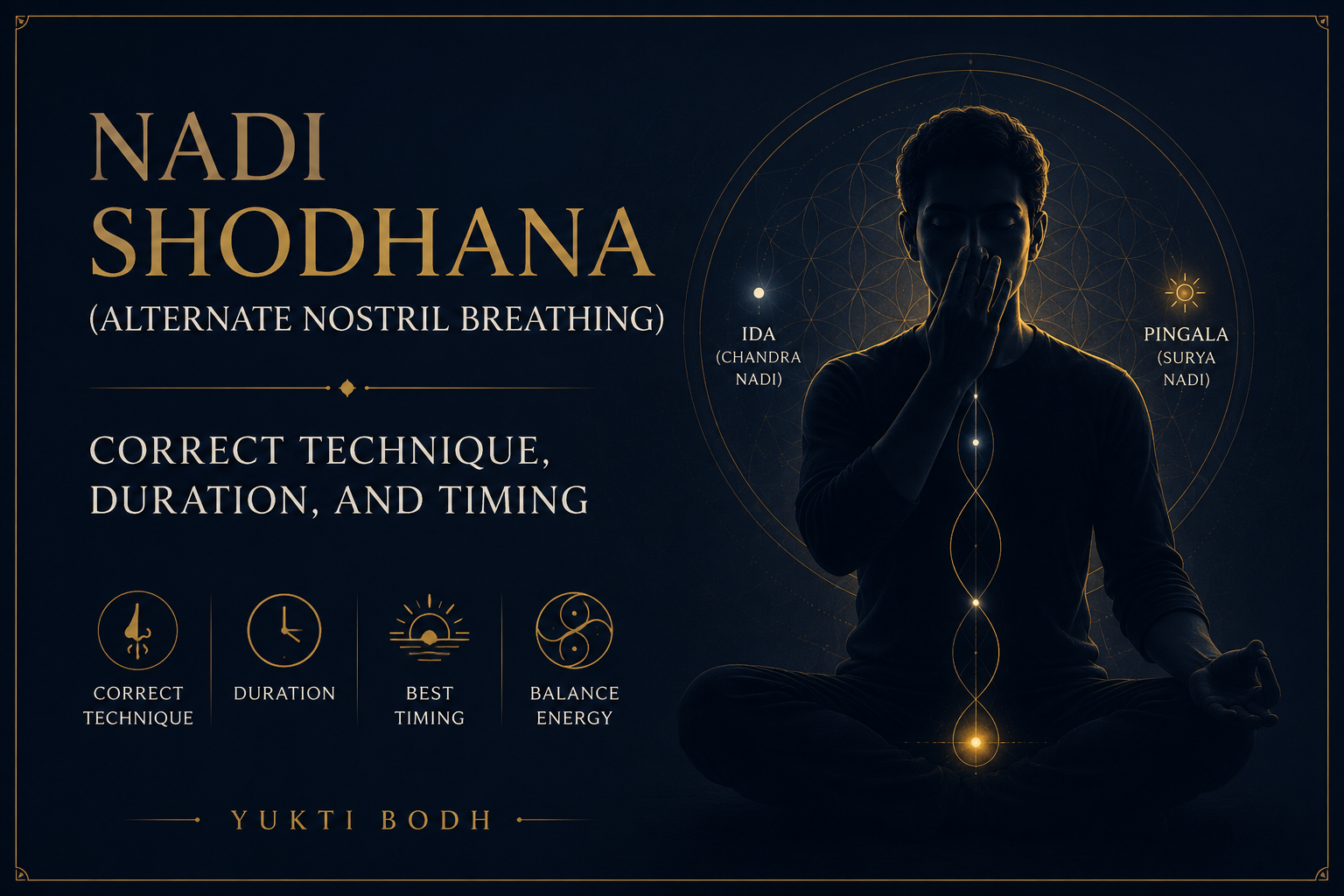
Nadi Shodhana — alternate nostril breathing — is described in almost every classical Hatha Yoga and Pranayama text as the foundational practice of the entire Pranayama system. Its name means channel purification (Nadi — channel, Shodhana — purification). Its purpose is precisely that: the systematic purification of the Ida and Pingala Nadis and the gradual opening of the Sushumna.
Without Nadi Shodhana as a consistent foundation, every other Pranayama practice has limited penetrating power. With it, the Nadi system progressively clears, and the more advanced practices — Kapalabhati, Bhramari, Kumbhaka — become exponentially more effective. This is why the classical texts consistently list Nadi Shodhana first and recommend it as the daily foundation before any other Pranayama is introduced.
The Two Nadis and Why Balance Matters
Ida Nadi — the left channel — is the lunar Nadi, cooling, feminine, associated with the parasympathetic nervous system, with the right hemisphere of the brain, with the introversion of awareness, and with the quality of Chandra (moon). It governs the left nostril: when Ida is dominant, the left nostril flows more freely.
Pingala Nadi — the right channel — is the solar Nadi, heating, masculine, associated with the sympathetic nervous system, with the left hemisphere of the brain, with the externalisation of awareness, and with the quality of Surya (sun). It governs the right nostril: when Pingala is dominant, the right nostril flows more freely.
In ordinary life, Ida and Pingala alternate in dominance roughly every 90 to 120 minutes — this natural alternation is called the Ultradian Rhythm and has been confirmed by modern nasal cycle research. When Ida alone is active for extended periods, the tendency is toward lethargy, introversion, and cooling of the system. When Pingala alone is active for extended periods, the tendency is toward agitation, overheating, and excessive outward drive.
Balance between Ida and Pingala — when both nostrils flow equally — is called Sushumna breathing. In this state, the central channel is most accessible, the mind is most naturally still, and meditation is most effective. Nadi Shodhana directly cultivates this balance.
The Classical Technique: Step by Step
The hand position used in classical Nadi Shodhana is Vishnu Mudra: the right hand is used, with the index finger and middle finger folded toward the palm. The thumb covers and releases the right nostril; the ring finger and little finger cover and release the left nostril.
Preparation: Sit in a stable, erect posture — Sukhasana, Siddhasana, or Padmasana. The spine must be straight and the body relaxed. Allow three to five natural breaths to settle before beginning.
The basic practice: Inhale through both nostrils naturally. Then close the right nostril with the thumb and exhale completely through the left nostril. Inhale through the left nostril. Close the left nostril with the ring finger, release the thumb, and exhale through the right nostril. Inhale through the right nostril. Close the right nostril with the thumb, release the ring finger, and exhale through the left nostril. This is one complete round.
The classical texts describe this as Anuloma-Viloma — with the grain and against the grain — the systematic alternation of the breath channel in a pattern that progressively balances the two Nadis.
Ratio and Timing: The Classical Approach
The classical Pranayama texts specify ratios for the three phases of the breath: Puraka (inhalation), Kumbhaka (retention), and Rechaka (exhalation). The most commonly prescribed basic ratio is 1:2 — inhale for a count of four, exhale for a count of eight, with no retention initially.
As the practice develops and the Nadi system purifies, retention (Kumbhaka) is introduced at a ratio of 1:4:2 — inhale for four counts, retain for sixteen counts, exhale for eight counts. This ratio is the classical standard described in the Hatha Yoga Pradipika and the Gheranda Samhita.
A word on the counting unit: the classical texts use a beat called a Matra — approximately one second, or one heartbeat. Using heartbeats as the counting unit naturally regulates the breath to the body’s own rhythm. A basic beginner’s ratio might be: Puraka 4 Matras, Rechaka 8 Matras. An intermediate ratio: Puraka 8, Kumbhaka 32, Rechaka 16. An advanced ratio: Puraka 16, Kumbhaka 64, Rechaka 32.
Never force the ratio beyond what is comfortable. The breath should remain smooth and without strain throughout. If strain appears at any point, reduce the ratio.
Duration: How Long to Practise
For Nadi Shodhana to function as Nadi Shuddhi — genuine channel purification — the classical texts recommend consistent daily practice over an extended period.
For beginners: ten to fifteen rounds daily, without retention. This takes approximately ten minutes. This alone, practised daily for three months, produces a noticeable change in the quality of the breath, the mind’s stability, and the capacity for meditation.
For intermediate practitioners: twenty to thirty rounds daily with 1:4:2 ratio retention. This takes approximately fifteen to twenty minutes and represents the practice described in classical texts as sufficient for significant Nadi purification.
For advanced practice: the classical texts describe practitioners performing Pranayama for an hour or more daily, building to the capacity for very extended Kumbhaka. This level of practice is best undertaken under direct guidance.
Morning practice is classically preferred — before food, ideally during the Brahma Muhurta (the hour before sunrise), when the Pranic environment is considered most pure and the mind is clearest.
Signs of Progress in Nadi Shodhana
The classical texts describe specific signs that indicate progress in Nadi Shodhana practice. The Hatha Yoga Pradipika states: the body becomes lean and glowing; the digestive fire increases; the inner sound (Nada) becomes perceptible; the practitioner is free from disease.
More immediately recognisable signs include: the breath becoming spontaneously slower and deeper outside formal practice; the ability to breathe through either nostril with equal ease; a noticeable increase in the stillness of the mind during and after practice; reduced reactivity to emotional triggers; and improvement in sleep quality.
The inner sound — Nada — becoming perceptible in meditation is a more advanced sign, typically arising after sustained practice of several months to years. It is the first clear indication that the Sushumna is beginning to open.
Common Errors and How to Correct Them
Several errors appear consistently in Nadi Shodhana practice.
Breathing through the mouth at any point: the breath must remain entirely nasal throughout. Mouth breathing bypasses the nasal filtering and warming functions and does not engage the Nadi system correctly.
Forcing the retention beyond comfort: Kumbhaka should be introduced only when the basic ratio without retention feels completely natural. Forcing extended retention before the system is ready creates tension and can produce headaches, anxiety, and irregular breathing patterns.
Losing the smoothness of the breath at transitions: the movement from inhale to retain to exhale should be seamless, without the breath catching or jerking. If the transition is rough, reduce the ratio until smoothness returns.
Inconsistency: occasional practice has limited cumulative effect. Nadi Shodhana’s power accumulates through daily repetition over weeks and months. Even ten minutes daily, every day, produces more transformation than an hour once a week.
Nadi Shodhana is the most direct classical tool for purifying the subtle body’s channel system and cultivating the mental stability that makes all other practice more effective. It is also the safest advanced Pranayama — without the heating intensity of Kapalabhati or the structural demands of extended Kumbhaka — making it suitable for virtually every practitioner.
The free Pranayama Guide on this site includes Nadi Shodhana with visual breathing animation and classical instruction, allowing you to practise with correct timing and technique. The Meditation Timer provides the distraction-free sitting environment for combining Nadi Shodhana with your meditation practice.
[Use the Pranayama Guide →] to practise Nadi Shodhana with visual guidance and classical technique today.
◎ Try the Tool
Find which chakras are balanced, blocked, or overactive with our free diagnostic.
Open Chakra Diagnostic →