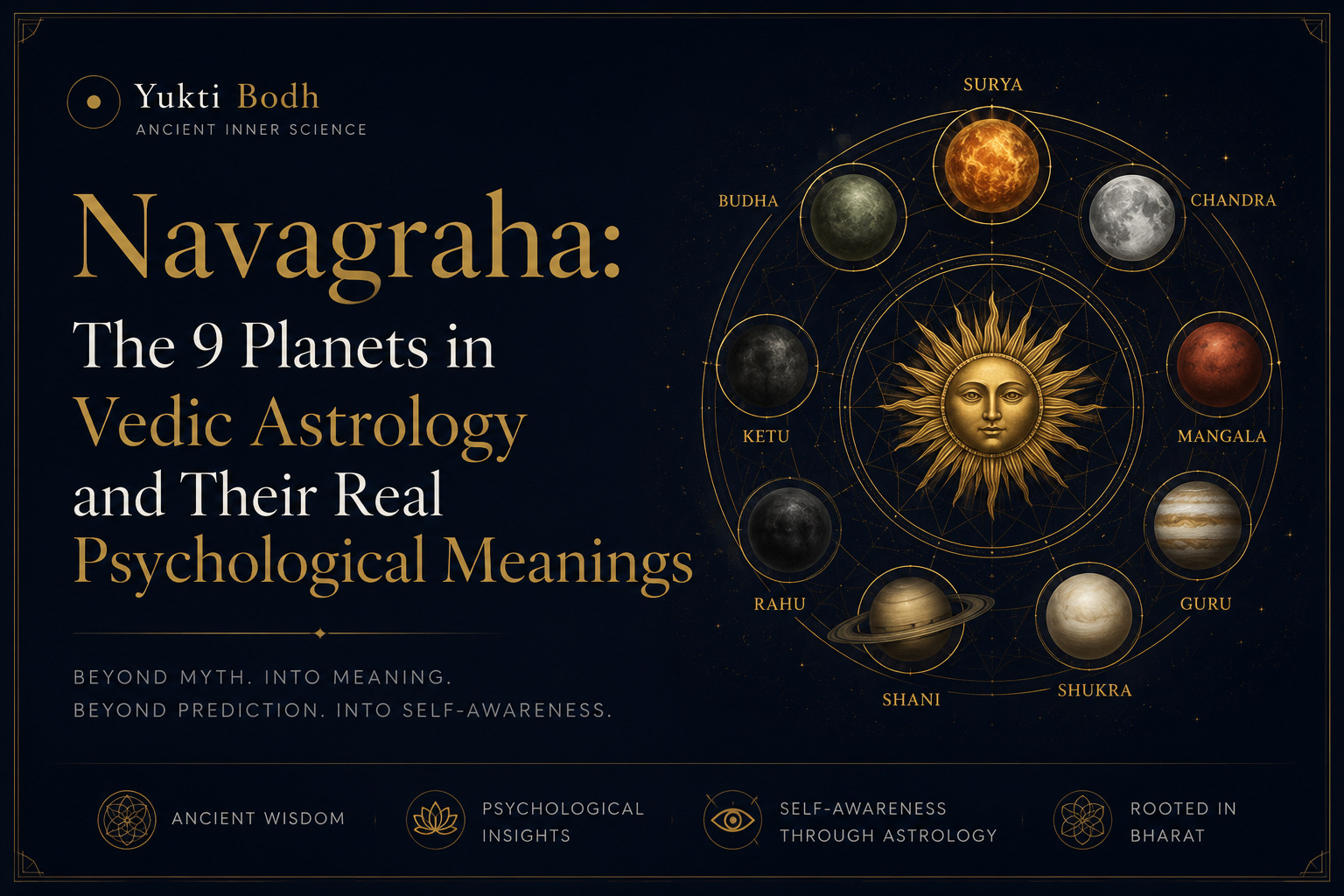
Navagraha: The 9 Planets in Vedic Astrology and Their Real Psychological Meanings
SEO Meta: The Navagraha — the nine planets of Jyotish — are not just celestial objects. Each is a complete psychological and karmic principle. Here is what each one actually represents.
Slug: /navagraha-9-planets-vedic-astrology-meaning/
The nine planets of Jyotish — the Navagraha — are not simply celestial objects whose positions are tracked and interpreted. In the classical Vedic framework, each Graha is a complete cosmic principle — a field of force that permeates both the outer world and the inner world of consciousness, simultaneously manifesting as astronomical reality and as a specific quality of human experience.
Graha means seizer or holder — the planets seize and hold the consciousness, directing it toward particular experiences and away from others. Understanding each planet’s nature — its qualities, its domains, its significations — is the foundation of reading any Jyotish chart.
Surya: The Sun — Soul, Authority, Father
Surya is the king of the Navagraha. In Jyotish, the Sun represents the soul (Atman) in its most fundamental expression; the father and paternal lineage; authority, government, and leadership; vitality, self-confidence, and the capacity to shine; the eyes and the heart; and medicine and healing through solar practices.
Unlike Western astrology, where the sun sign is the primary identifier, the sun in Jyotish is one factor among nine — significant, but not dominant. The sun’s placement by sign, house, and aspect indicates the quality of the soul’s expression in this life, the relationship with the father and authority, and the degree to which the native can act with genuine authority and clarity.
The sun is exalted in Aries and debilitated in Libra. It governs the sign Leo. It is a natural malefic — not harmful by nature, but its energy is intense and demands clear channels.
Chandra: The Moon — Mind, Mother, Nourishment
Chandra — the Moon — is arguably the most important planet in Jyotish, along with the Lagna. The moon represents the Manas — the mind in its receptive, responsive, feeling function; the mother and maternal care; emotional patterns and the quality of inner nourishment; memory, the past, and habitual tendencies; fluids in the body and the capacity for flow and adaptation; and the Antahkarana — the inner instrument of consciousness.
The moon’s placement is so significant in Jyotish that the entire Dasha system begins from the moon’s Nakshatra at birth. The Chandra Lagna — the sign occupied by the moon — functions as a second ascendant in chart interpretation. The moon governs Cancer and is exalted in Taurus, debilitated in Scorpio.
A strong, well-placed moon is perhaps the single most important indicator of a stable, nourished, mentally healthy life. A weak or afflicted moon — particularly in the eighth or sixth house, or conjunct malefics — is one of the most challenging configurations in the chart.
Mangala: Mars — Energy, Courage, Conflict
Mangala — Mars — is the warrior of the Navagraha. It represents directed energy, drive, and personal initiative; courage, independence, and the willingness to act despite difficulty; aggression, anger, and conflict when afflicted; the younger siblings; the blood and the bone marrow; and engineering, surgery, and military function.
Mars governs both Aries and Scorpio in classical Jyotish. It is exalted in Capricorn and debilitated in Cancer. Mars is a natural malefic — its energy is fiery, direct, and forceful.
A strong Mars indicates courage, energy, and the capacity for effective action. An afflicted Mars produces aggression, accidents, and the inflammatory diseases. Mars placed in the first, fourth, seventh, eighth, or twelfth house produces what is called Mangala Dosha — a condition requiring specific matching considerations in marriage compatibility assessment.
Budha: Mercury — Intellect, Communication, Discrimination
Budha — Mercury — is the prince of the Navagraha, the planet of intelligence in its analytical and communicative function. It governs the intellect and the capacity for rational analysis; language, writing, trade, and commerce; the nervous system and skin; education and learning; the capacity to discriminate between the real and the unreal; and friends and associates.
Mercury governs Gemini and Virgo. It is exalted in Virgo — here its analytical function is most precise — and debilitated in Pisces. Mercury is a neutral planet, taking on the qualities of whatever planets associate with it. With benefics it becomes highly beneficial; with malefics it can produce mental restlessness, dishonesty, or nervous disorders.
Guru: Jupiter — Wisdom, Expansion, Grace
Guru — Jupiter — is the greatest benefic of the Navagraha, the teacher and guide. It represents wisdom, knowledge, and the higher teachings; children, particularly sons; prosperity and expansion; the Guru principle — the force of grace and guidance in life; philosophy, religion, and law; the liver and fat tissue in the body; and the capacity for joy, generosity, and optimism.
Jupiter governs Sagittarius and Pisces. It is exalted in Cancer and debilitated in Capricorn. Jupiter’s placement in the chart indicates where grace and expansion operate — where things tend to grow, where knowledge and good fortune accumulate.
A strong Jupiter is one of the most protective influences in a chart — it can significantly mitigate the effects of difficult placements elsewhere.
Shukra: Venus — Beauty, Pleasure, Relationship
Shukra — Venus — is the second great benefic, the planet of beauty, pleasure, and the arts. It governs love, desire, and romantic relationship; beauty, aesthetics, and artistic capacity; luxury, comfort, and material enjoyment; the semen and reproductive vitality; conveyances and fine objects; and the face and eyes in their aesthetic aspect.
Venus governs Taurus and Libra. It is exalted in Pisces — where its capacity for unconditional love and beauty is most fully expressed — and debilitated in Virgo. Venus represents the principle of attraction — the magnetic force that draws things together, including souls in relationship.
Shani: Saturn — Discipline, Karma, Time
Shani — Saturn — is the great teacher of the Navagraha, the planet of karma, time, and the consequences of past action. It governs discipline, restriction, and the slow maturation of experience; servants, the common people, and those who are marginalised; the elderly and the principle of aging; bones, the nervous system (joints), and chronic conditions; loss, separation, and renunciation; and the spiritual path through austerity.
Saturn governs Capricorn and Aquarius. It is exalted in Libra — where its sense of justice and discipline is most refined — and debilitated in Aries.
Saturn’s periods — both the Mahadasha of nineteen years and the transits, particularly the seven-and-a-half year Sade Sati around the natal moon — are among the most significant and often challenging periods in a life. But Saturn is not malevolent. It is precise. What it destroys was not built on genuine foundations. What it rewards was built through sustained, disciplined, honest effort.
Rahu and Ketu: The Lunar Nodes — Karma and Liberation
Rahu and Ketu are the two shadow planets — mathematical points where the moon’s orbit crosses the ecliptic. They always occupy opposite signs, moving in retrograde motion through the zodiac.
Rahu — the north node — is the point of the moon’s ascending intersection with the ecliptic. It represents obsession, worldly desire, and the karmic direction of this life — what the soul has come to experience and accomplish in the outer world. Rahu amplifies and intensifies whatever it touches, often producing unusual, unconventional, or foreign-flavored results.
Ketu — the south node — is the opposite point. It represents past life mastery, spiritual intelligence, and the tendency to withdraw from what Rahu is intensely seeking. Ketu produces enlightenment and liberation — but also loss, dissolution, and the erosion of what has been too long clung to.
The axis of Rahu and Ketu in the birth chart — its house placement and sign — describes the fundamental karmic direction of this life, the tension between what is being released from the past and what is being built toward the future.
The nine planets are not external forces acting on a passive life. They are principles within consciousness itself — archetypal fields of experience that the chart maps in their specific configuration for a given individual.
To see the current planetary positions and understand the Nakshatra governing today — the practical, daily expression of the Navagraha system — the Vedic Moon and Panchang tool provides this information updated automatically. The Muhurat Calculator applies Navagraha principles to identify the most auspicious timing for your important decisions.
[Use the Vedic Moon and Panchang tool →] to see today’s planetary alignments in the classical framework.
★ Try the Tool
Generate your free Vedic birth chart — nakshatra, lagna, planetary positions, and more.
Open Vedic Chart Calculator →