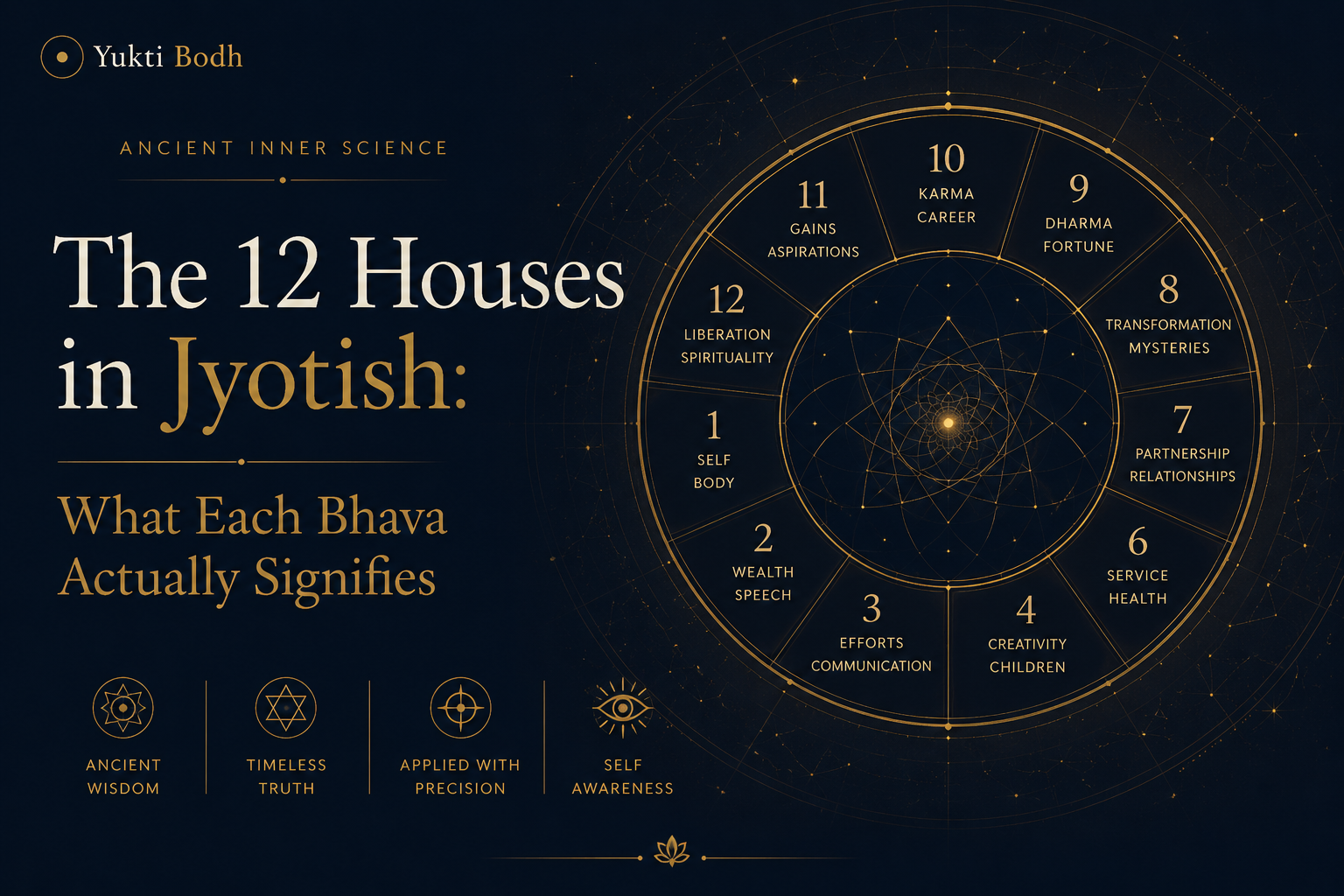
The 12 Houses in Jyotish: What Each Bhava Actually Signifies
The twelve houses — Bhavas — of the Jyotish chart are the framework through which the chart’s meaning is read. Each house governs a specific set of life domains with precision that, once understood, makes the chart an extraordinarily detailed map of a person’s life circumstances and trajectory.
Understanding the Bhavas correctly is the foundation of all Jyotish interpretation. Without it, even accurate planetary placements and Dasha timing cannot be correctly applied.
The Structure of the Bhava System
In classical Jyotish, the twelve Bhavas begin with the Lagna — the rising sign — as the first house. The most common house system used is whole sign houses: the entire sign containing the Lagna becomes the first house, the next sign becomes the second, and so on regardless of the specific degree of the Lagna within its sign.
This is a fundamental departure from most Western house systems (Placidus, Koch, Equal House) which divide space by degree from the exact ascendant point. The whole sign system is older, simpler, and — in the Jyotish framework — more precise for the purpose of house-based interpretation.
The twelve houses are grouped into several meaningful categories: Kendras (angular houses: 1, 4, 7, 10) — the most powerful houses, representing the four pillars of life; Trikonas (trine houses: 1, 5, 9) — the houses of dharma and fortune, considered highly auspicious; Dusthanas (difficult houses: 6, 8, 12) — houses of challenge, transformation, and loss; and Upachayas (growing houses: 3, 6, 10, 11) — houses that improve over time with effort.
First Bhava: Lagna — The Self
The first house is the most important single factor in the Jyotish chart. It represents the physical body and its overall vitality; the personality and the overall orientation of consciousness; the beginning of all things and the self as the subject of experience; and the general quality and direction of the life as a whole.
The sign on the first house — the Lagna sign — colours everything. The planet ruling that sign — the Lagna lord — is one of the most significant planets in the entire chart. Planets placed in the first house directly influence the body, personality, and life direction.
Second and Third Bhavas: Wealth and Effort
The second house governs accumulated wealth and financial resources; family of origin and early home life; speech, the face, and the voice; food and the mouth; and memory and accumulated knowledge.
The third house governs personal effort, courage, and self-initiated action; younger siblings; short journeys and local travel; communication, writing, and media; and the hands and arms. The third is an Upachaya house — it improves with effort over time.
Fourth and Fifth Bhavas: Home and Intelligence
The fourth house is the house of the mother; the home and domestic life; fixed assets, land, and property; the heart and emotional foundation; vehicles; and one’s homeland and relationship to it.
The fifth house is one of the most auspicious in the chart — a Trikona. It governs children and creativity; intelligence and the capacity for discriminative thought; past life merit (Purva Punya); romance and love affairs; speculation and investment; and spiritual practices, mantras, and devotion. A strong fifth house indicates a life richly supported by past karma.
Sixth, Seventh, and Eighth Bhavas: Challenge and Transformation
The sixth house is a Dusthana — a house of challenge. It governs enemies, obstacles, and debts; service, daily work, and health routines; disease and its treatment; employees and subordinates; and litigation. Planets in the sixth, though in a difficult house, can be powerful in competitive and service contexts.
The seventh house is the primary house of marriage and primary partnership; business partnerships and contracts; the public and how one is seen by others; foreign places and journeys; and the setting of the sun — the completion of things. The seventh is a Kendra — a pillar of life — and carries great weight in chart interpretation.
The eighth house is perhaps the most misunderstood in Western contexts. In Jyotish it governs longevity and the nature of death; transformation, sudden change, and disruption; hidden knowledge, the occult, and research; inheritance and the resources of others; chronic illness; and Kundalini and tantric practices. A strong eighth house, despite its reputation, indicates depth, resilience, and access to hidden dimensions of life.
Ninth, Tenth, Eleventh, and Twelfth Bhavas
The ninth house is the most auspicious in the chart — a Trikona. It governs the father and the guru; dharma and right action; higher education, philosophy, and religion; long journeys and pilgrimage; fortune and grace; and the higher mind. Planets in the ninth are significantly strengthened.
The tenth house is the house of career and public life; status, reputation, and authority; the government and institutions; right action in the world (Karma); and the highest point of one’s social contribution. As a Kendra, the tenth is one of the most powerful houses in the chart.
The eleventh house governs income, gains, and the fulfillment of desires; elder siblings; social networks and community; hopes and aspirations; and recurring income sources. As an Upachaya, it grows stronger over time.
The twelfth house is the final Dusthana. It governs expenditure and financial loss; foreign lands and emigration; liberation (Moksha) — it is the house of final release; sleep, meditation, and the dissolution of boundaries; hospitals, ashrams, and institutions of confinement; and the left eye. Despite its classification as a difficult house, a strong twelfth is essential for spiritual liberation and for those whose vocation involves seclusion or service in institutional settings.
How to Read the Bhavas in Practice
In chart interpretation, each Bhava is assessed on several levels: the sign occupying the house and the qualities it brings to that domain; the planets placed within the house and their natural and functional significances; the planet ruling the house (the house lord) and where it is placed in the chart — this tells the story of how that area of life is directed; and the aspects (Drishti) cast into the house by other planets.
The house lord’s placement is often more revealing than what is placed within the house itself. For example, the fifth house lord placed in the eighth tells a very different story about children, creativity, and past karma than the fifth lord placed in the ninth. This lord-based analysis — called Bhava lord analysis — is central to classical Jyotish interpretation.
Understanding the Bhavas transforms the Jyotish chart from a list of planetary positions into a coherent narrative of a life — its resources, its challenges, its timing, and its direction.
To understand the Nakshatra and Tithi operating today — and how the current astrological weather affects your own chart — the Vedic Moon and Panchang tool provides this daily, updated automatically. For selecting auspicious timing using Jyotish principles, the Muhurat Calculator is free to use at any time.
[Use the Vedic Moon and Panchang tool →] to see the full classical Panchang for today.
★ Try the Tool
Generate your free Vedic birth chart — nakshatra, lagna, planetary positions, and more.
Open Vedic Chart Calculator →