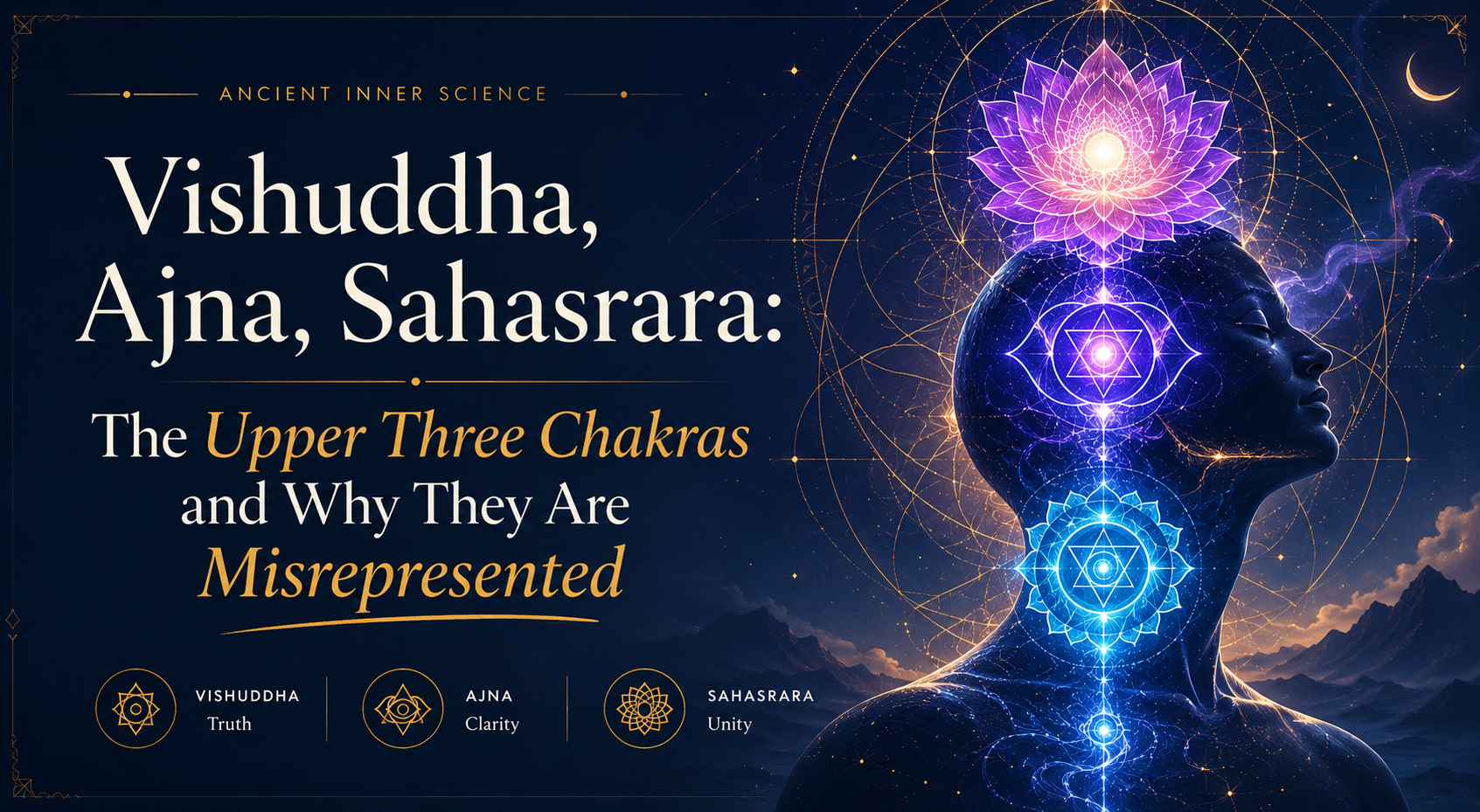
Vishuddha, Ajna, Sahasrara: The Upper Three Chakras and Why They Are Misrepresented
As the chakra system ascends from Muladhara toward the crown, something significant happens: the descriptions become more abstract, the Tattvas dissolve, and the language of the texts shifts from the detailed psycho-physical correspondences of the lower chakras to something that points beyond ordinary experience.
The upper three chakras — Vishuddha, Ajna, and Sahasrara — are the most frequently misrepresented in modern presentations. Vishuddha becomes a chakra of self-expression and authentic communication. Ajna becomes the third eye of intuition and psychic ability. Sahasrara becomes a purple lotus of cosmic consciousness and spiritual connection.
Each of these descriptions contains something real. Each of them also fundamentally misses what the texts are actually describing.
Vishuddha: The Purification Centre
Vishuddha comes from Vishuddhi — purification. It is located at the throat, in the region of the cervical plexus, and is described in the Sat-Chakra-Nirupana as a lotus of sixteen petals, smoke-coloured or purple, carrying the sixteen Sanskrit vowels.
The classical description of what is actually at the centre of Vishuddha is striking: a full moon circle — white and luminous — containing a white elephant (the mount of Indra, the king of the gods), and within a downward-pointing triangle, a white circle representing the Akasha Tattva — space or ether, the subtlest of the five elements.
This is the only classical chakra associated with the space element — the element from which all others arise. At Vishuddha, the physical Tattvas that governed the lower chakras — earth, water, fire, air — have resolved into their source. Only space remains.
The Tanmatra is Shabda — sound. Not the sound of speech, but the primary vibration from which all sound and language arise. The presiding deity is Sadashiva in his Ardhanarishvara form — half Shiva, half Shakti — indicating the beginning of non-dual experience. The Shakti is Shakini, luminous white, four-armed, carrying a bow, arrows, a noose, and a goad.
The association with communication and authentic expression comes from a real function of Vishuddha — it is where Vak, the power of speech, has its seat. But authentic Vak in the classical sense is not self-expression in the therapeutic sense. It is the capacity for truth — specifically, the alignment of what is spoken with what is perceived at the level of pure consciousness. This is an extremely refined capacity, not a matter of speaking your truth.
The Nectar of Immortality at Vishuddha
One of the most significant and least discussed aspects of Vishuddha in the classical texts is its relationship to Amrita — the nectar of immortality.
The texts describe a centre called Bindu above the palate, from which a drop of nectar — Amrita — perpetually drips downward. In ordinary consciousness, this nectar falls into the fire at Manipura and is consumed — this is one metaphorical description of the ageing and eventual death of the body.
In advanced practice, when Vishuddha is awakened and the Jalandhara Bandha (throat lock) is applied, the nectar is caught at the throat and purified rather than consumed by the fire below. The Hatha Yoga Pradipika describes this as one of the mechanisms of extended life and the prevention of degeneration.
This is not metaphor. It is a precise description of a physiological and energetic process that practitioners in the Hatha Yoga lineage worked to master.
Ajna: The Command Centre
Ajna means command or authority. The name itself indicates what this chakra actually is in the classical framework — not a psychic intuition centre, but the seat of the Guru principle, the inner teacher, the source of direct knowing that transcends sensory experience.
The Sat-Chakra-Nirupana describes Ajna as a lotus of two petals — luminous white — carrying the syllables Ham and Ksham. Within the pericarp is a triangle (Trikona) in which there is the Itara Linga — the third Linga of the subtle body system — shining like lightning.
The presiding deity at Ajna is Paramashiva in his form as Shambhu — the highest form of Shiva available within the individual subtle body. The Shakti is Hakini — six-headed, white, seated on a white lotus.
The two petals represent the meeting of Ida and Pingala — the two primary Nadis that have been running parallel to Sushumna converge at Ajna and merge into it. This is structurally significant: at Ajna, the duality of the solar and lunar currents, of masculine and feminine, of active and receptive, is resolved.
What the Ajna Actually Is: Command and Grace
The Ajna is described as the seat of the Manas — the mind in its most refined function — and the Buddhi — the intellect capable of discriminative wisdom. At this level, the faculty of Prajna arises: not intuition in the popular sense of a feeling or hunch, but the direct apprehension of truth that bypasses inferential reasoning.
The classical texts instruct the practitioner to meditate at the Ajna with the specific intent of receiving Guru’s instruction — not from an external teacher, but from the inner principle of wisdom that becomes accessible when the mind is sufficiently purified and concentrated. This is the source of the concept of the inner Guru.
The association with the third eye and clairvoyance is not entirely invented — the texts do describe the activation of faculties of perception beyond ordinary sense function. But in the classical context, these are described as potential distractions from the primary purpose of Ajna practice: the dissolution of the individual knower into the principle of knowing itself.
The Third Granthi: Rudra Granthi
At Ajna is located Rudra Granthi — the third and final psychic knot. Where Brahma Granthi bound consciousness to the physical world and Vishnu Granthi bound it to emotional attachment, Rudra Granthi binds it to spiritual attainment — to the fascination with extraordinary inner experiences, powers (Siddhis), and the subtler forms of ego that persist in advanced practitioners.
Rudra is the destroyer. The Rudra Granthi must be pierced — the attachment to spiritual experience itself must be released — before Kundalini can ascend to the Sahasrara. This is perhaps the most difficult of the three knots, because it requires releasing precisely what has sustained the practitioner’s inner journey.
Sahasrara: Not a Chakra
The Sahasrara is consistently described in classical texts as something different in kind from the six chakras below it. The Sat-Chakra-Nirupana is explicit: Sahasrara is not a chakra in the same sense. It is the abode of Shiva — pure, undifferentiated consciousness — the destination of Kundalini Shakti’s upward journey.
It is described as a lotus of one thousand petals, luminous white, located at the brahmarandhra — the crown of the head — its petals arranged in layers pointing downward, each carrying a Sanskrit syllable. In its centre is a luminous full moon, and in that moon a triangle, and in that triangle the supreme Shiva-Shakti in their eternal embrace.
The experience described when Kundalini reaches Sahasrara is the union of Shakti and Shiva — the return of individual consciousness to its source, the recognition that the self and the absolute were never genuinely separate. This is Samadhi — not a state of bliss in the psychological sense, but the direct recognition of what consciousness actually is.
The purple crown chakra of popular culture — associated with cosmic consciousness, spirituality, and the colour violet — is a distant and simplified echo of this classical description.
The upper chakras are not places of psychic power or elevated emotion. They are the progressive dissolution of the structures through which individual consciousness organises itself — culminating in the recognition that there was never anything other than consciousness to begin with.
For a complete chakra-by-chakra analysis with classical descriptions and a 42-day practice system, the Chakra Deep-Dive Report is the most thorough resource on this site. The Subtle Body Complete Guide covers the full traditional map — Koshas, Nadis, all seven chakras, and Kundalini — in one comprehensive framework.
Download the free Real Chakra System guide in Products section to begin with the foundational classical text.
◎ Try the Tool
Find which chakras are balanced, blocked, or overactive with our free diagnostic.
Open Chakra Diagnostic →