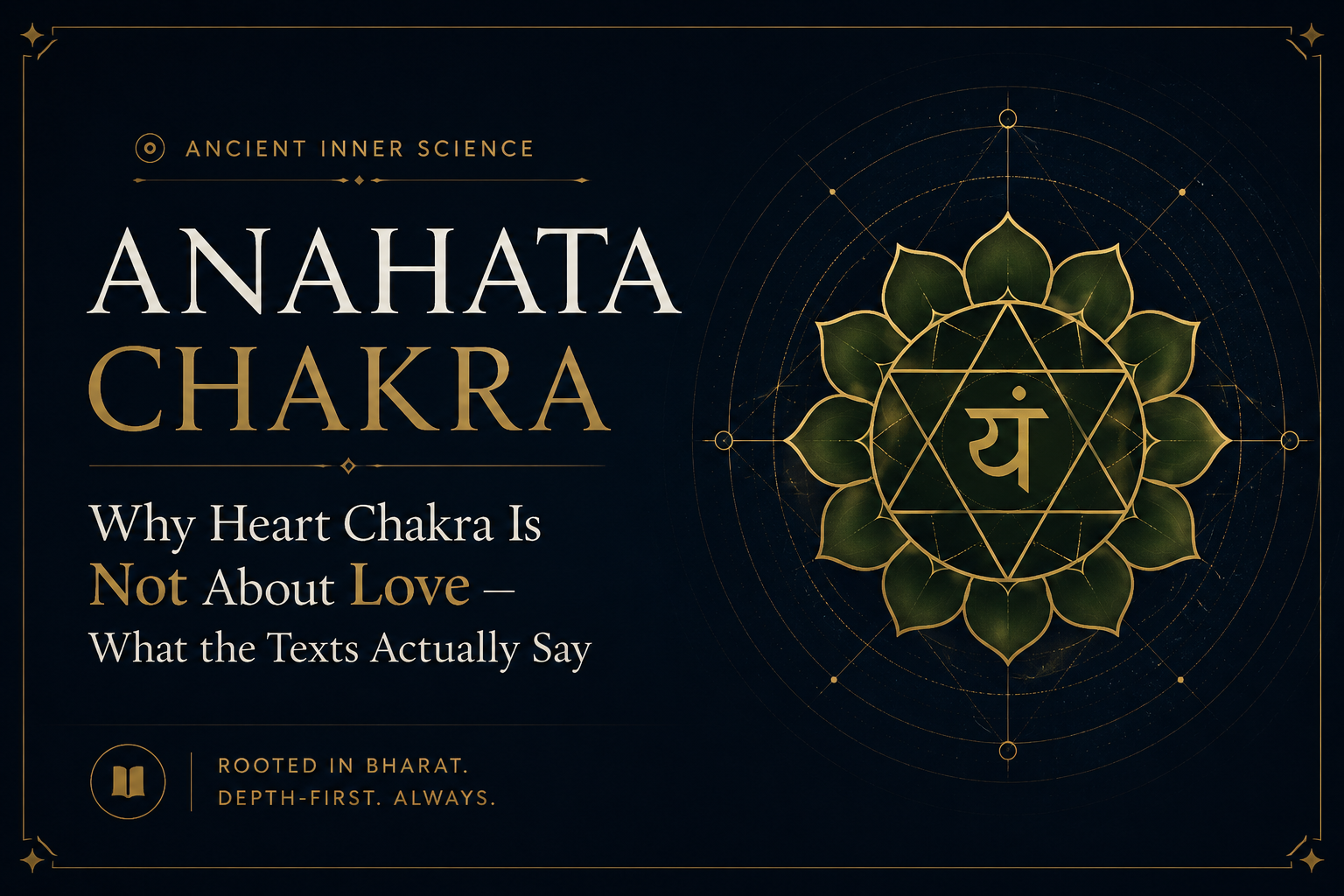
Anahata Chakra: Why Heart Chakra Is Not About Love — What the Texts Actually Say
Of all the chakras, Anahata has been most thoroughly romanticised. It is the heart chakra — the seat of love, compassion, connection, and emotional openness. Green coloured, associated with healing. When it is open, you love freely; when it is closed, you are defended and isolated.
This framing is not without truth. But it misidentifies what is actually located at the Anahata in the classical system. The heart chakra is not primarily about love. It is the seat of the individual self — the Jivatman, the witness, the I that persists beneath all the movements of experience.
The Name: The Unstruck Sound
Anahata means unstruck — from the Sanskrit An (not) and Ahata (struck or produced by contact). The name refers specifically to the Anahata Nada — the unstruck sound, also called the Nada Brahman or primal sound — which is heard in deep meditation at this level.
Every sound in the manifest world is produced by two objects striking each other — the clap of hands, the vibration of vocal cords, air moving through an instrument. The Anahata Nada is the sound that has no such cause — the primordial vibration from which manifest sound arises. In deep meditation at the Anahata, this sound is heard directly as a high, pure tone — described variously as a bell, a flute, a buzzing, or a roar, depending on the stage of development.
This is the primary meaning of the name. It has nothing to do with being open-hearted in the emotional sense.
Classical Description of the Chakra
The Sat-Chakra-Nirupana places Anahata at the heart region, in the spine behind the sternum. It is described as a lotus of twelve blue-black or red petals — some translations differ — carrying the syllables Ka, Kha, Ga, Gha, Nga, Cha, Chha, Ja, Jha, Nja, Ta, and Tha. The corresponding Vrittis are: lustfulness, fraudulence, indecision, repentance, hope, anxiety, longing, impartiality, arrogance, incompetence, discrimination, and defiance.
Again: these are not the qualities of an open loving heart. They are the precise textures of a consciousness that has become aware of itself as a self — that experiences hope and anxiety because it knows it can lose, that experiences longing because it recognises separation.
At the centre of the lotus is a smoky-coloured region — the air Tattva — with two interlocking triangles forming a hexagram. This is the Shatkona, the six-pointed star. Within one triangle is Isha — the presiding deity — depicted as white and two-armed, seated in lotus posture. Within the other triangle is the Bana Linga — a second Linga, different from the Svayambhu Linga at Muladhara. The Shakti is Kakini — four-armed, yellow, carrying a noose, a skull, and a trident.
The Jivatman at the Heart
The most significant classical statement about Anahata is this: it is the seat of the Jivatman — the individual self, the living soul. Within the Anahata, in a small space described as the size of a thumb, within a flame that burns without fuel, the Jivatman resides.
This is not the ego — the Ahamkara that operates at Manipura. The Jivatman is the witness — the consciousness that observes all experience without itself being modified by experience. It is what some traditions call the inner observer, the knower, the I-Am before it takes on qualities.
The classical texts describe a small inverted flame within the Anahata — the Jiva — and instruct the practitioner to direct sustained meditative attention to this flame. This is the practice of self-inquiry at the energetic level: finding the witness within the heart and abiding there.
Love as a Consequence, Not the Content
The association of Anahata with love is not incorrect. It is a consequence of what is actually here. When the Jivatman — the witness, the self — is clearly perceived and known, a natural quality of love and equanimity arises. Not the emotional love of attachment, which operates at the lower chakras, but something steadier: the recognition that what looks back at you from every face is the same consciousness that looks from within.
This is the Metta, the Karuna, the compassion that the contemplative traditions describe. It is not produced by opening the heart. It arises naturally when the self is genuinely encountered — when the Anahata is not bypassed through sentiment but genuinely entered through direct inquiry.
The Air Element and the Sense of Touch
The Vayu Tattva — air element — is associated with Anahata. Air is invisible, omnipresent, the medium through which sound travels, the breath that sustains life. Its quality is lightness, movement, and the capacity to touch without being grasped.
The Tanmatra associated with Anahata is Sparsha — touch. This is precise: the heart level is where genuine contact becomes possible. Not the contact of objects at the physical level, but the contact of consciousness recognising itself in another. The organ associated with Anahata is the hands — the Karmendriya of grasping and giving. The hands are the instruments through which the heart acts in the world.
The Second Granthi: Vishnu Granthi
At Anahata is located Vishnu Granthi — the second psychic knot. Where Brahma Granthi at Muladhara binds consciousness to the physical and sensory world, Vishnu Granthi binds it to emotional attachment, personal relationship, and the desire for recognition.
Vishnu Granthi is the knot of Rajas — the quality of passionate activity and attachment to outcome. It is particularly relevant to practitioners who have developed some capacity for concentration and inner work but remain strongly attached to their experience, their progress, their spiritual identity.
Releasing Vishnu Granthi is a genuine threshold — often experienced as a difficult letting go of what has been most cherished about one’s inner life and relationships.
Anahata is not the centre of love as an emotion. It is the seat of the self that, when genuinely encountered, discovers that separation was always partial — and that what has always been called love was the intuition of this discovery, seeking its own source.
For the complete chakra-by-chakra system with full psychological depth and a 42-day practice guide, the Chakra Deep-Dive Report covers Anahata and all other chakras in full detail. For a personalised reading of your specific chakra patterns, the Chakra Assessment Report provides direct, individualised guidance.
Check and diagnose your chakra in tools section to ground yourself in the classical framework before going deeper.
◎ Try the Tool
Find which chakras are balanced, blocked, or overactive with our free diagnostic.
Open Chakra Diagnostic →