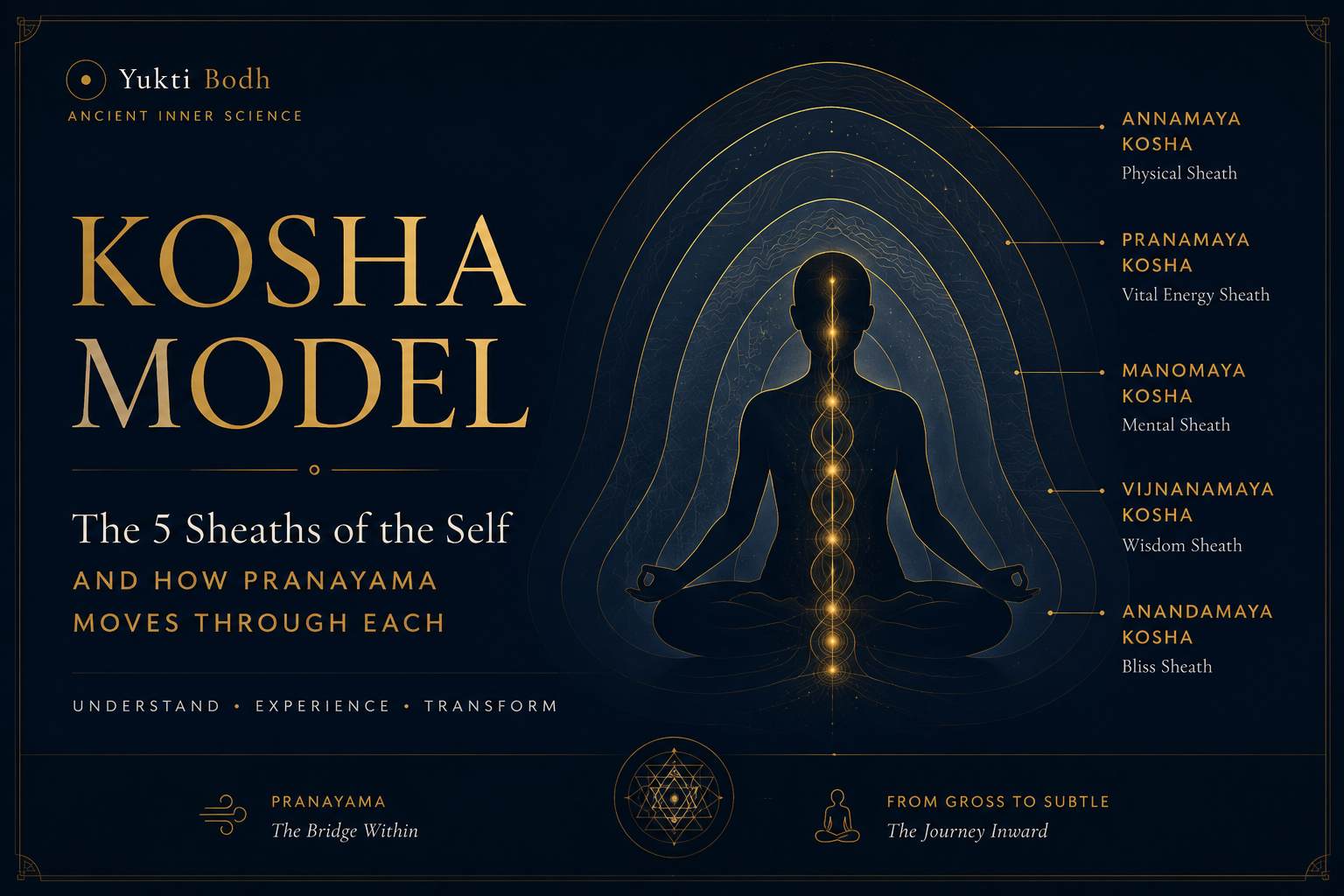
Kosha Model: The 5 Sheaths of the Self and How Pranayama Moves Through Each
The Kosha model — Pancha Kosha, the five sheaths — is one of the most elegant and practically useful frameworks in the entire classical Vedic tradition. It describes the human being not as a single entity with body and mind, but as a nested set of five increasingly subtle layers, each one enveloping the next like the layers of an onion, with pure consciousness — Atman — at the innermost centre.
This model, drawn primarily from the Taittiriya Upanishad, has practical implications that extend far beyond philosophy. It explains why practices that work at the physical level also affect the mental and emotional level. It explains why mental stress manifests as physical disease. And it explains, with precision, how Pranayama works — not just on the breath, but through the entire multi-layered structure of the self.
The Five Koshas: An Overview
Annamaya Kosha — the food body. The most gross and visible sheath: the physical body, composed of and sustained by food (Anna). This is the body of flesh, bone, blood, and tissue — the body that is born, grows, ages, and dies. It is called the food body because it is made from food and returns to food (earth) at death.
Pranamaya Kosha — the energy body. The sheath of Prana — the vital force that animates the physical body and gives it life. The Pranamaya Kosha includes the five Vayus and the Nadi system. It is subtler than the physical body but closely linked to it — changes in the Pranamaya Kosha directly affect the Annamaya Kosha, and vice versa. Disease most often begins in the Pranamaya Kosha before manifesting in the physical body.
Manomaya Kosha — the mental body. The sheath of Manas — the processing, receiving mind — and of the five Jnanendriyas (organs of perception: sight, hearing, smell, taste, touch). The Manomaya Kosha processes sensory experience and generates thoughts, feelings, and perceptions. It is the sheath of ordinary waking consciousness.
Vijnanamaya Kosha — the intellect body. The sheath of Buddhi — discriminative intelligence — and of the Ahamkara (ego-identity). The Vijnanamaya Kosha governs the higher functions of the mind: discernment, decision-making, the capacity to distinguish between the real and the unreal, and the sense of personal identity. It is subtler than the Manomaya Kosha and operates beneath its surface.
Anandamaya Kosha — the bliss body. The most subtle sheath, the causal body — the field of deep, dreamless sleep and of the sattvic joy that arises in the absence of mental agitation. The Anandamaya Kosha is the closest layer to Atman — the pure witness consciousness at the centre — but it is still a sheath: it is experienced bliss, not consciousness itself. Atman is the awareness in which even the Anandamaya Kosha appears.
How the Koshas Interpenetrate
The five Koshas are not separate layers that can be addressed in isolation. They interpenetrate — each affecting the others in both directions, with the subtler always having more fundamental influence over the grosser.
The Pranamaya Kosha sustains the Annamaya Kosha: when Prana withdraws from the physical body, the physical body dies. The quality of the Pranamaya Kosha directly governs the health of the physical body — which is why Pranayama has physical health effects that are not simply respiratory.
The Manomaya Kosha directly governs the Pranamaya Kosha: mental states alter Pranic patterns immediately and measurably. Fear causes Prana to contract. Joy causes it to expand. Anxiety disturbs the breath. This bidirectional relationship is the basis for the psychosomatic medicine that Ayurveda has practised for thousands of years.
The Vijnanamaya Kosha governs the Manomaya Kosha: the quality of discriminative intelligence determines whether the mind is captured by its own contents or is capable of observing them with some degree of equanimity.
And the Anandamaya Kosha suffuses all the others with its natural quality of sattvic joy when the grosser sheaths are sufficiently purified to allow its light to permeate.
How Pranayama Works Through the Koshas
Pranayama’s classical description as a practice for the Pranamaya Kosha is accurate but incomplete. Because the Koshas interpenetrate, working at the Pranamaya level creates cascading effects through the other sheaths.
At the Annamaya Kosha (physical): Pranayama directly affects the respiratory, cardiovascular, and nervous systems. Improved oxygenation, vagal tone, and the mechanical effects of abdominal breathing on the digestive organs are all Annamaya effects.
At the Pranamaya Kosha (energetic): Pranayama is the primary practice for the Pranamaya sheath. Nadi Shodhana purifies and balances the Nadi system. Kapalabhati stimulates and clears the Pranic pathways. Kumbhaka (breath retention) creates the contained Pranic pressure that drives Prana into the Sushumna.
At the Manomaya Kosha (mental): the slowing and regularisation of the breath directly calms the mind. The Bhramari vibration withdraws the senses from external objects. The concentrated awareness required for ratio breathing develops the quality of sustained attention. These are all Manomaya effects of Pranayama.
At the Vijnanamaya Kosha (intellectual): the deepened state of discrimination that arises from regular Pranayama practice — the increased capacity to observe the mind without being captured by it — is a Vijnanamaya effect. The practitioner begins to see thoughts as objects of awareness rather than as the self, which is the beginning of the discriminative capacity the Vijnanamaya Kosha represents.
At the Anandamaya Kosha (bliss): in advanced Kumbhaka practice — particularly extended internal retention with Maha Bandha — practitioners report states of profound stillness and joy that correspond to the Anandamaya sheath. These states arise naturally as the grosser sheaths become quiet enough for the bliss body’s quality to permeate through.
Practical Application: Working with the Koshas
Understanding which Kosha is most disturbed in a given condition allows the practitioner to choose practices that address the root rather than the symptom.
Physical symptoms (Annamaya disturbance): begin at the physical level with the Shatkarmas and correct Asana, but understand that the root is often Pranamaya — a disturbance in the Pranic patterns that govern the affected organ or system. Pranayama for the relevant Vayu addresses this root.
Emotional disturbance (Manomaya disturbance): Pranayama works on the Manomaya through its direct effect on the Pranamaya — calming Pranic agitation calms mental agitation. Bhramari and Nadi Shodhana are particularly effective for Manomaya level disturbance.
Intellectual confusion or poor discernment (Vijnanamaya disturbance): advanced Pranayama, particularly extended Kumbhaka, and Dharana practice — the concentrated attention of chakra meditation — directly develop the Vijnanamaya function.
Lack of access to the deeper joy and contentment of the Anandamaya: this is addressed by deepening the practice of all the preceding Koshas — the bliss body is not directly cultivated but is naturally revealed as the grosser sheaths become transparent through consistent practice.
The Kosha model is one of the most practically intelligent frameworks the classical tradition offers for understanding the human being — and for understanding why practices that work at one level of the self produce effects at every other level simultaneously.
The Subtle Body Complete Guide on this site covers the Kosha model in full alongside the Nadi system, the chakras, and the complete traditional map of the subtle body. For the Pranayama practices that work most directly with the Pranamaya Kosha, the free Pranayama Guide provides classical instruction with visual breathing animation.
[Get the Subtle Body Complete Guide →] for the complete classical map of the five sheaths and the practices that work through each.
◎ Try the Tool
Find which chakras are balanced, blocked, or overactive with our free diagnostic.
Open Chakra Diagnostic →