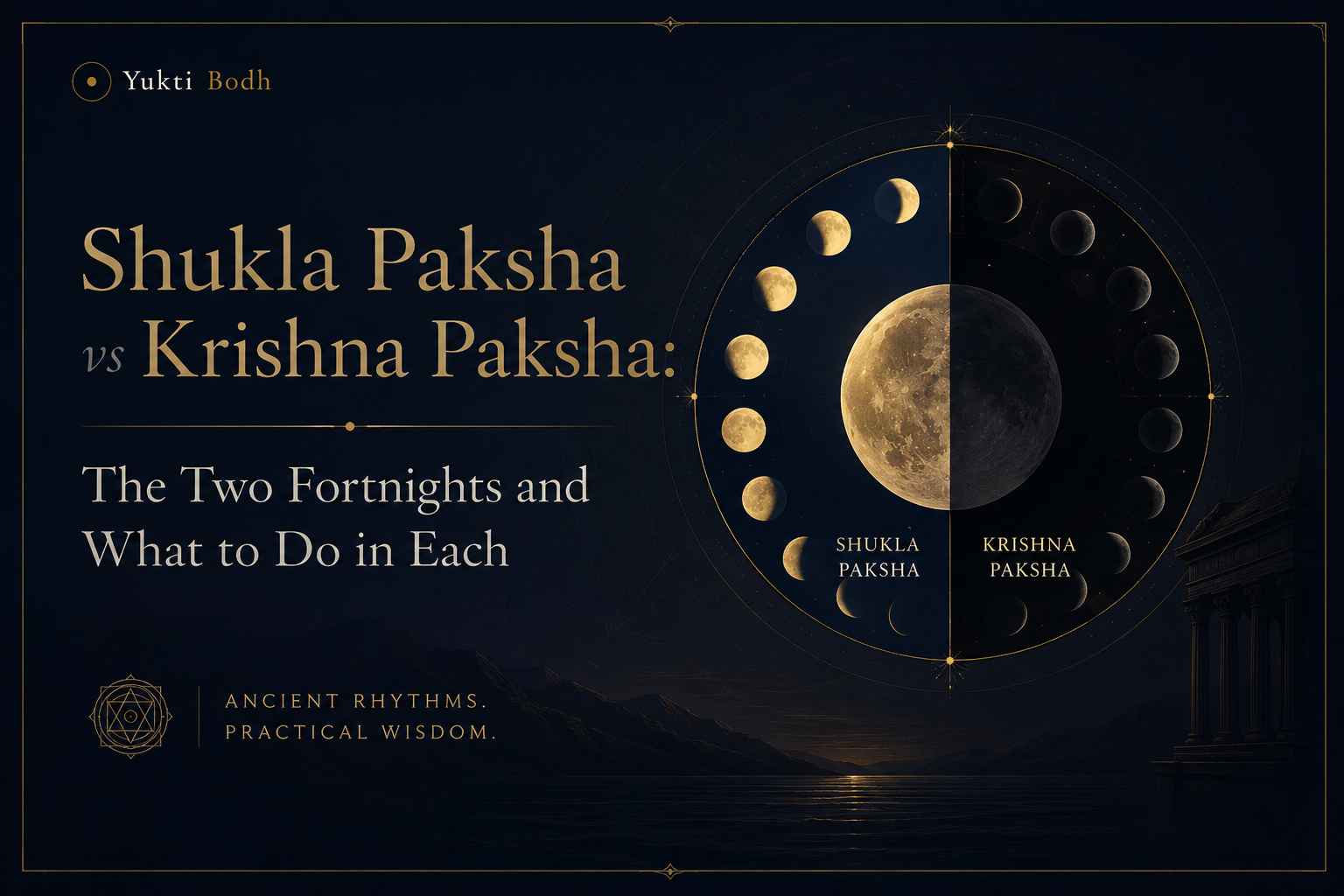
Shukla Paksha vs Krishna Paksha: The Two Fortnights and What to Do in Each
The lunar month in the Vedic tradition is divided into two fortnights — the Shukla Paksha and the Krishna Paksha. Shukla means bright or white: the Shukla Paksha is the waxing half of the month, from new moon to full moon, when the moon grows in size and luminosity. Krishna means dark: the Krishna Paksha is the waning half, from full moon to new moon, when the moon diminishes.
This division is not merely descriptive. The two Pakshas have distinct qualities — distinct influences on the mind, the emotions, and the outcomes of actions initiated within them. The classical tradition has detailed guidelines for which activities are best begun in which Paksha. Understanding these guidelines is practical knowledge, not superstition.
The Energetics of Shukla Paksha
During the Shukla Paksha, the moon is gaining light. The lunar energy is building, expanding, accumulating. The tidal pull of the moon’s gravity on the earth’s water systems — including the fluid systems of the human body — is increasing. The mind, which the classical texts connect directly to the moon (Chandra governs Manas), tends to be more outwardly directed, more expansive, and more receptive to external input.
The classical tradition considers Shukla Paksha the most auspicious fortnight for initiating new ventures. The expanding energy of the growing moon supports and amplifies what is begun during this period. New business launches, weddings, Griha Pravesh (entering a new home), sowing seeds in agriculture, beginning new studies, starting new practices — all are considered most auspicious in Shukla Paksha, ideally in the period between the first and the eleventh Tithi.
The Panchami (5th), Saptami (7th), and Dashami (10th) Tithis of the Shukla Paksha are considered among the most broadly auspicious for beginnings within this already auspicious fortnight.
The Energetics of Krishna Paksha
During the Krishna Paksha, the moon is losing light. The lunar energy is withdrawing, consolidating, deepening. The tidal pull decreases. The mind turns more inward, more reflective, more comfortable with solitude and inner work.
The Krishna Paksha is not considered inauspicious — this is a common misunderstanding. It is suited to a different quality of activity. Activities that involve completion, consolidation, harvesting the results of what has been built, ending what has run its course, inner practice, meditation, and retreat are all supported by the contracting energy of the waning moon.
In agricultural traditions, the Krishna Paksha is considered appropriate for harvesting — the life force has withdrawn from the surface into the roots, making the harvest moment ideal for extraction and preservation. This same principle extends to any activity where the goal is to draw inward, consolidate, or complete rather than initiate and expand.
The first half of the Krishna Paksha — roughly the first seven Tithis after the full moon — retains much of the Purnima energy and is not considered particularly inauspicious. The second half — the final seven or eight Tithis approaching the new moon — is when the withdrawing energy is most pronounced, and when the classical tradition most strongly advises against major new beginnings.
Amavasya: The New Moon as Threshold
The last day of the Krishna Paksha — the 15th Krishna Tithi, Amavasya — is the new moon, the darkest night of the month. In Vedic tradition, Amavasya is a significant threshold — a moment of maximum darkness and maximum potential simultaneously.
Amavasya is classically associated with the ancestors — the Pitrus — whose presence is considered most accessible when the barrier between the living and the departed is at its thinnest. Pitru Tarpan — offerings of water, sesame, and rice to the ancestors — is traditionally performed on Amavasya. In some lineages, the new moon is also considered a potent time for certain Tantric and Shaivite practices, because the darkness that removes all external distraction allows deeper inner access.
For most other activities — new beginnings, contracts, marriages, travel — Amavasya is generally avoided. This is not fear of the dark but recognition of the quality of the moment: it is a time for completion and transition, not for planting new seeds.
Purnima: The Full Moon as Peak
Purnima — the full moon, the 15th Shukla Tithi — is the counterpart of Amavasya: maximum light, maximum lunar energy, maximum outward expression. The mind at Purnima tends to be most active, most emotionally charged, most sensitive.
The classical tradition treats Purnima as broadly auspicious for worship, celebration, and the completion of auspicious activities. Important festivals cluster around the full moon: Purnima is the day of Guru Purnima (the full moon of Ashadha), Sharad Purnima (the full moon of Ashwin, considered the most auspicious of all Purnimas), Holi (Phalguna Purnima), and Buddha Purnima (Vaishakha Purnima).
The lunar energy at its peak makes Purnima particularly supportive for meditation, mantra practice, and any activity where heightened sensitivity and receptivity are assets rather than liabilities.
Working with the Paksha Cycle Practically
The most practical application of Paksha awareness is aligning the rhythm of your own activity with the rhythm of the lunar cycle — not rigidly, but with awareness.
In Shukla Paksha: initiate important projects, make significant decisions, begin new practices, schedule important meetings or launches, plant intentions.
In Krishna Paksha: review and refine what has been initiated, complete pending tasks, engage in inner work and reflection, clear what is no longer needed, consolidate gains.
At Purnima: review the month’s progress, celebrate completions, engage in extended meditation or prayer.
At Amavasya: rest, reflect, perform ancestral acknowledgement if that is part of your practice, and prepare the ground for what will be initiated in the coming Shukla Paksha.
This rhythm mirrors the natural energetic cycle of the moon — the same cycle that governs the tides, the growth of plants, and the fluid systems of the body. Aligning human activity with this cycle is not magical thinking. It is working with natural forces rather than against them.
The Paksha framework is one of the most immediately applicable elements of the Vedic time system — requiring no calculation, no chart, and no specialist knowledge beyond knowing whether the moon is waxing or waning on any given day.
The Vedic Moon and Panchang tool on this site shows the current Paksha automatically, along with the Tithi, Nakshatra, and full Panchang for today. For selecting the most auspicious Tithi and Paksha for important decisions and events, the Muhurat Calculator incorporates both factors as primary inputs.
[Use the Vedic Moon and Panchang tool →] to see today’s Paksha, Tithi, and the full classical Panchang.
★ Try the Tool
Generate your free Vedic birth chart — nakshatra, lagna, planetary positions, and more.
Open Vedic Chart Calculator →