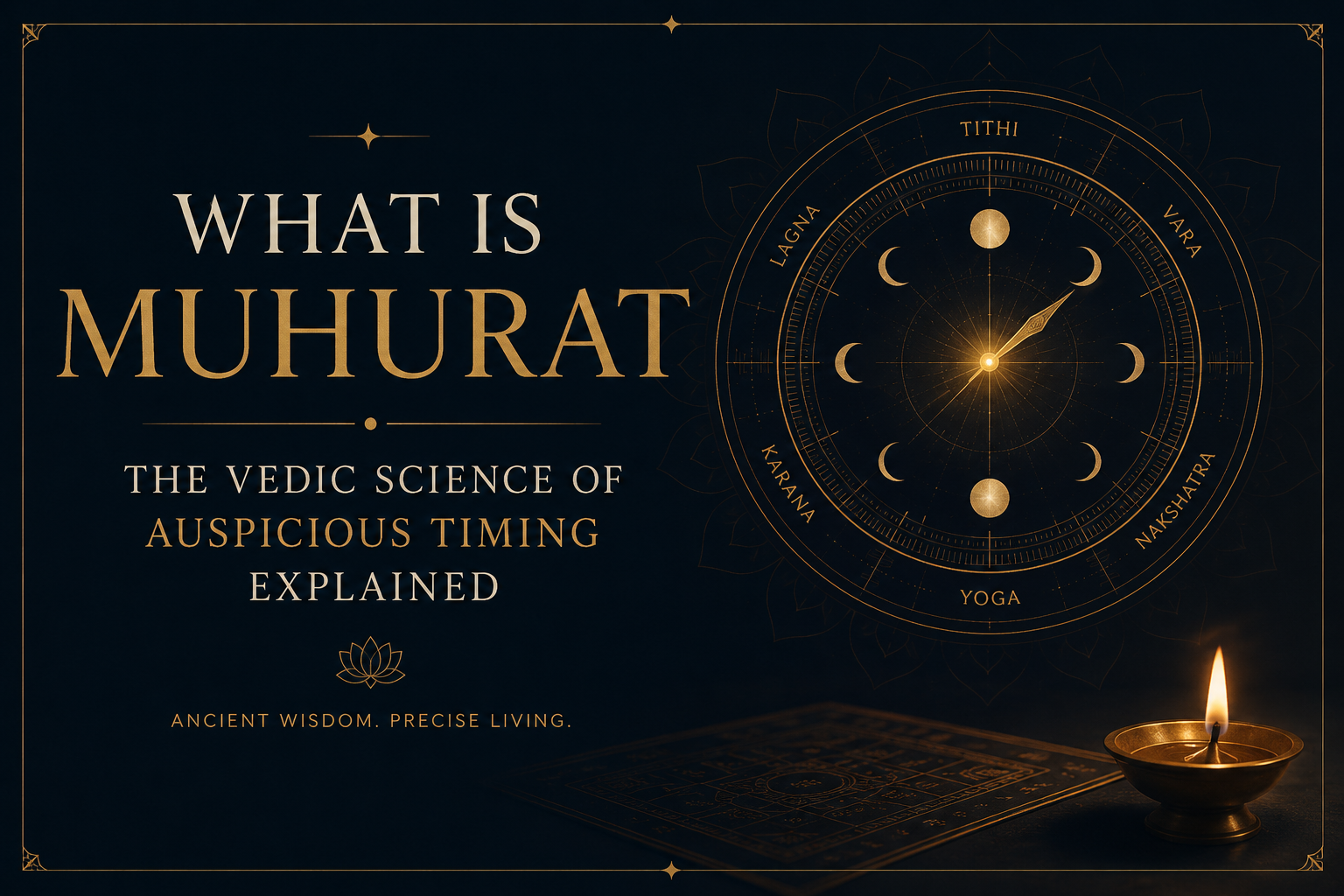
What Is Muhurat: The Vedic Science of Auspicious Timing Explained
In India, important events are rarely begun without consulting the Muhurat. Weddings are scheduled months in advance with a Jyotishi. New businesses check the Muhurat before launch day. Home entries, vehicle purchases, the start of medical treatments, the beginning of journeys — all of these are timed with reference to the Muhurat system in traditional practice.
To the modern secular eye, this can appear to be superstition — the belief that some moments are magically lucky and others unlucky. This misunderstands both what Muhurat is and what the Vedic tradition believes about time.
What Muhurat Actually Is
Muhurat comes from the Sanskrit Muhu (moment) and Rta (cosmic order, right timing). A Muhurat is not a lucky moment in the sense of being randomly fortunate. It is a moment of alignment — a window in time when the qualities of the celestial environment most strongly support a particular type of action.
The Vedic understanding is that time is not a neutral container. Time is structured — it has qualities and influences that vary continuously as the positions of the sun, moon, and planets change. Some configurations strongly support beginnings; others support completion, rest, or inward work. The science of Muhurat is the science of identifying which configurations support which types of action, and timing important activities accordingly.
This is not fundamentally different from the modern understanding that human physiology has circadian rhythms — that cognitive performance, physical strength, and hormonal cycles follow predictable patterns tied to the sun’s cycle. The Muhurat system extends this same logic: celestial cycles create predictable patterns in the qualities of time, and intelligent action aligns itself with those patterns.
The Five Elements of Muhurat: The Panchang
Every Muhurat is assessed through the five elements of the Panchang:
Tithi (lunar day): different Tithis are auspicious for different categories of action. Shukla Paksha is generally preferred for beginnings. Rikta Tithis (4th, 9th, 14th) are avoided for most Muhurats.
Vara (weekday): Monday and Thursday are broadly auspicious. Saturday is generally avoided for new beginnings due to Saturn’s restrictive quality.
Nakshatra: the moon’s lunar mansion at the Muhurat moment is one of the most important factors. Pushya, Rohini, Hasta, and the three Uttara Nakshatras are among the most broadly auspicious. Mula, Ardra, and Ashlesha are generally avoided.
Yoga: the 27 Panchangic Yogas range from highly auspicious (Siddha, Amrita, Shiva) to highly inauspicious (Vishkumbha, Vajra, Vyaghata). Inauspicious Yogas are avoided for important Muhurats.
Karana: the Bhadra or Vishti Karana must be absent from the chosen time window.
Additional Muhurat Factors Beyond the Panchang
The Lagna of the Muhurat: the rising sign at the exact proposed time is assessed for strength and benefic influence. A Muhurat with a powerful, unafflicted Lagna — ideally with a benefic planet in the first house — gives the event the strongest possible beginning.
The moon’s strength: the moon should be in a strong sign and free from association with severe malefic planets.
Inauspicious periods: Rahu Kala, Yamaganda, and Gulika are avoided for important Muhurat windows.
The personal chart: for the most personalised Muhurat, the timing should be assessed in relation to the individual’s birth chart — a Muhurat that is broadly auspicious may still be less than ideal if it activates difficult houses in the native’s personal chart.
What Muhurat Can and Cannot Do
What Muhurat can do: identify moments when the celestial environment most strongly supports a particular category of action; help avoid moments of particularly heavy adverse planetary influence; and create a quality of conscious intentionality in the timing of important actions — the act of seeking an auspicious moment itself brings a quality of seriousness and preparation to whatever is being initiated.
What Muhurat cannot do: overcome the fundamental quality of the project, relationship, or decision being initiated. A business with a flawed business model, launched at a perfect Muhurat, will still have a flawed business model. The Muhurat sets the best possible initial conditions — it does not determine the outcome.
The classical tradition is clear on this: Muhurat is one input into intelligent decision-making, not a substitute for it.
Muhurat is the practical daily expression of Jyotish — the application of the science of time to the ordinary decisions of life. Used intelligently, with appropriate humility about what it can and cannot accomplish, it is one of the most immediately useful tools the Vedic tradition offers.
The Muhurat Calculator on this site applies the full Panchang framework to the most common categories of important life decisions — providing not just the recommended timing but the full reasoning behind it. The Vedic Moon and Panchang tool provides the daily Panchang for ongoing timing awareness.
[Use the Muhurat Calculator →] to find the most auspicious timing for your important decisions using the complete Vedic framework
★ Try the Tool
Generate your free Vedic birth chart — nakshatra, lagna, planetary positions, and more.
Open Vedic Chart Calculator →