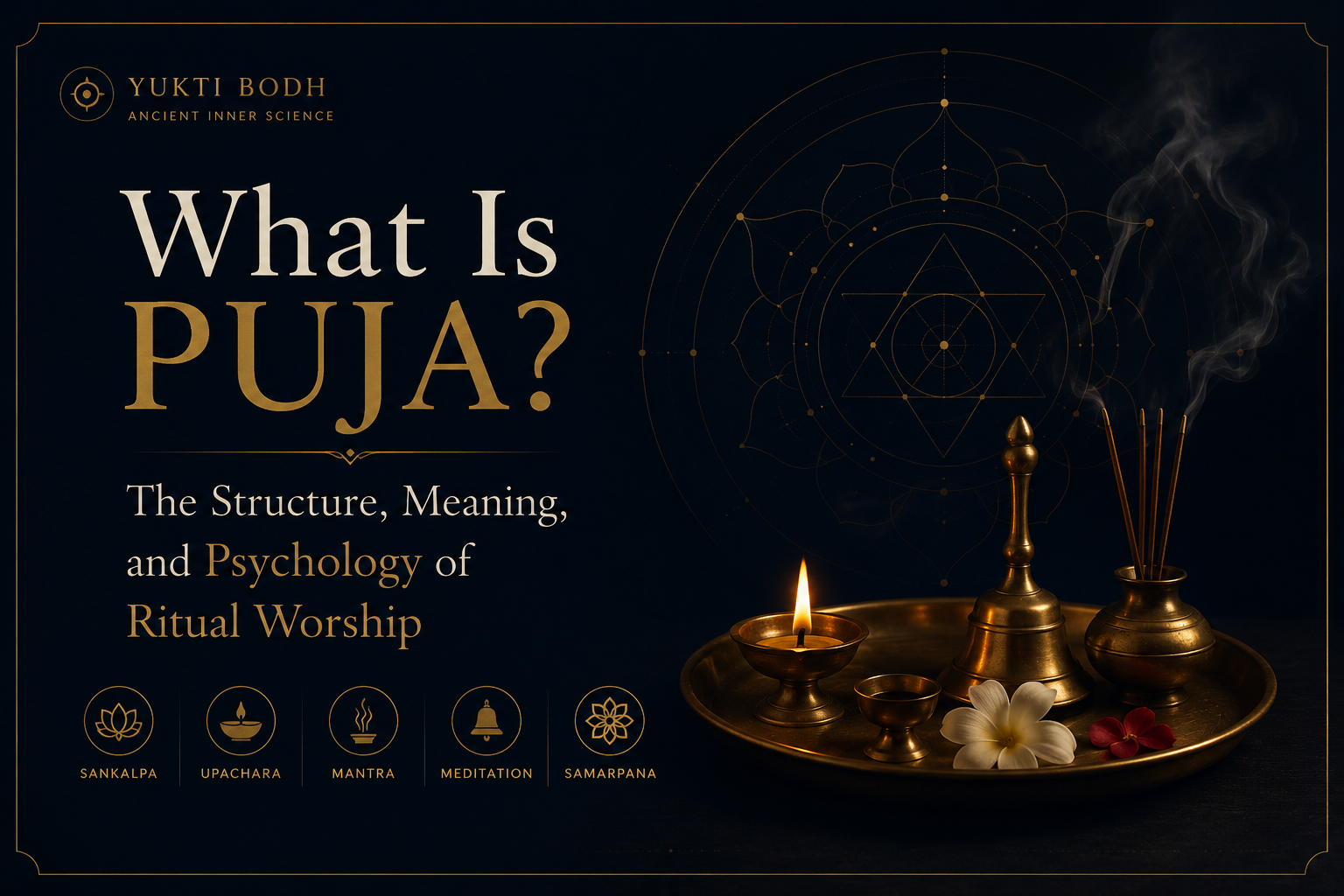
What Is Puja: The Structure, Meaning, and Psychology of Ritual Worship
SEO Meta: Puja is not merely religious ceremony. It is a precise psychological and energetic system for cultivating specific qualities of consciousness. Here is the complete classical framework.
Slug: /what-is-puja-structure-meaning-psychology/
Puja is one of the most widely practised and least deeply understood rituals in the Hindu tradition. Millions perform Puja daily — some with elaborate preparations, others with a single flower and a stick of incense. In modern secular contexts it is often characterised as religious ceremony, superstitious idol worship, or at best a meditative routine.
The classical understanding is quite different. Puja — from the Sanskrit root Puj, to honour — is a precisely structured psychological and energetic system for cultivating specific inner qualities, establishing a relationship between the individual consciousness and a particular divine principle, and creating the internal conditions for genuine inner transformation.
The Deity as Principle, Not Person
In the Vedic and Tantric traditions, the deities are not supernatural persons who need to be appeased or who dispense favours to their worshippers. They are personifications of specific cosmic and psychological principles — recognisable patterns in the field of consciousness given form, story, and image to make them accessible to the human mind.
Ganesha is the principle of intelligent obstacle removal. Saraswati is the principle of Vak — the power of speech, knowledge, and creative intelligence. Lakshmi is the principle of Shri — auspiciousness, beauty, abundance, and the qualities that sustain flourishing. Shiva is the principle of pure awareness — the witness, the stillness at the heart of all change. Shakti-Devi is the principle of dynamic power — the force through which consciousness creates, sustains, and dissolves.
When you perform Puja to Ganesha, you are establishing a relationship with the principle of intelligent obstacle removal within your own consciousness — invoking it, acknowledging it, and cultivating it. The external ritual is the vehicle; the internal transformation is the content.
The Shodashopachara: The Sixteen Offerings
The most complete form of Puja is the Shodashopachara — the sixteen-offering Puja. The sixteen offerings and their inner meaning:
Avahana (invocation): the conscious invitation of the deity’s presence — the deliberate turn of attention toward the principle being invoked. Asana (seat): stabilising the mind — providing a seat for the invited awareness to rest in. Padya (water for feet): humility — recognising what is being honoured as worthy of intimate service. Arghya (water for hands): offering one’s capacity for action to the worshipped principle. Achamana (water for sipping): purification of speech. Snana (bathing): purification of perception — the washing of the inner instrument by the five nectars of the senses engaged in service. Vastra (clothing): dignity — recognising the principle as complete. Gandha (sandalwood): offering of the sense of smell and through it the entire physical body. Pushpa (flowers): beauty offered as awareness — recognising what is beautiful as an expression of the divine. Dhupa (incense): purification of the subtle environment through fragrance. Dipa (lamp): offering one’s capacity for illumination — one’s intelligence and awareness — to the divine principle. Naivedya (food): offering the sustaining energy of life itself to the principle. Tambula (betel): the offering of completion. Pradakshina (circumambulation): recognition that the divine principle is at the centre of one’s life — enacted geometrically. Namaskara (prostration): the most complete gesture of inner surrender.
The Psychology of Ritual: Why External Form Matters
The classical argument for external ritual rests on a precise understanding of how human consciousness works.
The mind in ordinary waking life is embodied — embedded in sensory experience, physical gesture, and the texture of material things. A purely mental practice — with no external anchors — requires a degree of concentration that most practitioners simply do not have in the early stages of practice.
External ritual provides the scaffolding that developing concentration uses. The physical acts of Puja — the specific gestures, smells, sounds, and sights — create a multisensory environment that engages the mind at every level simultaneously, making wandering less likely and depth more accessible.
Over time, as concentration deepens, the external ritual becomes progressively internalised — eventually performed entirely within the subtle body as pure inner visualisation. But the classical tradition insists that beginning with the external form, rather than leaping directly to internalised practice, produces faster and more reliable inner development.
Puja and Bhakti: Devotion as a Path
In the classical classification of spiritual paths, Bhakti Yoga — the yoga of devotion — is described as the most accessible for most human beings, because it works with the most powerful force in human psychology: the capacity for love and attachment.
Puja is the primary practice of Bhakti Yoga — the structured channelling of the human capacity for love toward a principle of consciousness rather than toward a person or an object. When Puja is performed with genuine Bhava — genuine feeling, genuine presence — it activates the same neurological and emotional pathways as personal love, but directs them toward the cultivation of a specific inner quality.
The classical tradition describes the advanced Bhakta as someone who experiences the relationship with the deity as the most intimate and most real relationship of their life. This is not delusion. It is the logical conclusion of a practice that progressively deepens the relationship between individual consciousness and the cosmic principles it embodies.
Puja is a complete system — psychological, energetic, devotional, and philosophical — contained in the simple acts of offering flowers, light, food, and water to an image or symbol. Its depth is accessible to any practitioner willing to engage it with genuine presence rather than mechanical performance.
For timing Puja to the most auspicious moments — the Sandhya hours, the auspicious Tithis and Nakshatras, the specific deity days of the week — the Vedic Moon and Panchang tool provides the daily framework. The Muhurat Calculator identifies the most auspicious windows for beginning or establishing a new Puja practice.
[Use the Vedic Moon and Panchang tool →] to align your Puja practice with the most auspicious times in the daily and monthly cycle.
★ Try the Tool
Generate your free Vedic birth chart — nakshatra, lagna, planetary positions, and more.
Open Vedic Chart Calculator →