You’re Not Tired. You’re Burned Out. Here’s How to Know the Difference.
Sleep doesn’t help anymore.
You take a weekend. You take a holiday. You come back and within two days you’re back at the same level of hollow, grey, can’t-be-bothered-to-care that you left with.
That is not tiredness. Tiredness responds to rest. What you’re describing is burnout — and the distinction matters enormously because they require completely different responses.
The Research Behind Burnout
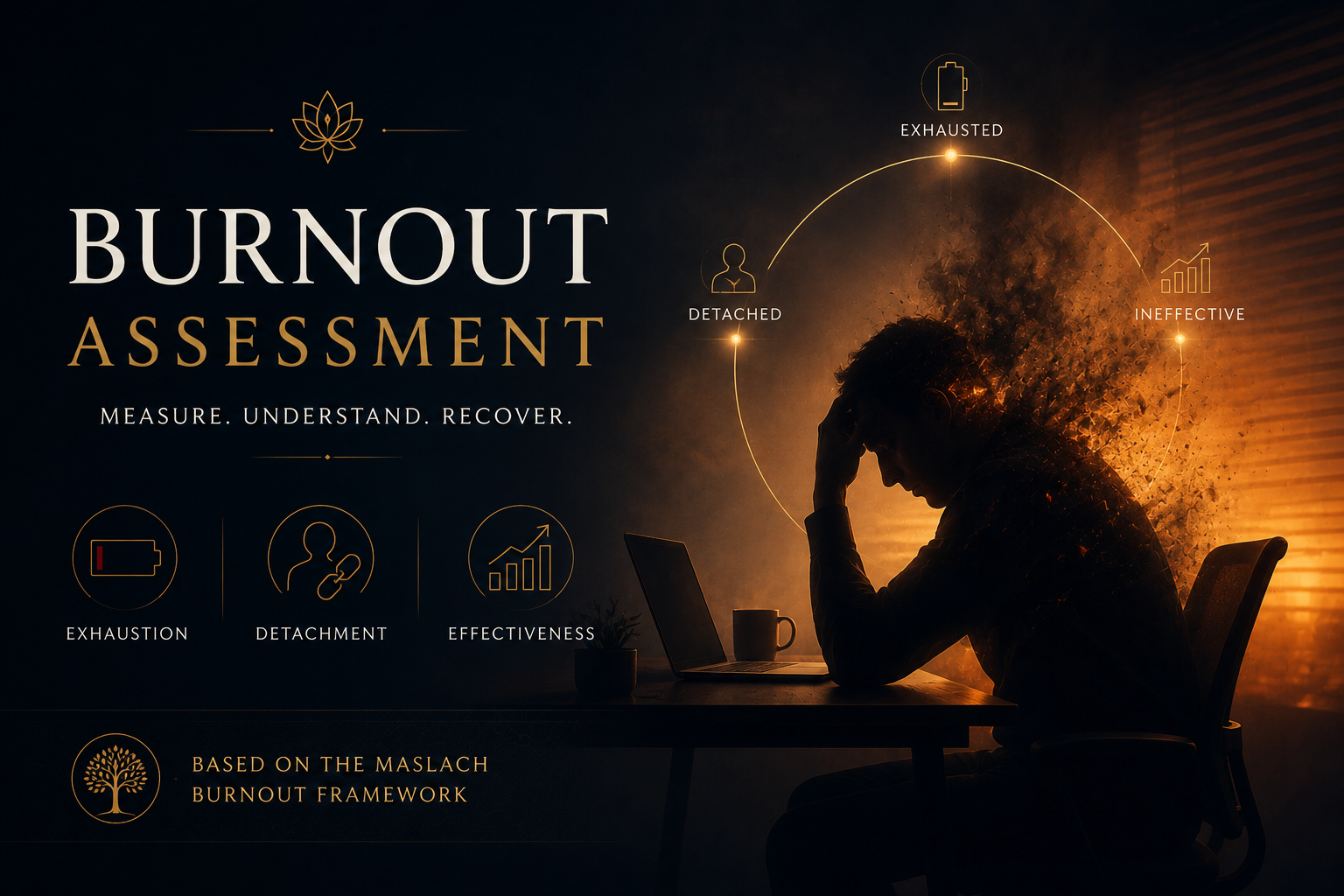
In 1981, social psychologist Christina Maslach published what became the most widely cited burnout research in the field. Her framework — the Maslach Burnout Inventory — identified burnout not as a single feeling but as a three-dimensional syndrome:
Exhaustion: The depletion of emotional and physical energy beyond what rest can restore. You feel empty even after sleep. There is no reserve.
Depersonalisation: Emotional detachment from the work you once cared about, and from the people involved in it. Patients become cases. Colleagues become obstacles. Work becomes something you endure, not something you do. This is the dimension that looks like cynicism from the outside.
Reduced Personal Accomplishment: The quiet, corrosive belief that nothing you do makes a difference. Your effort doesn’t produce outcomes. Your presence doesn’t matter. This is the dimension most associated with depression-adjacent thinking.
Burnout is not just high exhaustion. Most people misidentify it at the exhaustion stage and try to rest their way out of it — which addresses one dimension while the other two continue to deteriorate.
Why Most Burnout Conversations Miss the Point
The wellness industry has co-opted burnout as a synonym for stress. “Take a bath. Do yoga. Set boundaries.”
These are not wrong suggestions for stress management. They are approximately useless for clinical-range burnout, because burnout is not primarily about stress load — it’s about the chronic mismatch between what the work demands and what the environment provides.
Maslach’s research identified six mismatches that reliably produce burnout: workload (too much), control (too little), reward (inadequate), community (broken), fairness (absent), and values (misaligned).
You can meditate every morning and still burn out if you work in an environment where effort is invisible, credit is redistributed upward, and the work itself has become meaningless to you.
The Three Profiles Worth Knowing
High Exhaustion Only: Early stage. Rest, boundary-setting, and workload reduction can still work.
High Exhaustion + High Depersonalisation: Mid-stage. The detachment is now a coping mechanism. The environment likely needs to change, not just your self-care practices.
All Three High: Severe burnout. This typically requires structural change — role, organisation, or career direction — alongside clinical support. Wellness interventions alone will not resolve this profile.
What the Assessment Measures
The 21-question MBI measures all three dimensions separately with validated scoring. You get your exact position on each axis — not “you are burned out” (unhelpfully binary) but exactly where you sit across exhaustion, depersonalisation, and efficacy, with interpretation of what that combination means.
Take the Assessment
21 questions. 5 minutes. Free scores on all three dimensions. Full recovery protocol available for ₹99 — specific to your profile combination, not generic advice.
→ Take the Burnout Assessment at yuktilabs.in/mind/burnout/
🧠 Try the Tool
Explore our free psychology assessments — Big Five, GAD-7, attachment style, and more.
See All Psychology Tests →