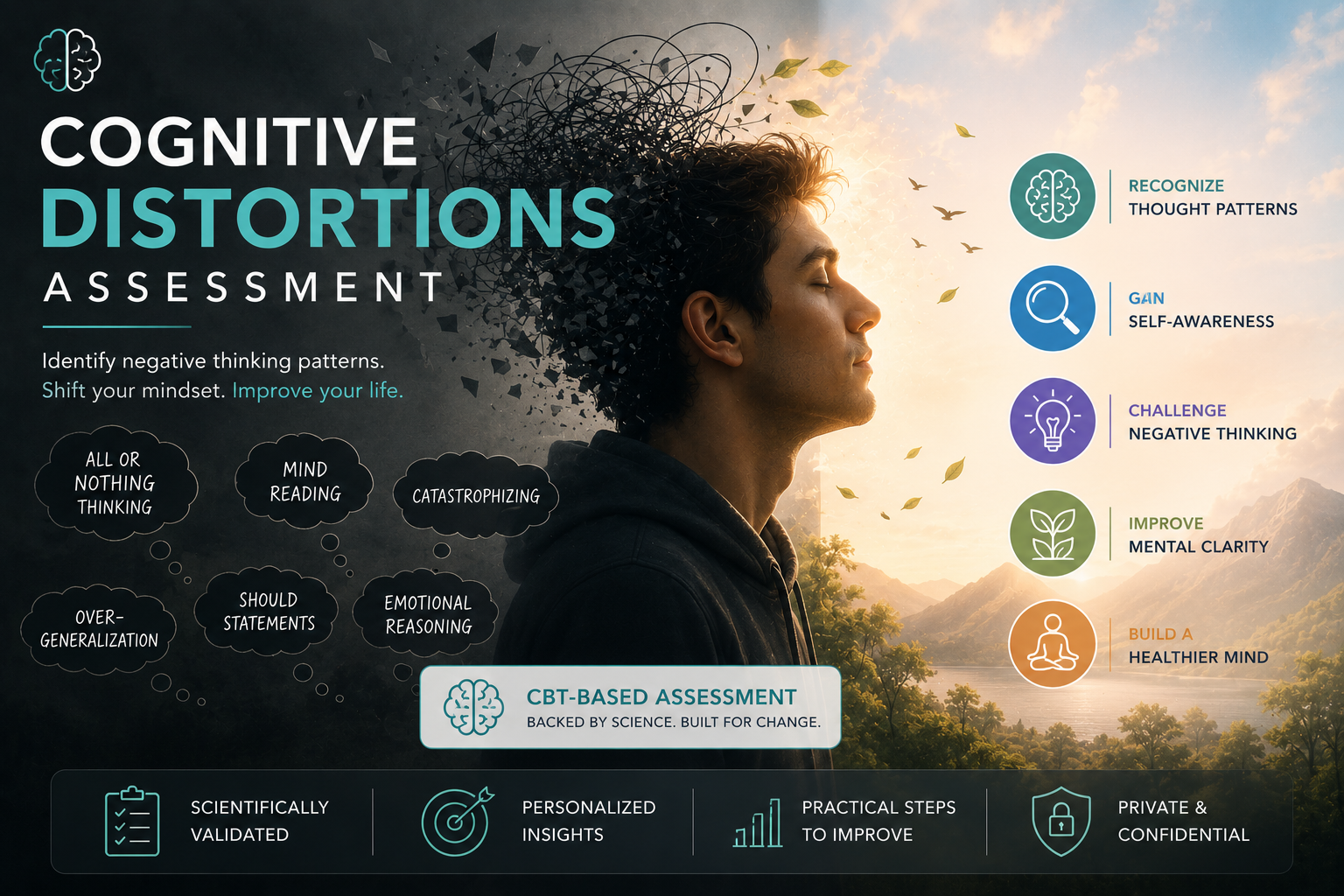
Your Brain Is Lying to You — 10 Ways It Distorts Reality (And How to Catch It)
You’ve had the thought: I always mess things up.
Or: They didn’t reply — they must be angry with me.
Or: If I can’t do this perfectly, there’s no point trying.
These are not rational assessments of reality. They are cognitive distortions — systematic errors in thinking that your brain runs automatically, below the level of conscious choice, shaping every interpretation you make before you’ve had a chance to examine it.
Aaron Beck identified them in the 1960s. Half a century later, dismantling them is still the core mechanism of the most evidence-backed psychological treatment in existence.
What Are Cognitive Distortions?
Cognitive distortions are not signs of mental illness. They are features of human cognition — shortcuts that evolved for survival but misfire in the context of modern life.
Beck identified ten primary patterns. His student David Burns later popularised them. Here are the ones that appear most frequently:
All-or-Nothing Thinking: Reality exists only in extremes. Success or failure. Perfect or worthless. One setback is total collapse. This pattern makes resilience structurally impossible.
Catastrophising: Automatically jumping to the worst plausible outcome. Not “this could be difficult” but “this will destroy everything.” The anxiety this generates is proportionate to a threat that exists only in the projection.
Mind Reading: Assuming you know what others are thinking, without evidence, and usually assuming the worst. The colleague who didn’t acknowledge your email is definitely annoyed. The friend who seemed quiet is probably angry with you.
Emotional Reasoning: Treating feelings as facts. I feel worthless, therefore I am worthless. I feel like a failure, therefore I have failed. Emotions are real. They are not reliable narrators of external reality.
Should Statements: Rigid internal rules about how you and others ought to behave. When reality fails to comply — which it does constantly — the result is chronic guilt, frustration, and resentment.
Personalisation: Taking responsibility for things outside your control. Your child’s bad day is your failure as a parent. Your partner’s mood is something you caused. This one is particularly corrosive because it feels like conscientiousness.
Overgeneralisation: A single negative event becomes a universal pattern. This always happens to me. I never get this right. Nothing ever works.
Mental Filter: Focusing exclusively on a single negative detail while filtering out everything else. One critical comment erases ten complimentary ones.
Discounting the Positive: Not just ignoring positives — actively disqualifying them. They only said that to be nice. That doesn’t count. Anyone could have done that.
Magnification/Minimisation: Exaggerating the significance of problems and shrinking the significance of achievements. Your mistakes are catastrophes; your successes are flukes.
Why This Is the Foundation of CBT
Cognitive Behavioural Therapy — the most extensively studied psychological intervention, with over 2,000 clinical trials supporting its efficacy — is built almost entirely on one mechanism: identifying distorted thoughts, examining the evidence for and against them, and developing more accurate alternatives.
This is not positive thinking. It is not telling yourself everything is fine. It is applying basic epistemic standards — what is the actual evidence? — to thoughts your brain presents as obvious facts.
The distortions are the entry point. You cannot challenge a thought you haven’t identified.
What the Assessment Tells You
The 40-question CBT-based assessment scores all ten distortion types separately. Most people have two or three dominant patterns — the ones that activate automatically across different situations and domains.
Knowing your specific dominant distortions is more useful than knowing you “overthink” or “are too hard on yourself.” The intervention is different for catastrophising versus personalisation versus mental filter — and generic self-help advice tends to address all of them poorly precisely because it doesn’t distinguish between them.
All ten distortions are scored free. The full CBT reframe protocol — specific to your highest-scoring patterns — is available for ₹99.
Take the Test
40 questions. 8 minutes. All 10 distortions scored free.
→ Take the Cognitive Distortions Test at yuktilabs.in/mind/cognitive-distortions/
🧠 Try the Tool
Explore our free psychology assessments — Big Five, GAD-7, attachment style, and more.
See All Psychology Tests →