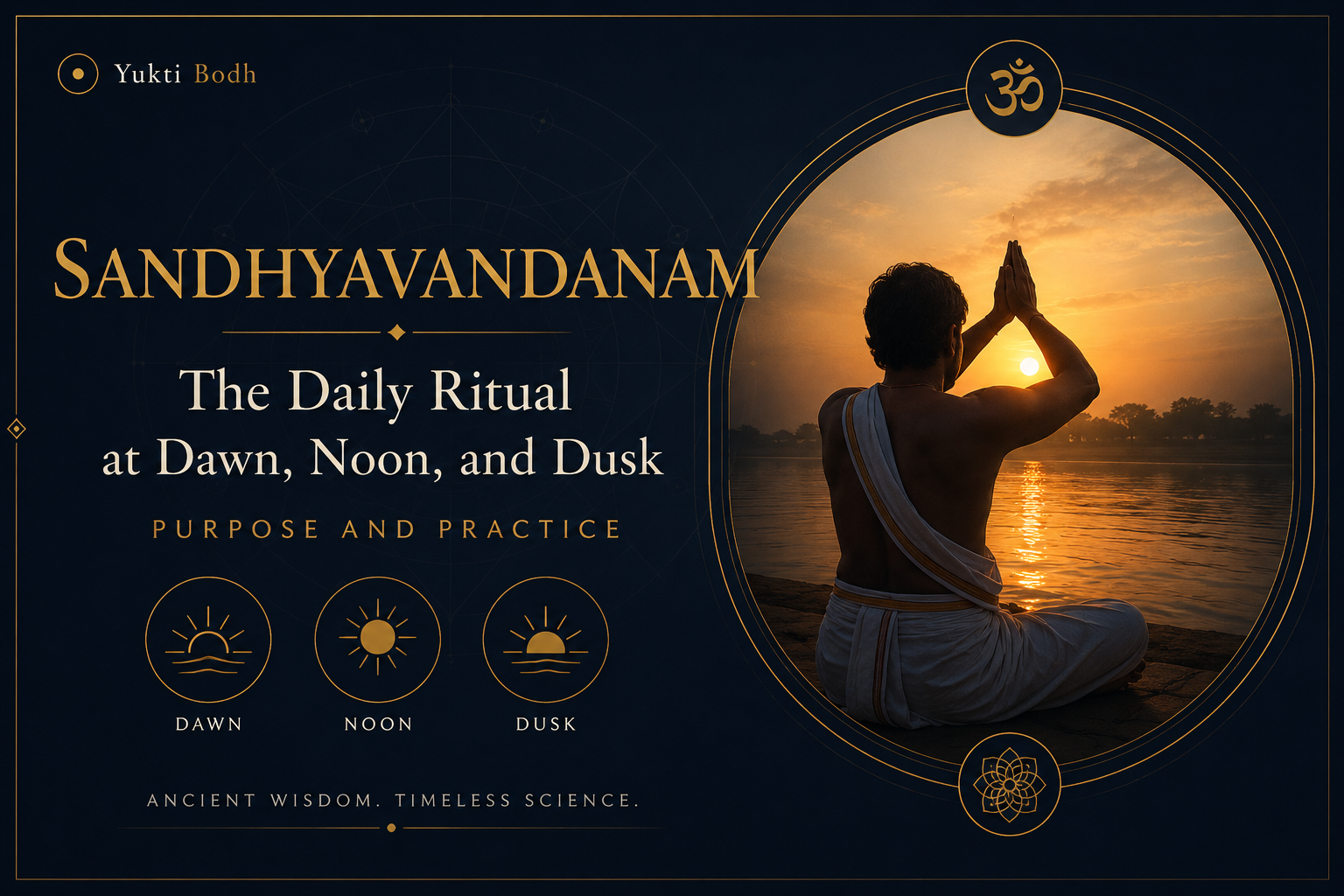
Sandhyavandanam: The Daily Ritual at Dawn, Noon, and Dusk — Purpose and Practice
Sandhyavandanam — literally the salutation to the Sandhya — is one of the most ancient and most systematically structured daily practices in the Vedic tradition. It is performed at the three Sandhyas: Pratah Sandhya (dawn), Madhyahna Sandhya (noon), and Sayam Sandhya (dusk).
For a Brahmin in the classical tradition, Sandhyavandanam was a non-negotiable daily obligation — the foundational practice of conscious life, performed three times a day from the time of the sacred thread ceremony until death. In modern life, this level of commitment is rare. But understanding what Sandhyavandanam is and why the three Sandhyas are its timing reveals something important about the Vedic understanding of time, consciousness, and daily practice.
What Is the Sandhya
Sandhya is a Sanskrit word meaning junction or meeting point. The three Sandhyas are the three junctions in the solar day — the moments when the qualities of two different time periods meet.
Dawn is the meeting of night and day — darkness and light, the unconscious and the conscious. It is the moment when consciousness makes the transition from sleep to waking.
Noon is the moment of maximum solar intensity — the turning point when the sun’s arc begins its descent. Solar Prana is at its most concentrated.
Dusk is the mirror of dawn — the meeting of day and night when consciousness makes the transition from full waking activity toward the resting, inward quality of evening.
In the classical understanding, these junction moments are energetically significant — the transition between two different qualities of Pranic field creates an opening that is more powerful than either side of the junction alone. This is why the Sandhyas are the most potent moments for both formal practice and ritual.
The Structure of Sandhyavandanam
The classical Sandhyavandanam sequence includes: Achamana (ritual water sipping for purification); Pranayama (specific breathing practice for Pranic settling); Marjana (water sprinkling accompanied by Rig Vedic mantras); Pranayama with Gayatri (breathing the Gayatri Mantra in a specific ratio); Arghya (water offering to the sun — facing east at dawn, upward at noon, west at dusk); Gayatri Japa (repetition of the Gayatri Mantra 108 times or 10 times in shortened form); Tarpana (water offering to deities, sages, and ancestors); and Namaskara (prostration marking the formal conclusion).
The Gayatri Mantra: The Core of Sandhyavandanam
The Gayatri Mantra is the heart of Sandhyavandanam and one of the most significant mantras in the entire Vedic tradition. It appears in the Rig Veda (3.62.10) and has been recited daily by practitioners for millennia.
The mantra: Om Bhur Bhuvah Svah, Tat Savitur Varenyam, Bhargo Devasya Dhimahi, Dhiyo Yo Nah Prachodayat.
The meaning: we meditate on the brilliant light of the divine solar intelligence — may it inspire and direct our intellects.
The Gayatri is a prayer to Savitar — the solar deity — to illuminate the intellect (Vijnanamaya Kosha) so that discriminative wisdom can function clearly. Its daily repetition at the three Sandhyas — the moments of maximum solar transition — aligns the practitioner’s inner intelligence with the solar intelligence that governs time and illumines consciousness.
Why the Three Sandhyas Are the Right Time for Practice
At the Sandhya moments, the Prana in the environment is in a state of transition — the qualities of the previous period are withdrawing and the qualities of the next period are emerging. This transitional state creates a natural opening in the ordinary Pranic field: the mind is momentarily between the two dominant qualities. This between-ness is a window for practice — a moment of natural Pratyahara in which the mind can more easily turn inward.
Additionally, the Sandhyas correspond to the moments of maximum transition in the light spectrum — the change in light quality at dawn and dusk affects human physiology directly, altering melatonin levels, cortisol rhythms, and hormonal balance in ways that make these moments naturally more conducive to inner practice.
The practical wisdom encoded in the three-times-daily structure of Sandhyavandanam is the recognition that daily life has natural rhythms, and that aligning practice with these rhythms produces cumulative effects that random-timing practice does not.
Sandhyavandanam is one of the most complete daily practice systems ever developed — combining purification, Pranayama, mantra, and solar alignment into a structured sequence that can be completed in fifteen to thirty minutes and performed three times daily without elaborate preparation.
For practitioners who want to align their daily Pranayama and meditation with the Vedic understanding of auspicious timing, the Vedic Moon and Panchang tool shows the daily Panchang. The Meditation Timer provides the structured container for the Gayatri Japa component.
[Use the Vedic Moon and Panchang tool →] to track the Sandhya moments and align your daily practice with the classical timing framework.
◎ Try the Tool
Find which chakras are balanced, blocked, or overactive with our free diagnostic.
Open Chakra Diagnostic →