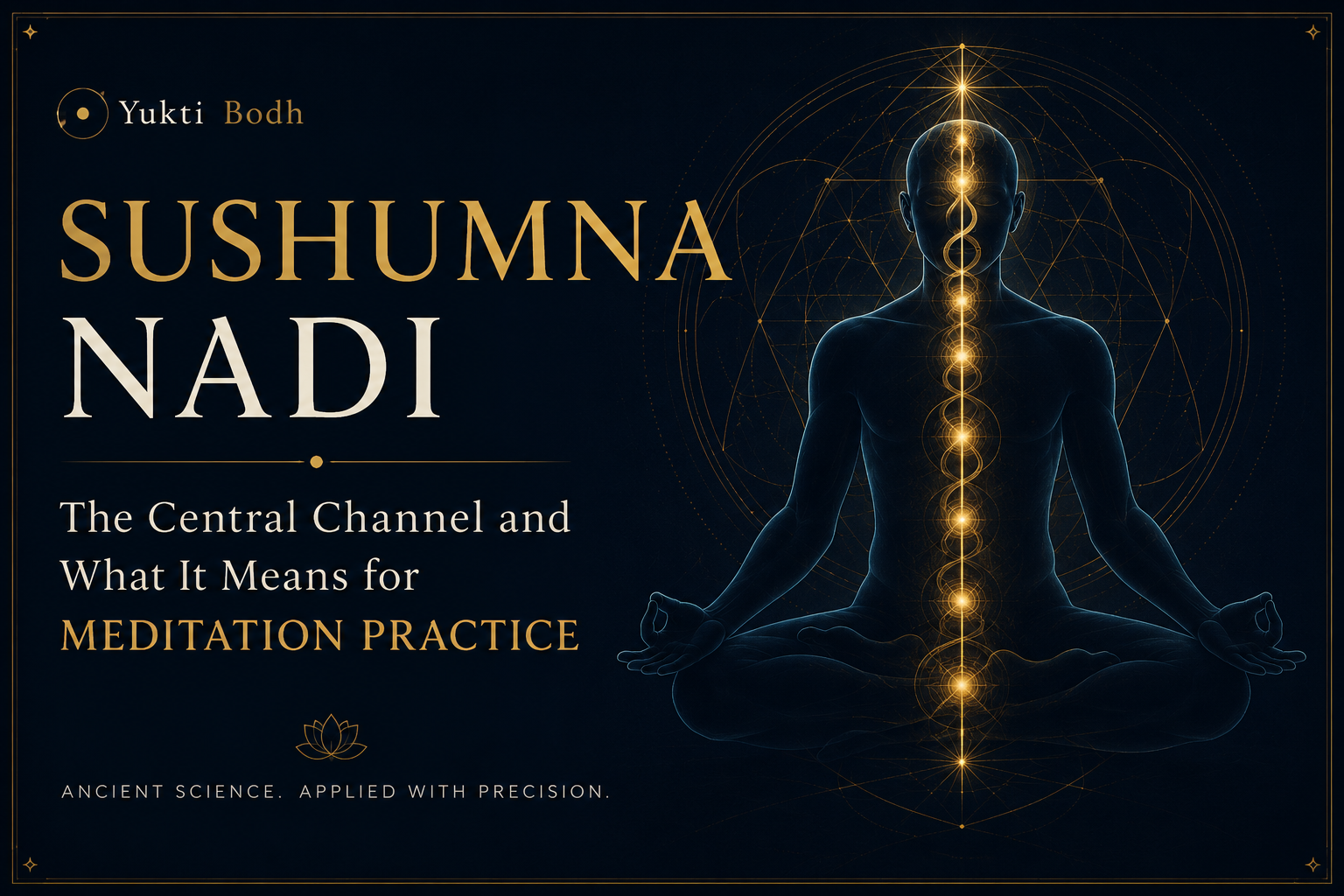
Sushumna Nadi: The Central Channel and What It Means for Meditation Practice
Among the 72,000 Nadis of the subtle body, Sushumna is supreme. Not because it is the most active — in ordinary life, Sushumna is largely dormant — but because of what happens when it opens. The classical texts are unanimous: genuine meditation, the movement of Kundalini, and the direct realisation of the self all occur in the Sushumna. Everything else — the activities of Ida and Pingala, the outward movement of the senses, the arising of thoughts and emotions — takes place outside it.
Understanding Sushumna changes the entire understanding of what meditation is and what is being aimed for.
The Classical Description of Sushumna
Sushumna runs from Muladhara at the base of the spine to Sahasrara at the crown of the head, passing through each of the six chakras in its path. Within Sushumna, the classical texts describe three concentric inner channels: Vajrini Nadi inside Sushumna, Chitrini Nadi inside Vajrini, and Brahma Nadi at the innermost centre. It is through the Brahma Nadi that Kundalini Shakti moves in her upward journey.
The Sat-Chakra-Nirupana describes Sushumna as like a string of brilliant gems — the chakras as luminous jewels threaded along the central channel. It is called by many names: Saraswati (the river of knowledge), Shambhavi (the path of Shambhu, Shiva), and simply the middle path.
Why Sushumna Is Dormant in Ordinary Life
In the ordinary waking state, consciousness flows outward through Ida and Pingala into sensory experience, thought, and activity. Sushumna remains closed: the sleeping Kundalini at its base blocks its entrance, and the Pranic currents of daily life flow through the peripheral channels.
The natural moments when Sushumna opens briefly in ordinary life include: the transition between waking and sleep, deep dreamless sleep itself, the transition between sleep and waking, moments of peak creative inspiration, and the brief transition moments in the nasal cycle when both nostrils flow equally.
How Practice Opens Sushumna
The classical path for opening Sushumna is a progressive development through the entire Hatha Yoga and Pranayama system. The primary mechanism is the meeting of Prana Vayu and Apana Vayu in the navel region — an ignition of the inner fire that provides the heat and force for Kundalini to begin her upward movement. This meeting is created by Pranayama — specifically by Kumbhaka (retention) with Mula Bandha and Uddiyana Bandha applied.
Nadi Shodhana purifies Ida and Pingala — a necessary prerequisite, because Sushumna can only open when the two flanking channels are clean and balanced. Moola Bandha, applied consistently in practice, gradually awakens Muladhara and the sleeping Kundalini at its base.
Sushumna and Meditation: The Direct Relationship
The classical texts describe a relationship between Sushumna and meditation that is not metaphorical: meditation occurs in Sushumna. The quality of inner experience that we call meditation — the genuine cessation of the mind’s outward movement and its resting in its own source — is the experiential correlate of Sushumna being open and Prana moving through it.
This explains the difference between meditation sessions where genuine depth occurs and sessions where it does not. Both may involve the same technique and duration. The variable is the condition of the subtle body — specifically, whether Sushumna is open or closed. When Sushumna is open, the mind naturally turns inward, thoughts slow without effort, and a quality of witness awareness becomes accessible.
Signs That Sushumna Is Opening
Practitioners who work consistently with the Pranayama and Bandha system over months and years report recognisable signs that correlate with progressive Sushumna opening: the breath in meditation becomes very slow and very subtle; both nostrils flow equally for extended periods during and after practice; a quality of central awareness arises — presence that is neither outwardly directed nor inwardly receptive but simply still and self-aware; heat in the spine, particularly in the region of the lower chakras; and inner sounds (Nada) becoming perceptible — the high, clear tones described in classical Nada Yoga texts.
Sushumna is the spine of the classical practice system — the channel through which everything the tradition points toward actually occurs. Working to open it is not a specialised advanced practice for rare adepts. It is the natural direction of the entire classical system of Pranayama, Bandha, and meditation, progressively applied over time.
The Pranayama Guide on this site — with Nadi Shodhana, Kapalabhati, Bhramari, and the complete classical breath practices — is the most direct entry point to the systematic work of opening Sushumna. The Meditation Timer provides the distraction-free sitting environment in which the open Sushumna is most productively engaged.
[Use the Pranayama Guide →] to begin the systematic practice that gradually opens the Sushumna and deepens meditation
◎ Try the Tool
Find which chakras are balanced, blocked, or overactive with our free diagnostic.
Open Chakra Diagnostic →