The Only Personality Test That Actually Predicts Your Future (And It’s Not MBTI)
You’ve probably taken a personality test at some point.
Maybe MBTI told you you’re an INFJ. Maybe an Instagram quiz confirmed you’re “the empath of the group.” Maybe your company ran a DISC assessment before a team workshop.
And then — nothing changed. You read the result, nodded, and moved on.
Here’s why: most personality tests are entertainment dressed as science. The Big Five is not.
What Is the Big Five — and Why Does It Actually Matter?
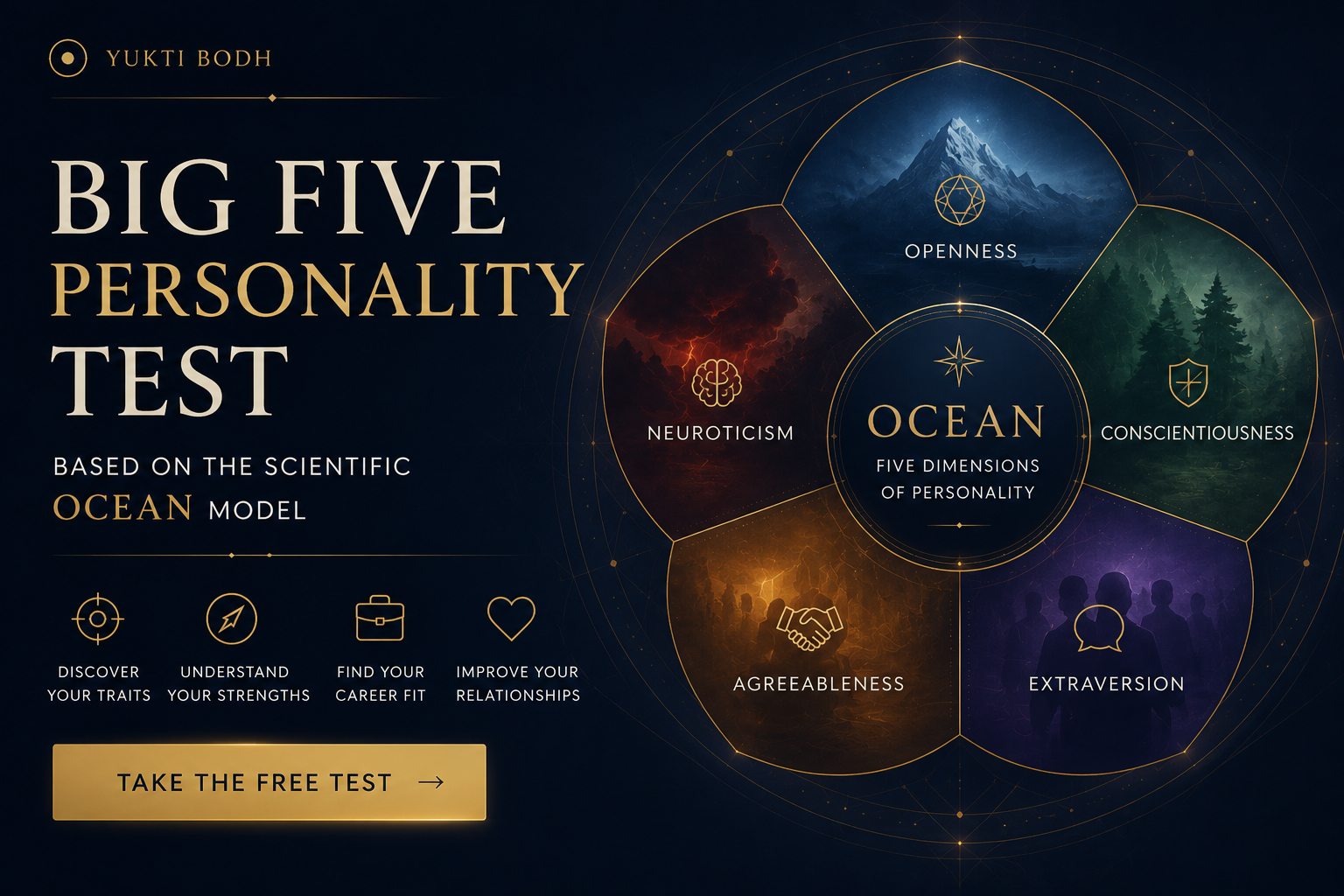
The Big Five, also known as the OCEAN model, is the most scientifically validated personality framework ever developed. Not because one psychologist invented it and marketed it well, but because it emerged from decades of independent factor analysis across dozens of research groups — in different languages, different cultures, different continents — and they kept arriving at the same five dimensions.
O — Openness to Experience Your appetite for novelty, creativity, abstract thinking, and intellectual curiosity. High scorers seek complexity. Low scorers prefer familiarity and structure.
C — Conscientiousness Your capacity for discipline, organisation, follow-through, and goal-directed behaviour. The single strongest predictor of career success across almost every field studied.
E — Extraversion Not just whether you like parties. Your baseline need for social stimulation, dominance in groups, and positive emotional responsiveness to external rewards.
A — Agreeableness Your orientation toward cooperation, trust, and others’ needs versus self-interest. High agreeableness predicts relationship satisfaction; low agreeableness predicts negotiating power.
N — Neuroticism Your emotional reactivity. How intensely you respond to stress, setbacks, and perceived threats. The strongest predictor of anxiety, depression, and relationship conflict.
What MBTI Gets Wrong That Big Five Gets Right
MBTI puts you in a box: you’re either an introvert or an extrovert. Either a thinker or a feeler. Either judging or perceiving.
The Big Five measures you on a continuous spectrum. You don’t become an introvert — you score 34th percentile on Extraversion, which is meaningfully different from scoring at the 12th or the 52nd.
That distinction matters because human personality doesn’t snap into types. It distributes. And the research comparing the two is decisive: Big Five scores predict job performance, relationship quality, health outcomes, and long-term wellbeing. MBTI scores, in most longitudinal studies, do not — and they’re notoriously unstable, with people testing into different “types” months apart.
What Your Big Five Score Actually Predicts
The research on this is extensive. Here’s what actually holds up:
Career outcomes: High Conscientiousness predicts performance across nearly every job category studied. High Openness predicts success in creative, research, and innovation-heavy roles. Low Neuroticism predicts leadership effectiveness.
Relationship quality: High Agreeableness + low Neuroticism is the combination most strongly associated with long-term relationship satisfaction — in both partners.
Mental health trajectory: High Neuroticism is the single strongest personality predictor of developing anxiety or depressive disorders. Not a diagnosis — a risk profile.
Income: Conscientiousness and Extraversion both show consistent positive correlations with earnings across decades of data.
The Part Nobody Tells You: Your Shadow Traits
Every Big Five profile has a shadow side — the cost of your strengths.
High Conscientiousness without high Openness becomes rigid perfectionism. High Agreeableness without enough self-direction becomes people-pleasing that erodes your own needs. High Extraversion in the wrong environment becomes exhausting performance. Understanding the shadow of your profile is where the real self-knowledge lives.
What the Test Won’t Tell You
Your Big Five profile is not destiny. These are stable tendencies, not fixed identities. High Neuroticism doesn’t mean you’ll always be anxious — it means anxiety is your default mode under unmanaged stress, which is information you can act on.
The research is also clear that traits shift — slowly — over decades. Conscientiousness typically rises through your 20s and 30s. Agreeableness rises with age. Neuroticism, without deliberate intervention, stays relatively stable.
Knowing where you are now is the baseline. What you do with it is the variable.
Take the Test
The full 50-question IPIP Big Five takes about 10 minutes. You get a free radar chart across all five dimensions, with interpretation — not just a score dump. No login required.
→ Take the Big Five Test at yuktilabs.in/mind/big-five/
🧠 Try the Tool
Explore our free psychology assessments — Big Five, GAD-7, attachment style, and more.
See All Psychology Tests →