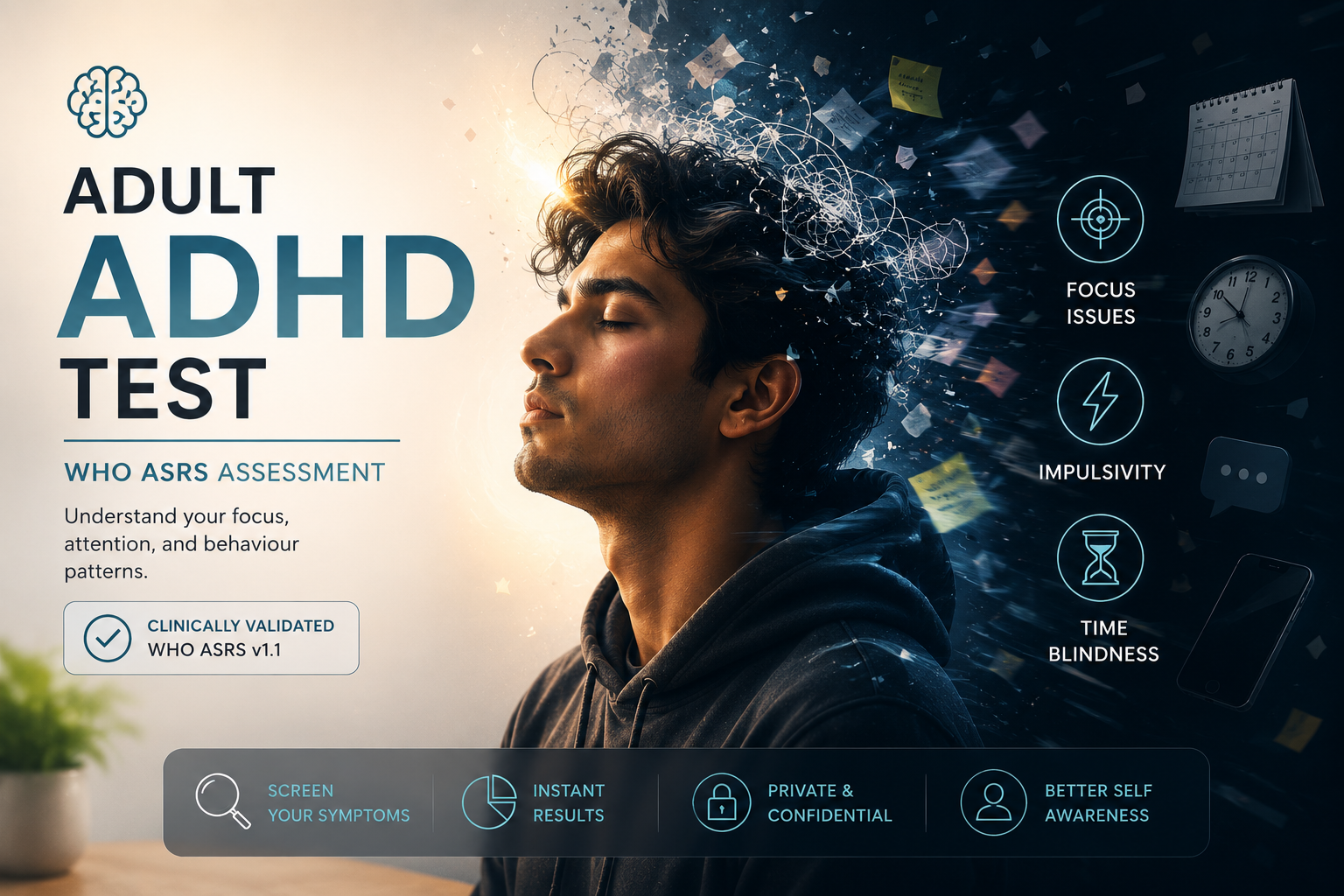
Adult ADHD Looks Nothing Like You Think — Take the WHO Screen That Changes That
You are intelligent. You know this.
You can solve complex problems, have ideas faster than you can write them down, and in a crisis you are the most useful person in the room.
And yet: you cannot finish things. You lose track of time constantly. Your desk, your inbox, your browser tabs — all of them are a monument to interrupted intentions. You’ve been told you’re careless, disorganised, unreliable. You’ve spent years believing them.
It may not be a character failure. It may be ADHD.
Why Adult ADHD Goes Undiagnosed
The average age of ADHD diagnosis for adults is 38. For women, it’s later. For adults in India, where adult mental health screening is still nascent, most cases are never diagnosed at all.
The reason is simple: ADHD in adults looks nothing like ADHD in children.
The hyperactive 7-year-old bouncing off classroom walls is easy to identify. The 31-year-old who is consistently brilliant in meetings but cannot complete a single report on deadline does not fit the picture anyone learned.
Adult ADHD presents as:
- Starting multiple projects with intense focus, completing almost none
- Chronic underperformance relative to obvious capability
- Time blindness — not just being late, but genuinely losing track of hours
- Emotional dysregulation that others experience as disproportionate reactions
- A constant background hum of mental noise that makes sustained attention exhausting
- Functioning adequately in high-stimulation, high-stakes environments; collapsing in routine ones
What Is the ASRS?
The Adult ADHD Self-Report Scale, version 1.1, was developed by researchers Kessler, Adler, and colleagues, and formally endorsed by the World Health Organisation in 2005.
It’s not a casual quiz. It’s the same screening instrument used in clinical consultations worldwide. 18 questions across two subscales — Inattention and Hyperactivity/Impulsivity. The scoring identifies whether your pattern of symptoms falls within the clinical range for further assessment.
It does not diagnose ADHD. No self-report instrument does. What it does is answer the question: is what I’m experiencing consistent with ADHD, at a level that warrants speaking to a professional?
For the majority of adults who have spent years being told they’re lazy, disorganised, or “not reaching their potential” — that answer is significant.
The ADHD Tax
People with undiagnosed ADHD pay a tax that never shows up on any account.
The hours spent re-reading the same paragraph because focus collapsed. The relationships damaged by forgotten commitments. The career momentum lost to half-finished projects. The self-esteem eroded by decades of apparent proof that you can’t do what everyone else seems to manage effortlessly.
ADHD isn’t an excuse. It’s a neurological difference in how dopamine regulates attention, motivation, and time perception. Understanding it doesn’t remove responsibility — it changes the conditions you need to work effectively.
What Happens After the Screen
If your results suggest clinical-range scores, the next step is a proper assessment by a psychiatrist or clinical psychologist. In India, ADHD diagnosis in adults is available — though finding a clinician experienced with adult presentations requires some searching.
The screen is the starting point. It tells you whether the conversation is worth having.
Take the Screen
18 questions. 4 minutes. Free, always — clinical screening should not have a paywall.
→ Take the Adult ADHD Screen at yuktilabs.in/mind/adhd/
🧠 Try the Tool
Explore our free psychology assessments — Big Five, GAD-7, attachment style, and more.
See All Psychology Tests →