What Is Kundalini Shakti: Definition from Tantric Texts, Not Pop Spirituality
Kundalini has become one of the most misused words in contemporary spiritual culture. It appears in yoga marketing, energy healing brochures, social media posts about spiritual awakening, and wellness product descriptions. In most of these contexts it refers to a vague sense of energy moving in the body, a feeling of aliveness, or a general state of heightened spiritual awareness.
The classical Tantric texts describe something considerably more specific — and considerably more demanding. Understanding what Kundalini Shakti actually is, in the framework within which the term was developed, is the necessary starting point for any serious engagement with this dimension of classical practice.
The Classical Definition
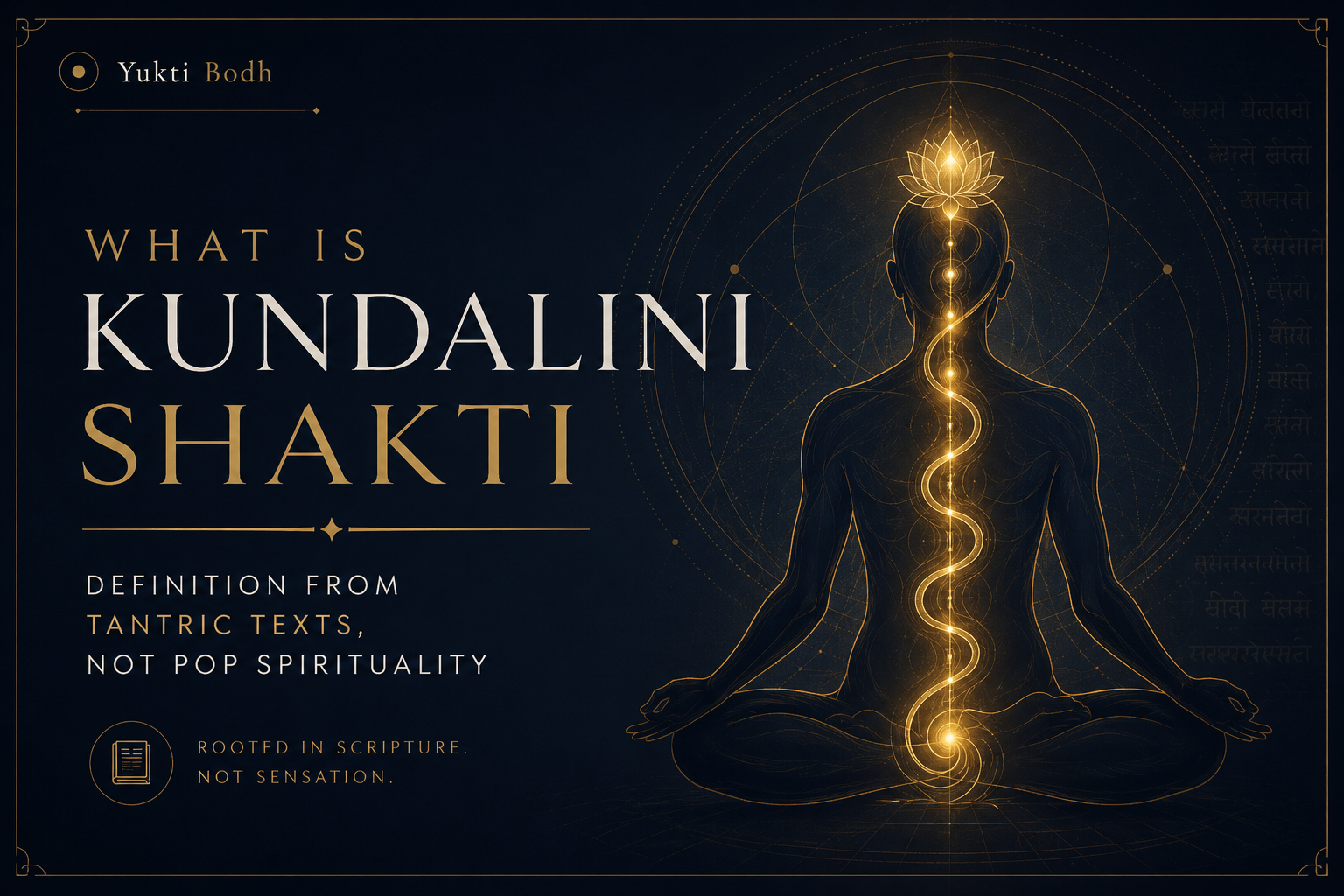
The Sat-Chakra-Nirupana, the primary text on the subtle body system, describes Kundalini as follows: she is the supreme Shakti, residing in all living beings, coiled three and a half times like a serpent around the Svayambhu Linga at Muladhara, her mouth closing the entrance to the Brahma Nadi. She is described as luminous as lightning, as fine as the fibre of the lotus stalk, and as the cause of all knowledge — and of all bondage, for as long as she sleeps.
She is Shakti — not energy in the modern sense, but Shakti in the Tantric philosophical sense: the dynamic, creative power of consciousness itself. In the non-dual Tantra of Kashmir Shaivism, Shiva — pure awareness — and Shakti — the power of awareness to know, will, and act — are not two separate principles but one reality appearing to itself in two aspects. Kundalini Shakti is this creative power, fully present in every human being, in its condensed, coiled, unmanifest form.
She is coiled three and a half times: three full coils represent the three states of ordinary consciousness — waking, dreaming, and deep sleep. The half coil represents the fourth state — Turiya, the witness consciousness — which is always present but ordinarily obscured. Kundalini’s coiling embodies all four states of consciousness in her dormant form.
She closes the entrance to the Brahma Nadi — the innermost channel of the Sushumna — with her mouth. This is both the cause of ordinary limitation and the gateway to liberation: when Kundalini uncurls and enters the Brahma Nadi, the path to the Sahasrara opens.
Kundalini as the Cause of Both Bondage and Liberation
One of the most important and least discussed aspects of the classical Kundalini teaching is this: the same Shakti that is the cause of liberation is also the cause of bondage.
In her dormant state — coiled at Muladhara, her energy flowing outward and downward through the Nadis of the gross body — Kundalini is the power that sustains the experience of ordinary limited consciousness. She is the force through which the infinite awareness of Shiva experiences itself as a finite individual. The entire world of name, form, sensation, desire, thought, and identity is sustained by her outward-flowing power.
When Kundalini awakens and begins her upward journey through the Sushumna, the same power that sustained the experience of limitation becomes the power of liberation. This is why the classical texts consistently emphasise that the Guru’s role in Kundalini practice is not to give the student something they do not have, but to reveal what is already fully present — to awaken what is sleeping.
What Kundalini Awakening Actually Means
True Kundalini awakening in the classical sense refers to the actual movement of Kundalini Shakti from her dormant position at Muladhara, through the Brahma Granthi, and into the Sushumna Nadi. This is an energetic event, not merely a psychological one — though it has profound and lasting psychological consequences.
The classical signs of genuine Kundalini awakening include: a distinct sensation of heat at the base of the spine; involuntary physical movements (Kriyas) as the Prana moves through previously blocked Nadi pathways; involuntary sounds including mantra sounds arising spontaneously; extraordinary states of consciousness including profound stillness and the experience of the Anahata Nada (inner sound); and a fundamental irreversible shift in the sense of identity — the recognition, however partial, that what one is is not bounded by the body-mind complex.
The Three Granthis: Why Kundalini Cannot Simply Rise
The classical texts describe three Granthis — psychic knots — that obstruct Kundalini’s upward path and must be pierced before she can move to the next level.
Brahma Granthi at Muladhara: the knot of physical attachment, Tamas, and the binding force of unconscious existence. Piercing it requires genuine Vairagya — dispassion toward purely physical and sensory experience — and the energetic purification achieved through Pranayama and Moola Bandha.
Vishnu Granthi at Anahata: the knot of emotional attachment, Rajas, and the binding force of personal relationship and spiritual ambition. Piercing it requires genuine equanimity in the face of both loss and gain in the emotional and relational sphere.
Rudra Granthi at Ajna: the knot of spiritual attachment — the most subtle and most difficult. It binds even advanced practitioners through attachment to extraordinary experiences, spiritual powers (Siddhis), and the refined forms of ego that develop in serious practitioners. Piercing it requires the complete surrender of the spiritual journey itself.
Kundalini Without a Teacher: The Classical Warning
The classical Tantric texts are unanimous on one point: Kundalini practice without a qualified teacher is not merely ineffective — it is potentially destabilising in ways that are difficult to reverse without appropriate guidance.
This warning arises from the direct observation, across centuries of teaching, that the awakening of Kundalini Shakti without a sufficiently purified subtle body, without the stabilising influence of a teacher who has navigated the same territory, and without the broader framework of classical practice to provide context and correction, frequently produces experiences that are overwhelming and disorienting.
The classical model is not to prevent Kundalini awakening but to prepare the practitioner adequately: years of Pranayama to purify the Nadis, Asana to stabilise the physical body, study to develop the Vijnanamaya Kosha, ethical living to establish Sattva, and a genuine relationship with a teacher who can recognise the signs of both progress and imbalance.
Kundalini Shakti is not a mood, not an energy trend, not a technique. She is the creative power of consciousness in its most fundamental form, dwelling in every human being, awaiting the conditions of purification and practice that will allow her to complete her return to her source.
For the complete map of the subtle body within which Kundalini moves — the Nadi system, the chakras, the Kosha framework — the Subtle Body Complete Guide provides the full classical context. The Pranayama Guide covers the breath practices that form the essential energetic preparation for this work.
[Get the Subtle Body Complete Guide →] for the full classical map of the subtle body and the Kundalini system.
◎ Try the Tool
Find which chakras are balanced, blocked, or overactive with our free diagnostic.
Open Chakra Diagnostic →